Owner-Occupied Commercial Property vs Investment Property
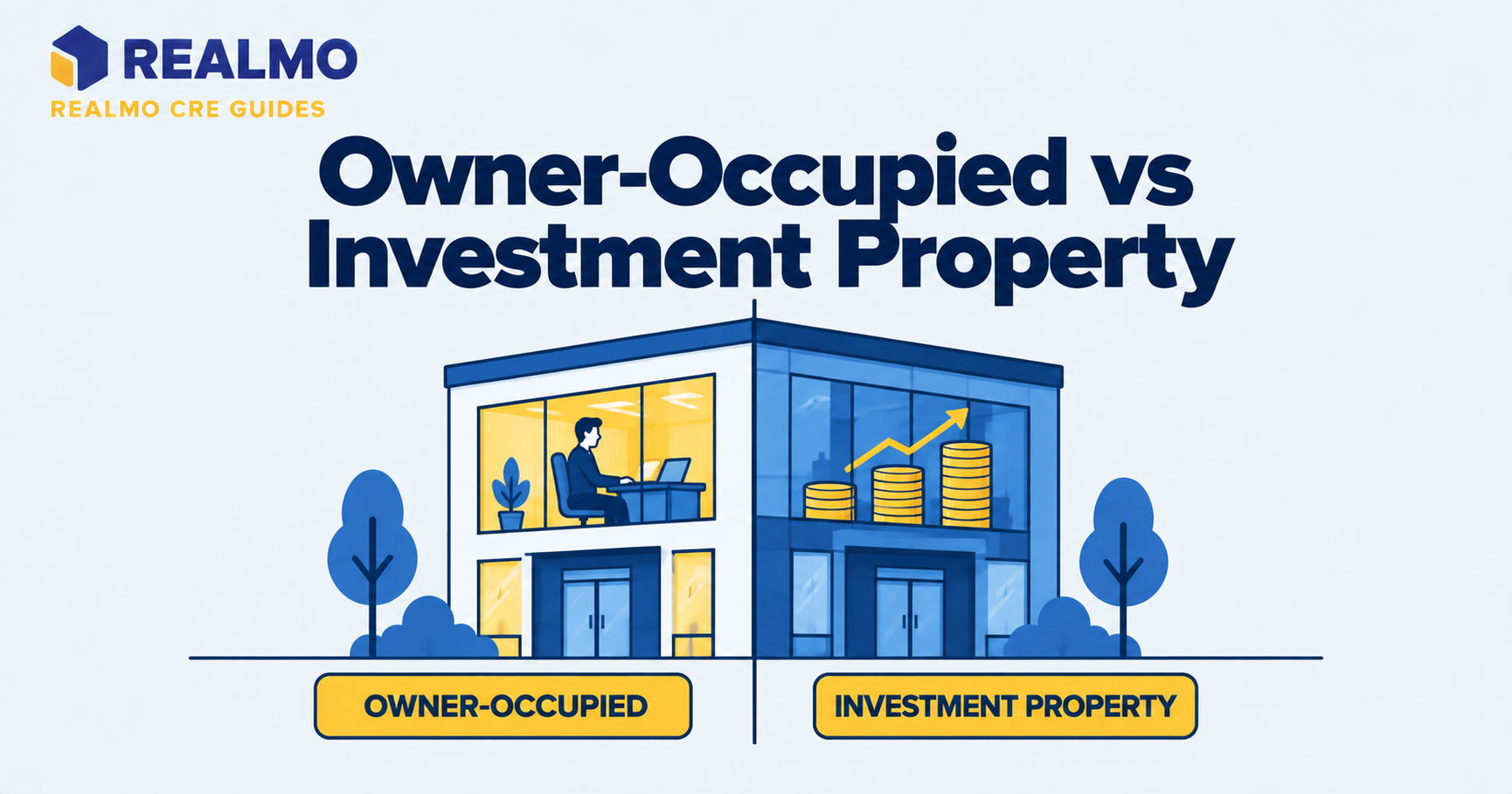
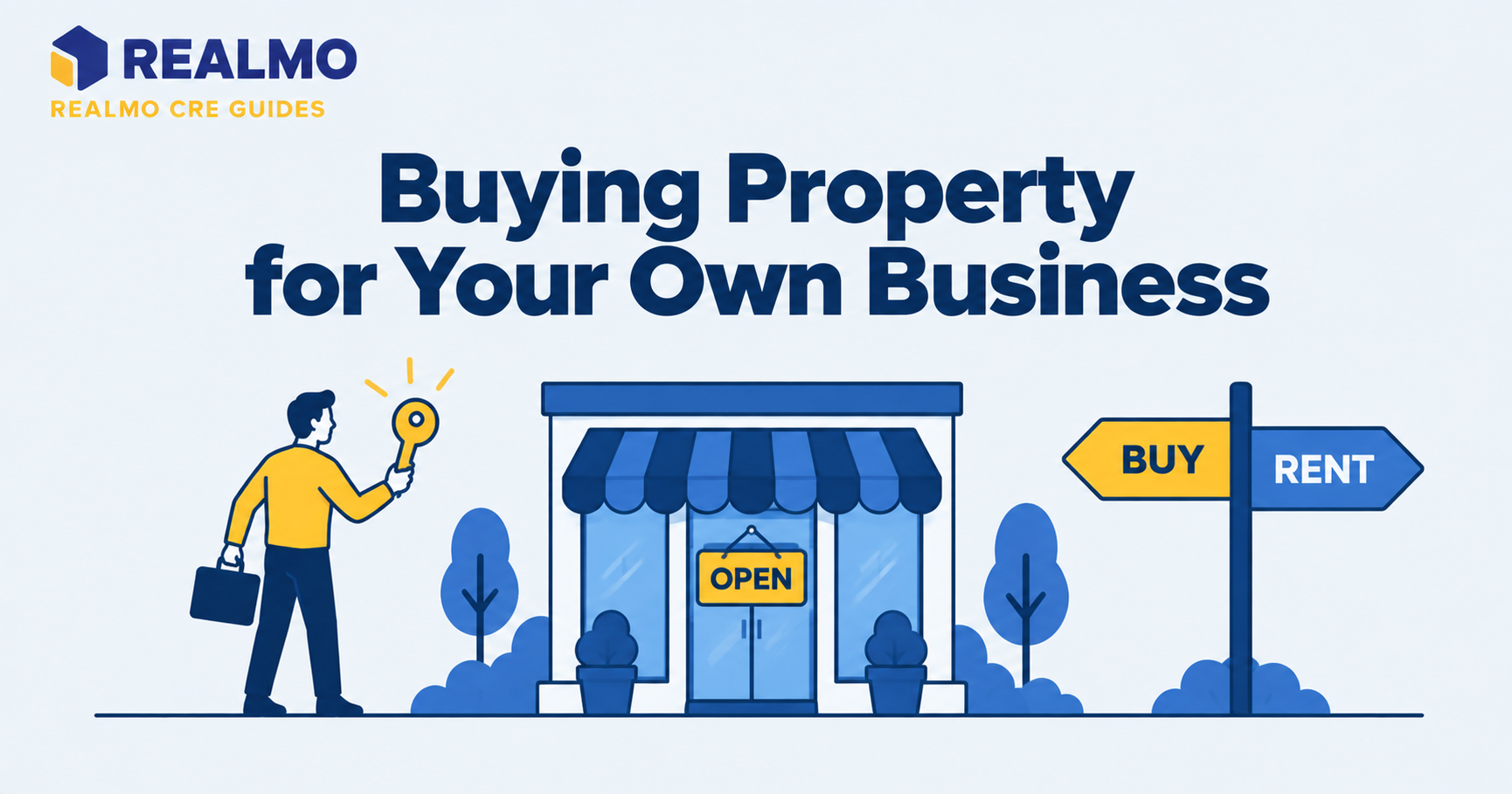
Owner-occupied commercial property is real estate a business buys and uses for its own operations. Investment property is bought to lease to third parties for income. The distinction drives which loan programs apply, how the building is appraised, and how income is reported. It also shapes what a sale looks like, even when the two buildings are identical.
Why the label changes financing, tax, and exit
A contractor renting 18,000 square feet decides to buy the building next door. She assumes the purchase is a real estate deal and starts talking to a bank about an investment loan. The bank quotes 25–30% down and sizes the loan off the property’s rent. Had she approached it as an owner-occupied purchase, an SBA-backed structure could have cut the equity requirement to roughly a tenth of project cost. The loan would have been sized off her company’s cash flow instead, rather than a hypothetical tenant’s.
The same misread runs the other way at exit. Owners who bought as occupiers commonly assume the sale is taxed like selling business equipment. Then they discover that depreciation taken over years of ownership gets recaptured, and that a 1031 exchange they never considered was available to them. The classification is not a formality. It sets the rules the deal plays by.
What counts as owner-occupied commercial property
Occupancy is measured by space, not intent. Lenders and government programs apply a threshold. The operating business must occupy a stated share of the building’s rentable square footage, with the remainder available to lease out. SBA programs set that bar at a majority of an existing building. New construction requires a higher initial share, with a phase-in schedule for the rest. Conventional lenders use similar thresholds when deciding which credit box a request belongs in.
Below the threshold, the building is an investment property that happens to house you. Above it, you are an occupier who happens to have tenants. Partial owner-occupancy (buying a four-suite building, taking one suite, leasing three) is common and legitimate. It produces a hybrid file that underwriters price cautiously, because two unrelated income sources have to hold up at once.
Owner-occupancy also has to be real. Lenders verify it with site visits, utility accounts, and the operating lease between entities. A building purchased under an occupier structure and then fully leased to outsiders can put the loan out of covenant.
How lenders underwrite each type differently
An investment loan is underwritten on the property. The analyst builds net operating income from in-place leases, applies a vacancy factor, and tests debt service coverage against the payment. Tenant credit and lease term drive the terms. The borrower’s personal balance sheet matters for guarantees, not for sizing.
An owner-occupied loan is underwritten on the business. The bank runs global cash flow (company earnings plus owner income) and treats the building as collateral rather than as the source of repayment. That shift is why SBA 504 financing can reach far higher loan-to-value than a conventional investment mortgage. The repayment source is an operating company the lender has already analyzed.
Appraisal follows the same split. Investment property is valued on income, with cap rate applied to stabilized NOI. Owner-occupied property is usually valued on market rent the space would command, not on what your company pays itself. A special-purpose building (a bowling alley, a plating shop, a veterinary hospital) can be worth a great deal to you. To the next buyer, it can be worth considerably less. Lenders discount for that gap.
Structuring ownership: operating company and property LLC
Most owner-occupiers do not hold the building inside the operating company. They form a separate LLC to own the real estate and sign a lease between the two entities. The structure separates operating liability from the asset and lets ownership of the building differ from ownership of the business. It also makes the property saleable or financeable on its own terms.
That lease has to be written at market rent and administered like a real one. A below-market rent starves the property entity of the income needed to cover debt service and inflates the operating company’s profit. An above-market rent does the reverse and complicates any later sale, because a buyer will underwrite market rent, not yours. Most of these leases are written triple net, which keeps the arithmetic clean: the occupier pays taxes, insurance, and maintenance directly, as it would anyway.
Self-rental arrangements carry specific tax treatment for passive income and losses, and inter-company leases affect the operating company’s financial statements under ASC 842, the current lease accounting standard. Both are worth reviewing with a licensed CPA before the structure is locked in.
Tax treatment through ownership and at sale
During ownership, the mechanics are the same for both types. Nonresidential real property depreciates straight-line over 39 years under the Modified Accelerated Cost Recovery System (MACRS), and mortgage interest, property taxes, insurance, and repairs are deductible against the income the property produces. A cost segregation study can reclassify components into shorter recovery periods for either category.
The differences show up at exit. Depreciation taken during ownership is recaptured on sale under the unrecaptured Section 1250 rules. That surprises occupiers who thought of the building as overhead, not as a depreciating asset. A 1031 exchange is available for property held for productive use in a trade or business, as well as for investment. An occupier who is relocating can commonly defer gain the same way a landlord can. That’s a point routinely missed, because the tool is discussed almost entirely in landlord terms. The 45-day identification and 180-day closing windows are statutory and unforgiving.
Sale terms differ too. An investment sale transfers leases. An occupier sale usually requires the seller to leave, or to stay as a tenant through a sale-leaseback: selling the building and leasing back the space. That converts the building into an income asset, and the seller into the tenant whose credit sets its value.
Worked example: buy your space or keep leasing
Illustrative figures only; substitute your own.
- Building: 20,000 SF, purchase price $2,000,000
- Market rent: $7.00/SF NNN → $140,000 per year
- Operating expenses (taxes, insurance, maintenance): $3.00/SF → $60,000
- Financing: $400,000 down, $1,600,000 loan, 7% illustrative rate, 25-year amortization → about $135,700 annual debt service
Leasing costs $140,000 in rent plus $60,000 in net expenses: $200,000 out of pocket.
Owning costs $135,700 in debt service plus the same $60,000 in expenses: $195,700 out of pocket. Roughly $24,100 of the first year’s payments is principal, so cash cost is near parity while a portion converts into equity. Depreciation also shelters part of the company’s income.
How to read it: the two options are close on cash. The real difference is what happens to the $400,000 down payment, plus closing costs and a capital reserve. That capital leaves the operating business. If it would have funded equipment, hiring, or working capital at a higher return, owning is expensive even when the monthly numbers tie. Pulling asking rents and sale comps for comparable buildings in the submarket keeps the assumed market rent honest. That single input drives the whole comparison. Realmo’s property analytics cover both without a paywall.
The common error: comparing rent against debt service alone, ignoring expenses, roof and HVAC reserves, and the opportunity cost of the equity.
Common mistakes owner-occupiers make
- Setting inter-company rent at whatever covers the mortgage. The property entity’s income no longer reflects market, and the eventual buyer or appraiser will restate it, usually to your disadvantage in a sale negotiation.
- Buying a building sized for today’s headcount. Outgrowing it in three years forces a sale into whatever market exists then, or a move that leaves you holding a vacant special-purpose asset.
- Ignoring resale marketability of specialized improvements. Heavy build-out that serves your process may add nothing to appraised value and can reduce the buyer pool to near zero.
- Treating the down payment as free capital. Equity locked in a building is unavailable for payroll, inventory, or a downturn, and it does not come back without a refinance or a sale.
- Skipping depreciation planning until the closing statement. Recapture is calculated on depreciation allowed or allowable, so declining to take it does not avoid the tax.
Related terms
Net operating income · Cap rate · Debt service coverage ratio · SBA 504 loan · Triple net lease · Sale-leaseback · 1031 exchange · Cost segregation
FAQs
Can I do a 1031 exchange on a building my company occupies?
Usually, yes. Section 1031 applies to property held for productive use in a trade or business, as well as property held for investment. A business relocating from a building it owns can commonly defer gain by exchanging into replacement property. The 45-day identification and 180-day closing deadlines apply. Confirm eligibility with a qualified intermediary and a licensed tax advisor.
How much of the building must my business occupy?
Loan programs set a minimum share of rentable square footage the operating company must use. New construction carries a higher initial requirement than existing buildings. Below that share, the request is underwritten as an investment property. Confirm the current threshold with the lender, since program rules are periodically updated.
Should the operating company or a separate LLC own the property?
A separate property LLC is the common structure. It isolates the asset from operating liability and allows building ownership to differ from business ownership among partners. It also makes the real estate independently financeable and saleable. It requires a written market-rate lease between the entities. Structure choice has tax and liability consequences; review it with counsel and a CPA.
Does owner-occupied property appraise differently?
Usually yes. The appraiser values the space at market rent it would command from a third party, not at what your company pays itself. Specialized improvements that serve your operation may add little to that figure, which is why highly customized buildings can appraise below construction cost.
What if my business outgrows the building?
Two paths: sell and exchange into a larger property, or lease the space out and keep it as an investment asset. The second converts the file into an investment property for loan-covenant purposes, so check the loan documents before signing an outside tenant.