How to Find Off-Market Commercial Properties
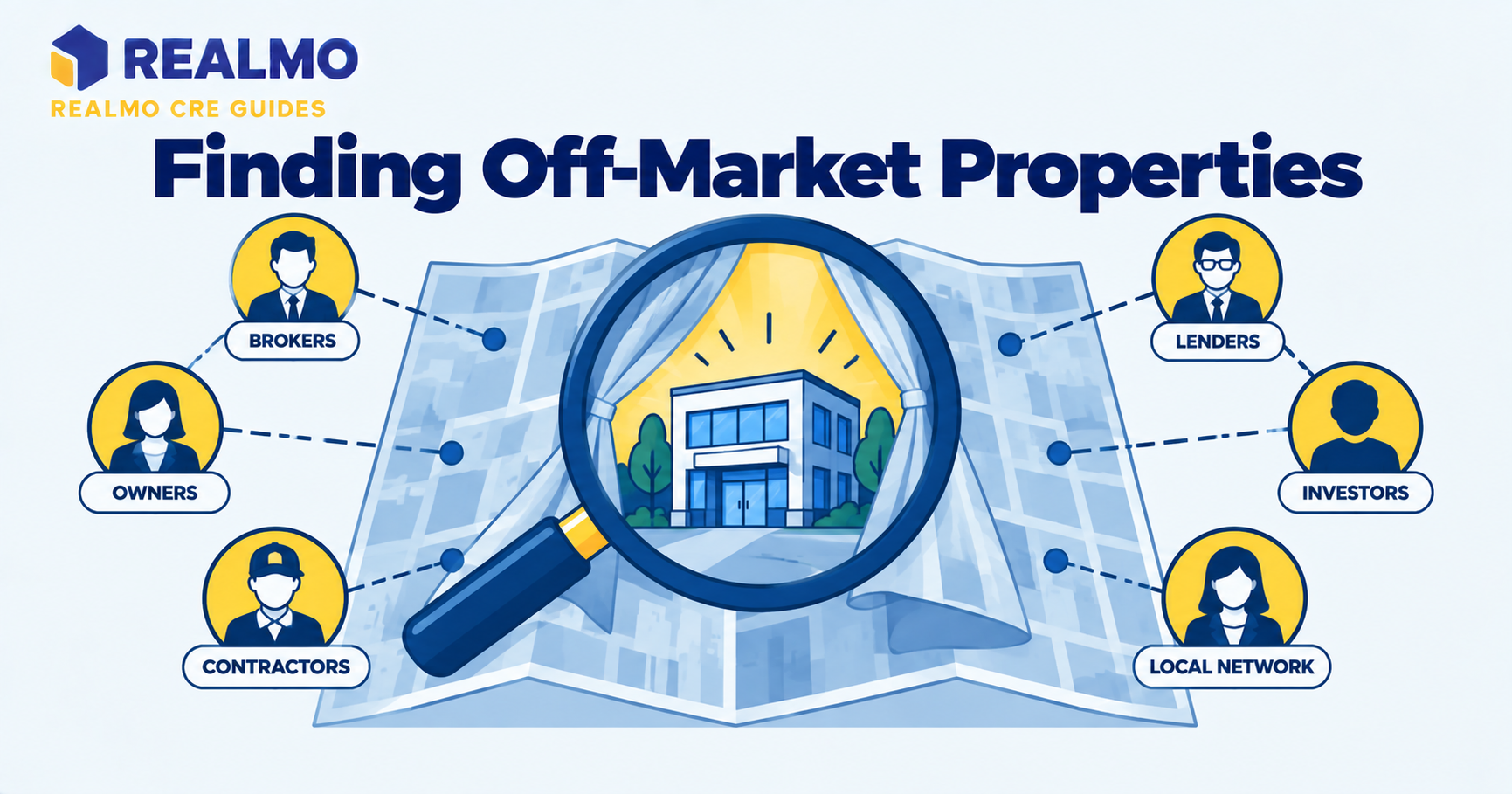
Off-market commercial properties are assets sold without public listing exposure: no listing-site posting, no sign, no marketing flyer in circulation. Brokers source them by researching ownership records, reading life-cycle and distress signals, and contacting owners directly before any listing agreement exists.
Why off-market sourcing decides who eats
A broker covering a submarket with a handful of active listings is competing against every other broker reading the same feed. The differentiator is the inventory nobody has seen. An owner who bought a flex building fifteen years ago, refinanced twice, and is now past the depreciation runway is a seller. He’s staring at a maturing loan and just hasn’t said it out loud yet. Whoever reaches him first controls the assignment, sets the price expectation, and usually keeps the buy side too.
The same work builds a buyer-side advantage. A 1031 exchange client has forty-five days to identify replacement property. A broker with a live owner database produces options that never touched the market. That is the difference between an exchange that closes and one that fails on the identification deadline.
Off-market vs. pocket listing vs. quiet marketing
These three get used interchangeably, and they are not the same thing. A true off-market property has no agreement in place. The owner isn’t selling yet, and there’s no marketing at all. A pocket listing means a signed listing agreement exists, but the broker withholds it from public syndication and shops it through a private network. Quiet marketing sits between them: a full listing package circulated to a curated buyer list, with no public posting.
The distinction matters for fiduciary duty. Once a listing agreement is signed, restricting exposure has to serve the seller’s stated objectives, not the broker’s desire to double-end the deal. Document the seller’s instruction in writing. Several state commissions and the broker duty-of-loyalty standards that apply to commercial agency have taken an interest in exactly this fact pattern.
Data sources that surface off-market commercial properties
Sourcing starts with ownership, not with buildings. County assessor and recorder files give the current owner of record, the transfer date, the recorded sale price, and the deed history. Mortgage recordings give the lender, the original loan amount, and the recording date, enough to estimate a maturity window. Secretary of state filings unwind LLC ownership into names and addresses, which is where mailing addresses come from.
Layer municipal data on top. Building permits show who is investing in an asset and who has stopped. Code violations, delinquent tax rolls, and lis pendens filings flag owners under pressure. Business license and utility-connection records help identify vacancy that no listing service reflects yet. Some platforms aggregate ownership records, valuation estimates, and current-versus-suggested-use data across the national property stock. Realmo is one of them. Together, these tools compress what used to be a week of courthouse work into a filtered list.
None of this is a substitute for physical canvassing. Driving a submarket surfaces deferred maintenance, half-empty parking lots, and “for lease by owner” signs that indicate an owner tired of managing the asset.
Ownership signals that predict a sale window
Owners sell for reasons that repeat. Hold period is the most reliable: private commercial owners cluster around a five-to-ten-year hold. The probability of a sale conversation rises sharply once an owner passes that band. Depreciation schedules reinforce it. A straight-line schedule runs 39 years for nonresidential real property and 27.5 for residential rental under IRS rules. But the front-loaded benefit of any cost segregation study is exhausted long before that, and the owner’s after-tax return quietly deteriorates.
Loan maturity is the second signal. A recorded mortgage with a ten-year term tells you roughly when the owner faces a refinance decision. If the property’s in-place income no longer supports a new loan at prevailing terms, the owner is choosing between a capital contribution and a sale.
Then there are the human triggers: probate filings, divorce decrees, and partnership dissolutions. Others include an owner entity whose registered agent changes, or a portfolio owner who just sold three of five assets. Each one puts a decision on a clock.
Outreach that earns a callback from an owner
Cold outreach fails because it opens with the broker’s need. An owner who receives four “are you interested in selling?” letters a month deletes the fifth. What earns a reply is specificity about the asset and the market. Cite what similar buildings on that corridor traded for. Cite what a tenant in that class pays per square foot. Cite what the owner’s building would appraise at, given its current use versus its highest and best use.
Sequence matters more than volume. A mailed letter referencing the property by address works best as a sequence. Follow it with a call ten days later, then a second letter with a one-page market brief. That sequence outperforms a single blast to a list ten times larger. Track every touch in a CRM with the parcel number as the key, because the same owner will show up under three different LLCs.
Give the owner a reason to talk that is not a transaction. A broker opinion of value costs a few hours and creates a file the owner keeps. When the sale decision arrives, the broker who produced that document is the one who gets the call.
Pricing a deal with no listing comps
Off-market assets have no asking price to anchor against, which is where brokers lose credibility fastest. Build value from recorded sales and income, not from listings. Pull closed transfers from recorder data, then adjust for date, location, and building class. Cross-check the result against income, using a capitalization rate derived from actual trades in the same product type.
Underwrite the rent roll before you underwrite the price. Lease expiration dates, escalation clauses, and any tenant credit quality issues move value more than a twenty-five basis point argument about cap rate. An owner-occupied building has no rent roll at all. Value it against market rent for the space instead, then decide whether a sale-leaseback structure serves the owner better than a vacant sale.
Worked example: sizing a farm and its yield
The figures below are illustrative only. They demonstrate the arithmetic, not expected results in any market.
Inputs. A broker defines a farm of 400 industrial buildings between 20,000 and 60,000 square feet in one submarket. Contact information is verified for 340 of them. The campaign runs three touches over six months.
Steps.
- 340 reachable owners × 15% response rate = 51 conversations.
- 51 conversations × 20% with a sale decision inside twelve months = 10 live opportunities.
- 10 opportunities × 40% win rate on the listing = 4 assignments.
- 4 assignments × $3,000,000 average price × 4% total commission × 50% listing-side share = $240,000 in gross commission.
Result. Roughly $240,000 from 340 owners and 1,020 touches, at a modeled cost per touch of $6 (about $6,100 in campaign spend).
How to read it. The sensitive variable is not the response rate; it is step two. Reaching owners is easy, and reaching them in their decision window is not. Doubling the farm size while keeping timing blind roughly doubles cost for the same yield. Filtering the farm by hold period and loan maturity before the first mailer raises step two without raising spend.
Common error. Brokers count step one as the metric and declare the campaign successful because conversations happened. Conversations that produce no listing are a cost, not a result. Measure to step three.
Compliance limits on cold outreach and fees
Direct outreach is regulated. Federal telemarketing rules restrict calls to numbers on the national Do Not Call registry and constrain automated dialing and prerecorded messages. Several states impose stricter rules, including call-time windows and separate state registries. Text messaging carries its own consent requirements. Commercial-to-commercial calls are not automatically exempt, and the exemptions that exist are narrower than most prospecting scripts assume.
Fee arrangements deserve equal care. Compensation for introducing a buyer to a seller is licensed activity in every state. That makes informal finder’s fees a licensing problem, not a business-terms problem. Confirm your specific outreach program and fee structure with a licensed attorney and your state real estate commission before it runs.
Common mistakes
- Buying a list and mailing it once. A single touch to a cold owner produces almost nothing, and it burns the address for the next broker, including you, six months later.
- Skipping entity research. Mail addressed to an LLC at the property address reaches a tenant, not a decision-maker. The result is a campaign with a response rate near zero and no way to diagnose why.
- Leading with a price. An unsolicited valuation offered before the owner shares operating data invites a correction and ends the conversation. Ask for the rent roll first.
- Treating off-market as permission to under-market. Once an owner signs a listing, limited exposure has to be their documented choice. Failing to paper that instruction creates real liability if the asset later appears mispriced.
- No follow-up system. Owners respond on their timeline. A broker without dated reminders tied to loan maturities loses deals to whoever called in the right month.
Related terms
Cap rate · Broker opinion of value · 1031 exchange · Highest and best use · Sale-leaseback · Tenant credit analysis · Cost segregation
FAQ
What does off-market mean in commercial real estate?
It means the property is being sold, or could be sold, without public marketing. There is no listing-site posting, and commonly no listing agreement at all. Buyers learn about it through direct owner contact or a broker’s private network rather than through a searchable database.
Is it legal to contact property owners directly about buying their building?
Yes, direct contact is legal. Telephone and text outreach falls under federal and state telemarketing rules, including Do Not Call registry restrictions and consent requirements for automated dialing. Mail is less restricted. Compensation for arranging a transaction requires a license in every state. Confirm your program with counsel.
Where do brokers get owner contact information?
County assessor and recorder files list the owner of record and a tax mailing address. Secretary of state business filings connect an LLC to its members and registered agent. Data platforms aggregate these sources, and skip-trace services fill gaps, though accuracy varies and every record should be verified before outreach.
How do you value a property that has never been listed?
Use recorded closed sales adjusted for date, location, and class, then cross-check against income capitalized at a rate drawn from comparable trades. Verify the rent roll, lease expirations, and escalations first, since lease structure moves value more than small cap rate differences.
How long does an off-market sourcing campaign take to produce a deal?
Longer than most brokers plan for. The constraint is timing, not reach. An owner responds when a hold period, loan maturity, or personal event puts a decision in front of them. In practice, campaigns run several quarters, not weeks.