What Is the Best State to Lease Office Space?
There isn’t really one right answer here, and anyone who tells you otherwise is probably trying to sell you something. Leasing office space is a decision that quietly shapes a business for years. It affects what you pay every month, sure, but also who you can hire, how easy it is for clients to reach you, and whether you’ll be stuck renegotiating everything in eighteen months because you didn’t leave room to grow. Rent tends to hog all the attention in these conversations, but it’s honestly just one piece of a much bigger puzzle.
Businesses today have more real options than they used to. Hybrid work broke a lot of the old assumptions about where offices “had to” be, and that’s opened up a wider map of genuinely attractive markets outside the usual coastal suspects. The smartest way to approach this isn’t comparing rent per square foot across states like it’s a spreadsheet exercise but looking at cost alongside labor availability, infrastructure, and where a local economy is actually headed.
What Makes a State Attractive for Office Leasing?
Beyond Rental Rates
A cheaper lease obviously helps the budget, but rent by itself doesn’t tell you much about whether a location will actually work. What matters just as much (sometimes more) is:
- Workforce availability
- Regional growth
- Taxes
- Transportation
- Whether the right industries cluster nearby
Think about it this way: a tech company probably cares a lot more about finding specialized talent than shaving a few dollars off rent, while a regional services firm might prioritize being close to its actual customers over almost anything else. The best market really just depends on what a business is trying to do.
Understanding Office Lease Pricing
Office pricing data can get confusing fast, mostly because a few different numbers are floating around that look similar but mean different things.
- The average asking rent is just the typical advertised rate across available space in a market.
- The weighted average, on the other hand, leans more heavily toward larger or more significant buildings, so it can tell a slightly different story than the plain average.
To make all this easier to actually use, the annual and monthly cost estimates below are based on roughly 2,000 square feet of office space — a useful, consistent yardstick, even though real-world costs will shift depending on the building, the lease terms, and what’s actually being negotiated.
Office Lease Costs Across the United States
Here’s the full state-by-state breakdown, using average asking rents to estimate what leasing about 2,000 square feet would actually cost per year and per month.
| State | Avg. $/SF/Year | Weighted Avg. $/SF/Year | Estimated Annual Cost (2,000 SF) | Estimated Monthly Cost |
| Michigan | 19.02 | 16.51 | $38,040 | ≈ $3,170 |
| Montana | 19.10 | 17.19 | $38,200 | ≈ $3,183 |
| Connecticut | 21.10 | 16.62 | $42,200 | ≈ $3,517 |
| Maryland | 22.10 | 20.09 | $44,200 | ≈ $3,683 |
| Oklahoma | 16.92 | 14.68 | $33,840 | ≈ $2,820 |
| North Dakota | 17.33 | 15.10 | $34,660 | ≈ $2,888 |
| New Hampshire | 17.36 | 16.04 | $34,720 | ≈ $2,893 |
| Iowa | 17.43 | 13.24 | $34,860 | ≈ $2,905 |
| Ohio | 17.57 | 15.24 | $35,140 | ≈ $2,928 |
| Indiana | 17.97 | 15.38 | $35,940 | ≈ $2,995 |
| Maine | 18.43 | 14.90 | $36,860 | ≈ $3,072 |
| Mississippi | 18.53 | 16.82 | $37,060 | ≈ $3,088 |
| Wisconsin | 18.54 | 16.02 | $37,080 | ≈ $3,090 |
| Minnesota | 18.72 | 16.48 | $37,440 | ≈ $3,120 |
| Louisiana | 18.74 | 20.89 | $37,480 | ≈ $3,123 |
| South Dakota | 19.26 | 14.99 | $38,520 | ≈ $3,210 |
| Vermont | 19.60 | 15.66 | $39,200 | ≈ $3,267 |
| Rhode Island | 19.77 | 25.12 | $39,540 | ≈ $3,295 |
| Arkansas | 19.84 | 19.13 | $39,680 | ≈ $3,307 |
| Kansas | 20.00 | 17.64 | $40,000 | ≈ $3,333 |
| Illinois | 20.20 | 18.11 | $40,400 | ≈ $3,367 |
| Alabama | 20.38 | 16.62 | $40,760 | ≈ $3,397 |
| Nebraska | 21.30 | 18.78 | $42,600 | ≈ $3,550 |
| Pennsylvania | 21.34 | 20.56 | $42,680 | ≈ $3,557 |
| Kentucky | 21.59 | 14.47 | $43,180 | ≈ $3,598 |
| Hawaii | 21.80 | 18.28 | $43,600 | ≈ $3,633 |
| Missouri | 22.32 | 19.15 | $44,640 | ≈ $3,720 |
| West Virginia | 22.38 | 15.76 | $44,760 | ≈ $3,730 |
| Georgia | 22.49 | 20.07 | $44,980 | ≈ $3,748 |
| Colorado | 22.50 | 18.07 | $45,000 | ≈ $3,750 |
| New Jersey | 22.71 | 20.12 | $45,420 | ≈ $3,785 |
| Utah | 24.28 | 25.52 | $48,560 | ≈ $4,047 |
| Tennessee | 24.65 | 18.60 | $49,300 | ≈ $4,108 |
| New Mexico | 24.89 | 20.51 | $49,780 | ≈ $4,148 |
| Washington | 25.13 | 22.63 | $50,260 | ≈ $4,188 |
| Virginia | 25.16 | 26.35 | $50,320 | ≈ $4,193 |
| Texas | 25.24 | 21.57 | $50,480 | ≈ $4,207 |
| South Carolina | 25.30 | 24.43 | $50,600 | ≈ $4,217 |
| Oregon | 25.81 | 23.81 | $51,620 | ≈ $4,302 |
| Massachusetts | 25.84 | 22.13 | $51,680 | ≈ $4,307 |
| Delaware | 26.84 | 19.40 | $53,680 | ≈ $4,473 |
| New York | 26.89 | 26.05 | $53,780 | ≈ $4,482 |
| Arizona | 27.61 | 24.06 | $55,220 | ≈ $4,602 |
| Florida | 28.00 | 23.60 | $56,000 | ≈ $4,667 |
| North Carolina | 29.53 | 28.21 | $59,060 | ≈ $4,922 |
| Idaho | 29.82 | 24.67 | $59,640 | ≈ $4,970 |
| Alaska | 34.86 | 35.20 | $69,720 | ≈ $5,810 |
| Nevada | 35.05 | 25.32 | $70,100 | ≈ $5,842 |
| California | 35.38 | 28.40 | $70,760 | ≈ $5,897 |
| Wyoming | 35.64 | 16.49 | $71,280 | ≈ $5,940 |
Looking at this spread, the gap is pretty wide. Leasing 2,000 square feet in Oklahoma runs around $33,840 a year, while the same footprint in Wyoming climbs past $71,000 — more than double for basically the same amount of space. A lot of the Midwest and South cluster comfortably in that $35,000 to $45,000 range, which tends to surprise people who assume “cheap office space” only exists in a handful of small, obscure states.
The pricier markets aren’t randomly scattered, either. They tend to sit along the West Coast or in places dealing with genuine supply constraints and fast growth, while much of the Midwest just quietly stays affordable year after year. None of this means cheap is automatically better or expensive is automatically smarter. It just means the numbers alone don’t tell the whole story, and shouldn’t be the only thing driving a decision.
The Best States to Lease Office Space Based on Different Business Priorities
Best States for Affordability
If keeping occupancy costs low is the priority, Oklahoma, North Dakota, Iowa, Ohio, Indiana, and New Hampshire all land near the bottom of the pricing table. That’s genuinely attractive for a lot of businesses.
But it’s worth being honest here: the cheapest rent doesn’t necessarily mean the cheapest business to run. Labor availability, how easy it is for customers to reach you, and the overall local economy still matter a great deal, and skipping over these factors just because a lease looks like a bargain can end up costing more down the line.
Best States for Business Growth
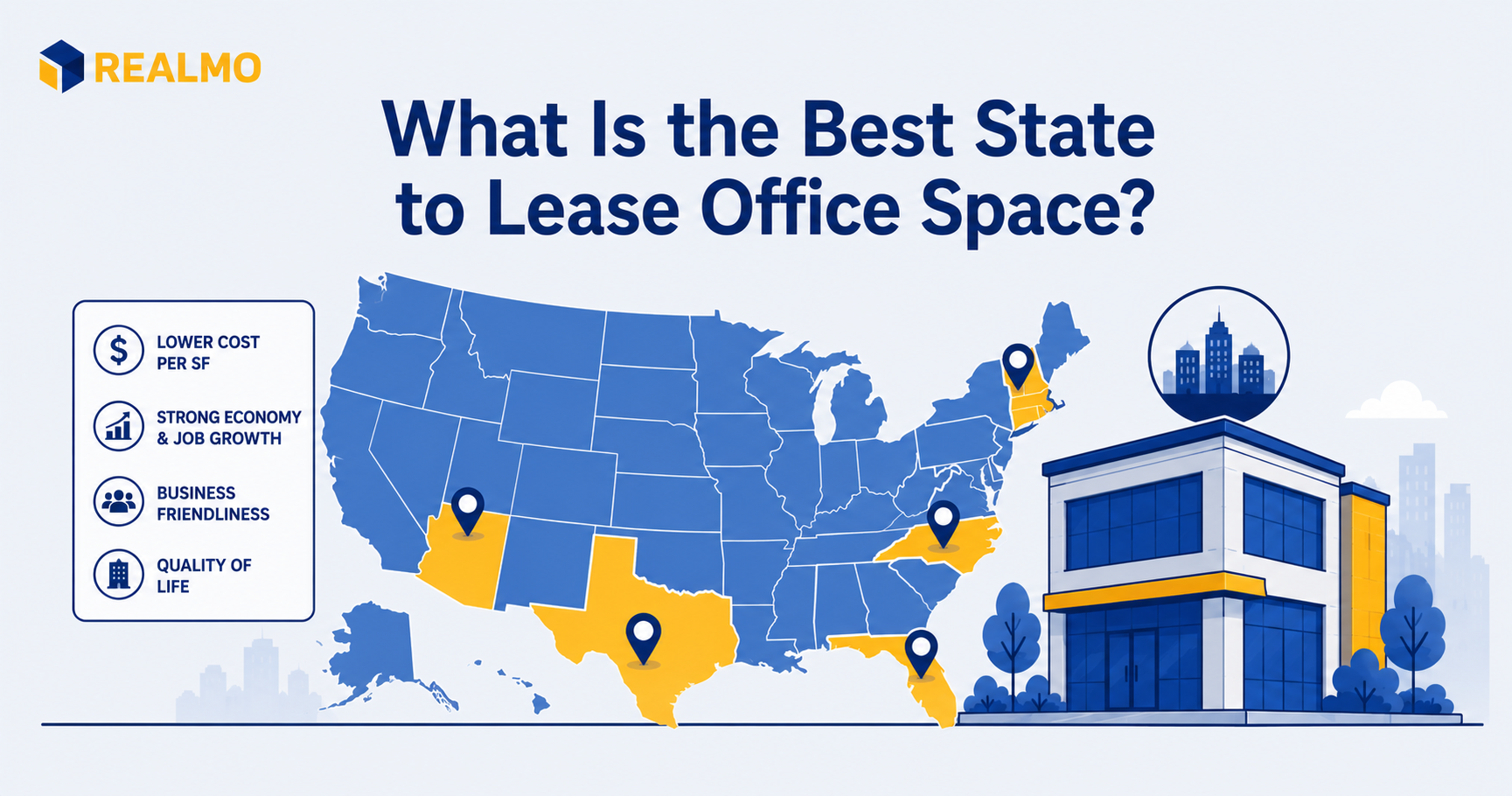
Plenty of companies are perfectly happy paying a bit more in rent if the state itself is genuinely growing. Texas, North Carolina, Tennessee, Georgia, Arizona, Utah, and Florida have all pulled in serious corporate relocations and fresh investment across a range of industries in recent years.
Rent’s higher than the bargain-bin states, sure, but a lot of businesses see that as a fair trade for better hiring pools and a stronger runway for future growth.
Premium Markets With Strategic Advantages
Then there’s the top tier: California, New York, Massachusetts, Washington, and Florida again, showing up on both lists depending on the metro. These states are expensive, no question, but companies keep paying up because of what’s actually there:
- Enormous customer bases
- Deep and specialized labor markets
- Industry ecosystems that took decades to build
For the right business, paying a premium here genuinely makes sense. If being near a major financial hub or a dense tech ecosystem is what drives revenue, saving a few thousand dollars a year on rent somewhere else just isn’t the same trade.
Office Cost Isn’t Everything: Other Factors That Matter
Workforce Availability
Where the talent actually is matters just as much as what the rent costs, maybe more. Educational institutions, the local skill base, unemployment levels, and which industries cluster in a region all shape how easy (or hard) it’ll be to hire and keep good people.
A market with slightly pricier office space can still come out ahead if it makes recruiting genuinely easier. That’s not a small thing.
Taxes, Regulations, and Business Climate
Rent is just one line item. State and local taxes, permitting headaches, regulatory complexity, and insurance costs all add up quietly in the background, and they can shift the real cost of doing business in a state far more than the advertised lease rate ever will.
Infrastructure and Accessibility
Highways, airports, transit, broadband — the boring stuff that nobody thinks about until it’s missing. A market with strong infrastructure tends to support better long-term business performance even when the lease itself costs a bit more, simply because everything downstream of the office runs smoother.
How Businesses Should Choose the Right Office Market
Match Office Space With Business Goals
The right office choice really depends on where a company’s actually headed:
- Company size
- Hiring plans
- Where customers are
- How hybrid work fits into daily operations all play a role
A fast-growing startup might chase labor growth above everything else, while a client-facing services firm might care more about visibility and easy access for the people walking through the door.
Compare Total Occupancy Costs
The advertised rent is really just the headline number. Utilities, passed-through property taxes, maintenance charges, parking, furniture, tech setup, even employee commuting costs — all of that adds up, and often reveals that two markets that looked similar on paper aren’t actually similar at all once the full picture comes into view.
Evaluate Long-Term Flexibility
Needs change. Expansion rights, the ability to shrink space if things slow down, sublease options, and renewal terms are the factors that deserve a real look before signing anything long-term. A lease that can bend a little as the business changes is often worth more than one that just offers the lowest starting number.
Common Mistakes When Comparing Office Lease Markets
Choosing Based Only on Price
Going with the cheapest market doesn’t guarantee the cheapest outcome. Higher turnover, a thinner labor pool, or weaker infrastructure can steadily eat away whatever was saved on rent, and often more.
Ignoring Local Market Conditions
Vacancy rates, upcoming development, and how much demand is actually out there in a specific submarket definitely shape what a lease really looks like day to day. Relying on statewide averages alone can paper over a lot of important local detail.
Underestimating Future Growth
It’s easy to lease exactly what’s needed right now and forget to leave room for what comes next. A business that grows faster than expected can end up facing an expensive, disruptive move well before the lease is even up, which is a headache that’s almost always avoidable with a little more planning up front.
The Bottom Line
There’s genuinely no single best state here, because there’s no single kind of business asking the question. Some companies will do just fine leaning on the affordability of a state like Oklahoma or Iowa. Others will get more value chasing the talent, infrastructure, and momentum found in places like Texas, Florida, California, or New York, even at a noticeably higher price tag.
The lease cost table above gives you a useful benchmark, but your actual occupancy costs will depend on the property, lease structure, and local market. The businesses that end up happiest with their office decision are usually the ones that looked past the price per square foot and asked a slightly harder question: does this location actually support where we’re trying to go?