Using a 1031 Exchange to Grow a CRE Portfolio
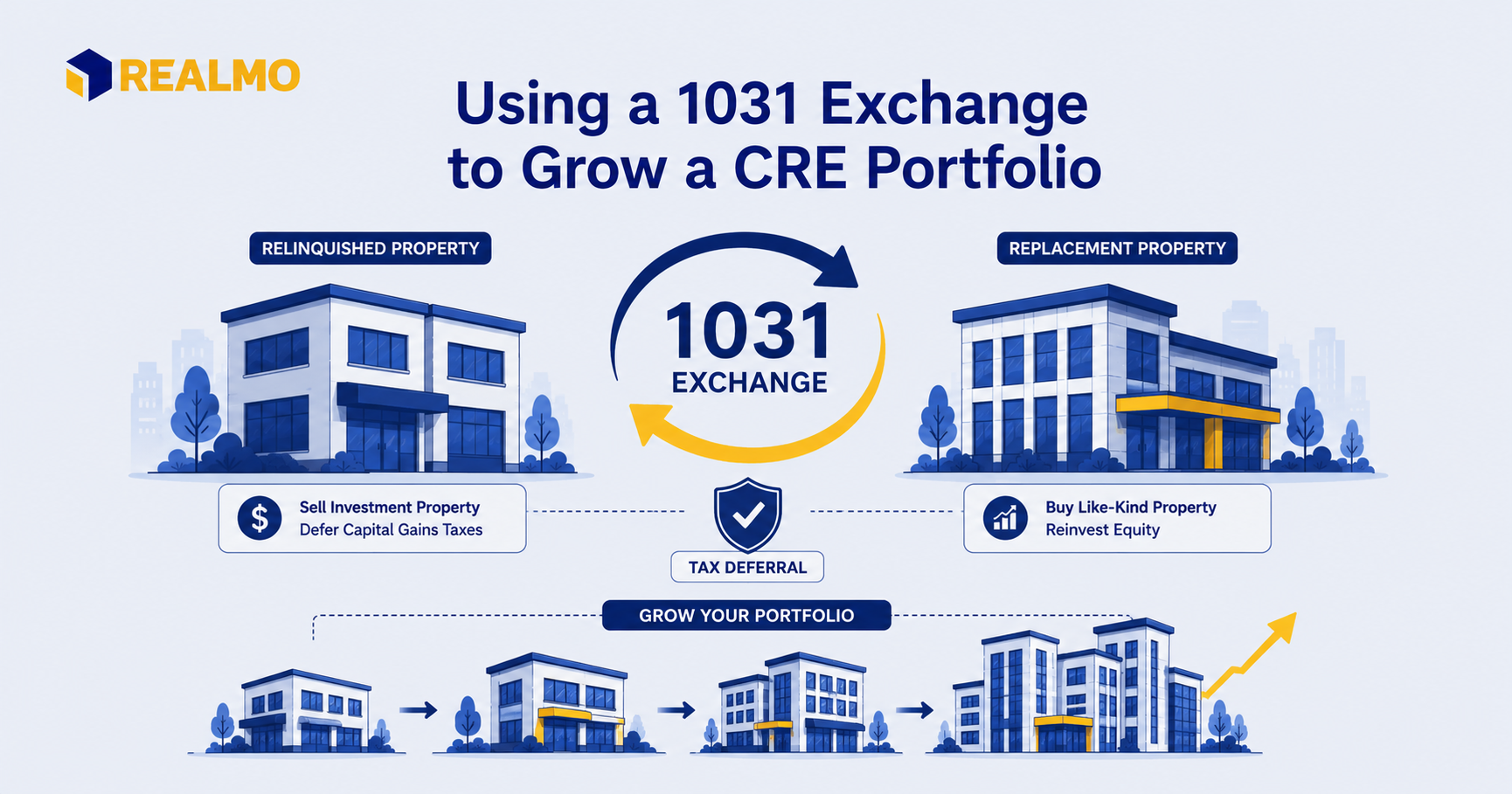
A strong sale price feels like a win until the tax bill enters the room. When a commercial property has appreciated, the sale can trigger capital gains, capital gains taxes, depreciation recapture, state taxes, and other closing-year tax consequences. If the property was held for a short period, some gain may be taxed at ordinary income rates. But if years of depreciation deductions lowered your basis, the taxable gain can look much larger than the cash profit you had in mind.
This makes a 1031 exchange more than a tax move. For real estate investors, it can turn one investment property into the next, larger investment property without losing as much equity at each sale.
In this article, you’ll learn how a 1031 exchange works, which rules can make or break it, and how investors use exchanges to trade up, diversify, and grow a CRE portfolio while deferring capital gains.
What a 1031 Exchange Is and Why It Grows Portfolios
The core mechanism
A 1031 exchange, also known as a like-kind exchange, is named after Section 1031 of the Internal Revenue Code. Basically, you sell real property held for investment or business use, reinvest into other like-kind real property, and defer capital gains taxes that would normally come due at sale. Section 1031 says no gain or loss is recognized when real property held for productive use in a trade or business, or for investment, is exchanged solely for like-kind real property that will also be held for business or investment use.
The honest word here is defer, not eliminate. A 1031 exchange doesn’t make the tax liability disappear by itself. It pushes the tax into the future by carrying the old gain into the replacement property’s basis. That’s why investors often describe it as an interest-free loan from the tax code: money that might have gone to taxes stays in the deal, where it can support:
- A larger down payment
- More debt capacity
- A stronger acquisition
Like-kind for real property after the TCJA
The Tax Cuts and Jobs Act narrowed Section 1031 so that like-kind exchange treatment now applies only to real property, not personal property. For CRE investors, the good news is that “like-kind” remains broad within real estate. The IRS gives examples such as:
- Buildings
- Land
- Rental property
It also notes that city property can be exchanged for farm property, or improved property for unimproved property. Primary residences and property held mainly for sale don’t qualify.
The Rules and Timeline That Make or Break the Exchange
The qualified intermediary
The first operational rule is blunt: you cannot touch the proceeds. In a deferred 1031 exchange, a qualified intermediary, often called a QI or exchange facilitator, receives the sale proceeds, holds them outside your control, and uses them to acquire the replacement property. IRS guidance recognizes the use of a qualified intermediary to facilitate a like-kind exchange.
Think of the QI as mandatory infrastructure, not optional paperwork help. Once the relinquished property is sold, the taxpayer has to complete a 1031 exchange without taking actual or constructive receipt of the money. If the funds land in your account, the exchange can fail before you even start shopping seriously.
Gary Lubarsky, CEO of Realmo
The 45-day and 180-day clocks
The timeline is a factor that can make many exchanges go sideways.
- After the relinquished property is transferred, the investor has 45 calendar days to identify replacement properties. The IRS instructions for Form 8824 state that the replacement property must be identified within 45 days after the property being given up is transferred.
- The second clock is the 180-day deadline. The replacement property must be received within 180 days after the transfer of the relinquished property, subject to the tax-return due-date rule.
Keep in mind that the 45-day and 180-day clocks run at the same time. You don’t get 45 days to identify and then another 180 days to close. Day one starts when the sale closes.
Most investors use the three-property rule: identify up to three replacement properties, regardless of value. There are other identification methods based on value, but they require more care. The safest move is to build the shortlist before listing the relinquished asset, not after the sale closes.
Equal-or-greater value, and how boot is taxed
To fully defer capital gains, the replacement property generally needs to be of equal or greater value, and all net proceeds need to be reinvested. You may create “boot” if:
- You trade down
- Keep cash
- Reduce debt without replacing it
Boot is the non-like-kind value received in the exchange, and it can trigger taxable gain. IRS regulations under Section 1031 explain that when money or other non-like-kind property is received, gain is recognized to that extent.
Example:
You sell a small retail strip center for $2 million and have $700,000 in realized gain. You buy a replacement property for $1.8 million and keep $200,000 in cash. That $200,000 is boot, so you may pay capital gains tax on that portion even though the rest of the realized gain is deferred. Partial 1031 exchanges can still be useful, but they need to be modeled before the deal closes.
Trading Up: How Deferral Compounds a Portfolio
Upgrading and diversifying without a tax drag
The growth case for a 1031 exchange is simple: more equity survives the sale.
In a regular taxable sale, part of the gain leaves the portfolio. In a successful 1031 exchange, more of that equity rolls into the next real estate investment. This can make the difference between buying another small asset and stepping into a better-located, higher-value, or higher-cash-flow property.
This is how investors trade up over time:
- A duplex becomes a small multifamily building
- A small multifamily building becomes a mixed-use asset
- A local retail property becomes a multi-tenant industrial building in a stronger logistics market
The replacement properties don’t need to match the old property type exactly, as long as both sides meet the investment or trade-or-business requirement.
The same logic works for diversification:
- An investor with too much exposure to one submarket can exchange into multiple replacement properties, subject to the identification rules
- Another investor might move from management-heavy assets into a triple-net leased property, or from one large asset into several smaller assets across different markets
Each exchange keeps more buying power inside the real estate portfolio than a fully taxed sale.
The estate-planning payoff
There’s also a long-game strategy often called “swap till you drop.” An investor keeps using 1031 exchanges during life, deferring capital gains taxes through successive trades. When heirs inherit the property, the basis may step up to fair market value at death, which can reduce or potentially erase the built-in deferred gain for income tax purposes. The IRS says the basis of inherited property is generally the fair market value on the date of the decedent’s death.
This doesn’t mean every estate plan is simple. Estate tax, ownership structure, state law, debt, trusts, and family goals are all important. But for long-term CRE owners, the combination of depreciation deductions, tax benefits, and tax deferral can become a major planning tool.
Advanced 1031 Strategies for Active Investors
Reverse 1031 exchange
A standard exchange assumes the sale happens first. But active investors know the market doesn’t always cooperate. Sometimes the right replacement property appears before the buyer for the old asset is ready. A reverse 1031 exchange solves the timing problem by letting an Exchange Accommodation Titleholder, or EAT, temporarily “park” title to either the replacement property or the relinquished property.
In other words, the EAT acts as a temporary holder so the investor doesn’t own both sides in a way that breaks the exchange. IRS Revenue Procedure 2000-37 created a safe harbor for certain parking arrangements involving exchange accommodation titleholders. The structure is useful in:
- Hot markets
- Competitive bidding situations
- Stalled sales where waiting would cost the investor the next deal
Cost and complexity present the major trade-off. Reverse exchanges often require more:
- Legal work
- Coordination
- Financing for the parked property
The timing also flips: once the EAT acquires the replacement property, the investor generally has 45 days to identify the property to be relinquished and 180 days to complete the exchange under the safe-harbor structure. IRS guidance describes reverse exchanges as involving replacement property parked with an exchange accommodation titleholder for no more than 180 days.
Build-to-suit/improvement exchange
A build-to-suit exchange, also called an improvement exchange, helps when the replacement property needs work before it can absorb the exchange value. Instead of simply buying a finished building, the investor uses exchange funds to improve or construct on the replacement property during the exchange period.
However, the investor can’t just take exchange proceeds and directly pay contractors on property they already own. The EAT usually holds title while improvements are made, and the improved property must be transferred to the taxpayer before the exchange period ends. The 180-day window is the hard constraint. A build-to-suit strategy can work well for:
- Vacant buildings
- Adaptive reuse
- Tenant-specific improvements
Remember: the tax strategy is only as strong as the construction schedule behind it. Permits, lenders, title work, contractors, inspections, and draw schedules have to line up. If the improvements are not complete within the exchange period, only the value actually received in time may count toward the exchange.
Common Mistakes That Blow an Exchange
Most failed exchanges come down to two problems:
- The investor missed the clock
- The investor touched the money
The 45-day identification deadline is especially unforgiving. A “nearly final” shortlist doesn’t help if it was not properly identified on time. The 180-day closing deadline is just as strict, so a delayed lender, title issue, or seller dispute can create real tax consequences.
Another common mistake is trading down without modeling boot. Keeping some cash may feel harmless, especially after a profitable sale, but cash left over at the end of the exchange can be taxable. Reduced debt can also create boot if it is not replaced with new debt or additional cash.
Investors also get into trouble by assuming every real estate asset qualifies. A primary residence is not investment property. Property held primarily for resale does not qualify. REIT shares and partnership interests are not the same as directly held like-kind real property. Refinancing right before or after an exchange can also attract scrutiny if it looks like a disguised way to pull cash out without an independent economic reason.
Reverse and improvement exchanges add another aspect of risk. They can be powerful, but they are not casual add-ons to a normal closing. If the EAT, financing, title, construction plan, and exchange documents are not coordinated early, the exchange can become expensive very quickly.
Conclusion
A 1031 exchange is one of the clearest tax strategies for compounding a CRE portfolio. It lets investors:
- Defer capital gains
- Preserve equity
- Move from one investment property into the next without taking the full tax hit at every sale
Used once, it can save a deal from unnecessary tax drag. Used repeatedly, it can become a portfolio-growth engine.
The investor who plans the exchange before listing the property has the advantage. Line up the qualified intermediary early, map the 45/180-day timeline, identify credible replacement properties, and model boot before closing. And since a successful 1031 exchange depends on both tax rules and deal execution, consult a tax professional and a real estate attorney before you commit.