Opportunistic Real Estate Investing
Picture two CRE deals: one is a stabilized office building collecting rent, while the other is a vacant lot with zoning work ahead, construction drawings in progress, and no income until a building opens. Both are real estate investments, but their risk profiles are completely different. And as investors move from fixed income to core, core-plus, value-add, and finally opportunistic real estate, they generally accept more execution risk for more potential upside.
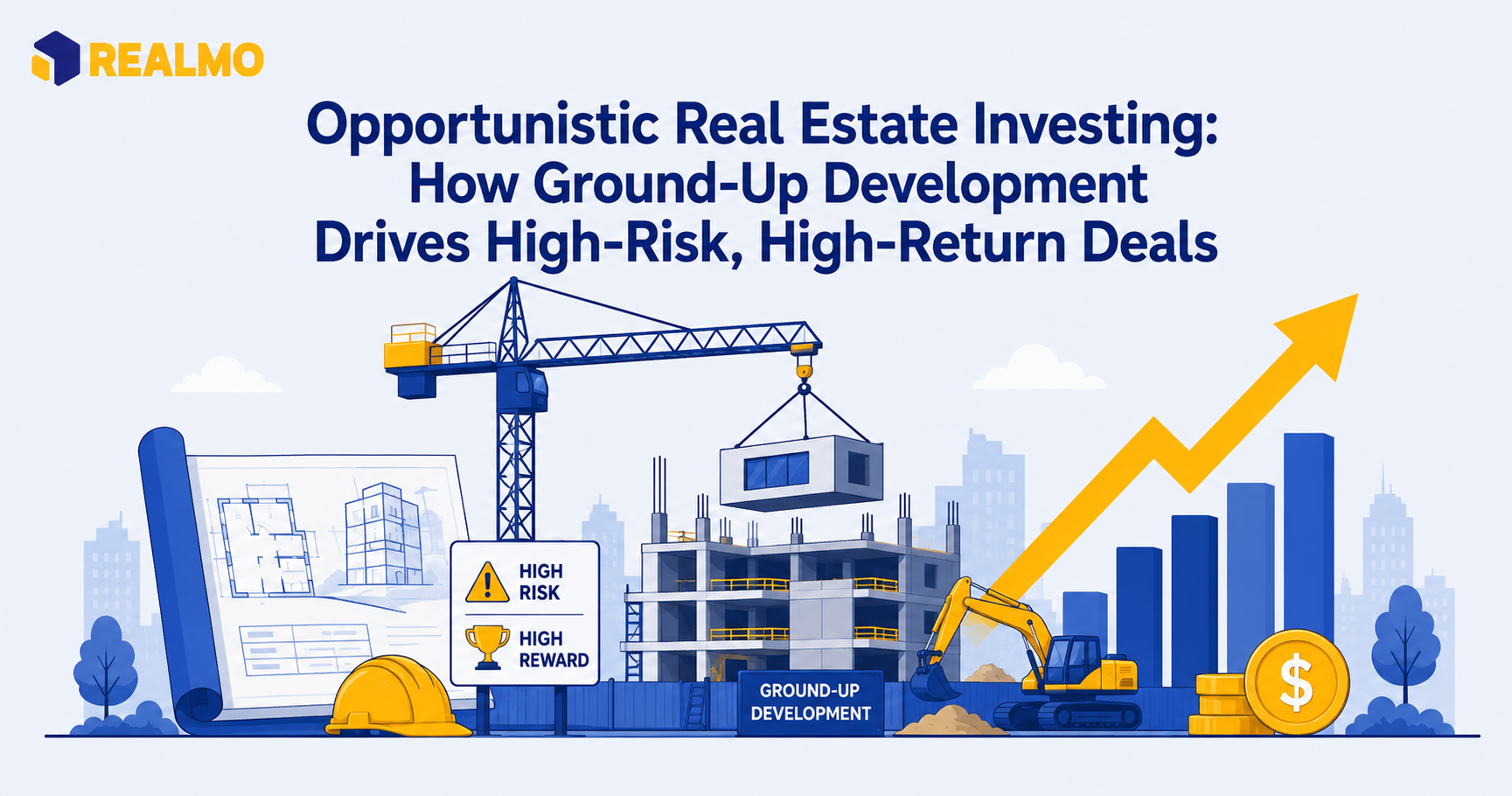
Opportunistic real estate investing occupies the most aggressive end of this spectrum. It includes ground-up development, major redevelopment, distressed properties, and other deals where the investor has to create much of the value rather than simply collect it. Cash flow may stay near zero for years, while the outcome depends on construction, leasing, financing, and the market at exit. In this guide, we’ll break down how these deals work, how developers finance and stage them, what realistic scenarios can look like, and where opportunistic strategies may fit in a broader real estate portfolio.
What Is Opportunistic Real Estate Investing?
Opportunistic real estate investing is a high-risk CRE strategy built around properties or projects that need substantial work before they can reach their expected value. This might include:
- Developing a property from the ground up
- Rebuilding an existing asset
- Turning around a distressed property
- Providing capital in a special situation
Investors typically accept limited near-term income and considerable execution risk in pursuit of higher capital appreciation.
Where opportunistic sits on the risk spectrum
Commercial real estate strategies are commonly grouped into four risk profiles:
- Core: sits at the conservative end, usually involving stabilized, well-leased properties with predictable income
- Core-plus: adds some leasing or operational risk
- Value-add: requires a more substantial business plan, such as renovation, repositioning, or lease-up
- Opportunistic: sits at the top of the curve because the property may be unbuilt, largely vacant, distressed, or dependent on a major transformation
The ordering reflects how much of the return depends on future execution rather than income that already exists. Moving up the spectrum introduces more uncertainty around construction, leasing, financing, and exit pricing, while creating more potential upside. At the opportunistic end, the risk can look closer to equities: strong execution can generate substantial gains, while a failed business plan can result in a serious loss of invested capital.
The core deal types: Development, redevelopment, distress, and debt
Opportunistic strategies can take several forms, but four deal types appear most often:
- Ground-up development. Buy land, secure approvals, build from scratch, lease the completed property, and eventually refinance or sell it.
- Redevelopment and repositioning. Acquire an existing asset and make major physical or operational changes, including conversion to a new use or extensive rebuilding.
- Distressed assets and turnarounds. Buy vacant, badly underperforming, overleveraged, or otherwise impaired properties and work to restore occupancy, operations, or financial stability.
- Special situations debt and private credit. Provide loans, rescue capital, preferred equity, or other structured financing where conventional capital may be difficult to obtain.
The mechanics vary quite a bit. A developer building an apartment tower faces different risks from a fund buying distressed debt. What makes both opportunistic is the amount of value that still has to be created after the initial investment.
The Anatomy of an Opportunistic Deal
Capital structure: Equity, debt, and leverage draws
A stabilized acquisition typically closes with the purchase price funded at once and permanent debt sized against existing income. Development works differently. The sponsor may contribute land and equity first, then draw construction debt over time as contractors complete work and costs come due. Lenders usually tie those advances to:
- Budgets
- Inspections
- Completed work
So the capital stack grows alongside the project instead of arriving fully funded on closing day.
Since the property may produce little or no income during construction, the deal can also use an interest reserve. Federal banking guidance describes structures where lenders capitalize interest into the loan balance during construction and expect repayment from a later sale, refinancing, or stabilized property cash flow
This makes timing critical. Delays don’t simply postpone rent but can:
- Increase carrying costs
- Consume contingency
- Deplete the interest reserve
- Leave the project needing more equity before it reaches stabilization
Why cash flow is an afterthought (and appreciation isn’t)
In many opportunistic deals, there’s nothing meaningful to distribute at first:
- A ground-up project may still be a construction site
- A redevelopment may lose tenants while work is underway
- A distressed building may need months of repairs and leasing before NOI resembles the underwriting
In other words, investors may wait years for substantial regular distributions.
So the return math leans heavily on value creation and capital appreciation. MSCI makes the same distinction across the risk spectrum: stabilized core investments expect more of their return from income, while riskier strategies rely more on appreciation. For an opportunistic investor, this means the future stabilized value is far more important than the first year’s cash yield. If rents, occupancy, costs, or exit pricing miss the model, there may be very little interim income to cushion the shortfall.
The deal lifecycle: Development to stabilization to exit
A typical ground-up timeline runs through four stages:
- Development and construction.
- Lease-up.
- Stabilization.
- Exit.
During construction, the sponsor controls budget and schedule. During lease-up, signed tenants start turning a project into an income-producing asset. Once occupancy and NOI reach a durable level, permanent financing can replace the construction loan.
The exit strategy usually comes next, although some owners hold longer. The sale price depends on the stabilized NOI and the cap rate buyers will pay for comparable completed properties at that time. Sponsors can’t safely assume the exit market will look like the market they entered several years earlier. That gap between today’s assumptions and tomorrow’s pricing is one of the biggest drivers of both value creation and loss.
Risk and Return: What Real Numbers Look Like
Illustrative returns across upside, base, and downside scenarios
Opportunistic underwriting should show a wide spread of outcomes. A sponsor might model an upside case where leasing beats plan, rents hold, and the exit cap rate stays favorable. Over roughly five to six years, a deal like that could produce a high-20s gross IRR and an equity multiple around 3.5x to 4x. These numbers aren’t a category guarantee, of course, but they show what strong execution plus a supportive market can do.
A softer case changes only a few assumptions. Occupancy takes longer to build, concessions rise, and the exit cap rate moves outward. The same project may fall toward a 10% to 11% IRR and roughly a 2x multiple over a longer hold. The asset still creates value, but investors spend more time and capital getting there.
Then there’s the downside case. Say leasing disappoints, costs run over budget, refinancing gets expensive, and buyers demand a higher cap rate. The exit value can fall below total invested capital, producing a sub-1x multiple and a negative IRR. This wide range of outcomes defines opportunistic investing more clearly than any single target-return number.
A ground-up development example scenario
Take a hypothetical $120 million ground-up industrial project. The sponsor expects a 20-month build, funds 40% of total cost with equity, and uses construction financing for the balance. After lease-up, the model targets $10.5 million in stabilized annual NOI. At a 6.0% exit cap rate, that implies a $175 million gross value. After repaying debt and allowing for selling costs, the equity could roughly double over a four-year business plan, which puts the simplified gross IRR near 20%. Some major opportunistic managers today disclose similar targets, though actual results vary widely.
The model looks solid because the numbers are rounded. The actual deal won’t be because multiple factors are at play:
- Zoning or entitlement approvals can take longer than planned
- Labor and materials can push construction above budget
- A key tenant can delay a lease or walk away, etc.
Federal lending guidance specifically treats feasibility, sensitivity analysis, pre-leasing, equity requirements, interest reserves, and takeout financing as core construction-risk questions. A development sponsor has to underwrite all of them before the first shovel hits the ground.
Is Opportunistic Investing Right for Your Portfolio?
Who pursues these deals
Large opportunistic deals mostly sit in the world of:
- Real estate private equity firms
- Alternative investment managers
- Developers
- Specialized operating partners
Brookfield, for example, describes its flagship opportunistic real estate strategy as targeting large, complex, distressed assets, turnarounds, and recapitalizations. These deals demand deep underwriting and active asset management because the sponsor has to manage construction, capital markets, leasing, and execution risk at once. Pensions and endowments can also participate, often through professionally managed closed-end funds, separate accounts, or joint ventures rather than directly running individual development projects themselves.
Portfolio role, access, and the diversification case
The label “opportunistic” doesn’t automatically mean higher returns. Research published by NCREIF found that, over the 17-year period studied, value-add funds underperformed core on a risk-adjusted basis, while opportunistic funds roughly matched core overall and underperformed it during parts of the period. MSCI has also shown that aggregate closed-end and open-end real estate fund performance can look surprisingly similar over long windows. Manager selection, timing, fees, leverage, and execution are still key.
This makes diversification a more defensible portfolio argument than a promise of outsized returns. Opportunistic exposure can add distinct development, distress, and capital-growth drivers to a real estate allocation. Access still remains less straightforward for individuals, though. Private funds often impose:
- Qualification requirements
- Long lockups
- Limited liquidity, even as newer vehicles have widened retail access
Conclusion
Opportunistic real estate sits at the top of the CRE risk curve for a reason. Investors take real development, leasing, financing, and exit risk in pursuit of higher returns. Strong deals look disciplined and avoid speculation. Underwrite the downside, challenge the exit assumptions, and judge the sponsor before the headline IRR.