Buying Commercial Property for Your Own Business
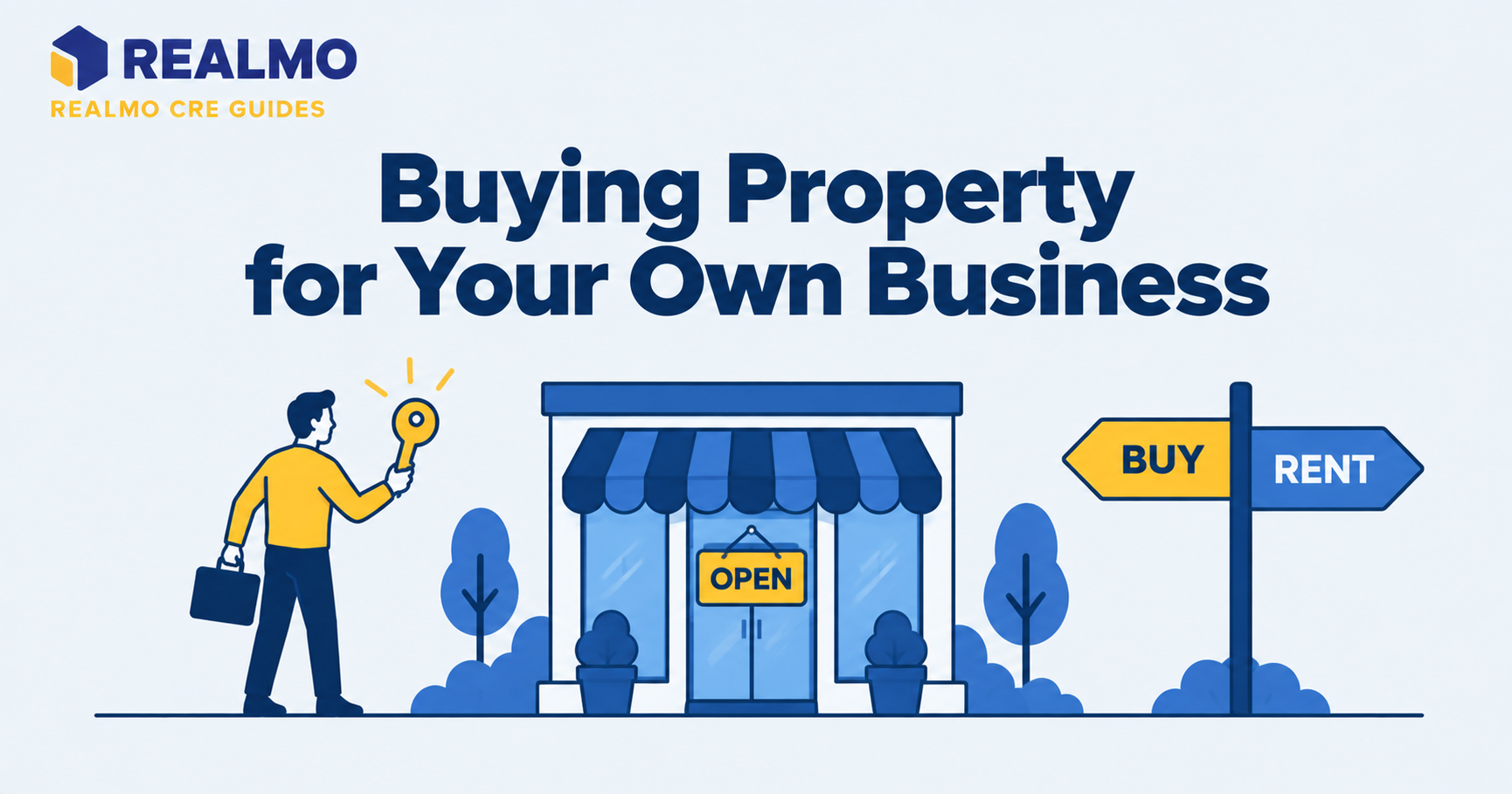
Buying commercial property for business use means purchasing a building your own company will occupy, rather than acquiring it as a passive investment. The buyer is both landlord and tenant. Financing is underwritten against business cash flow as well as the real estate, and the decision competes directly with signing a lease.
Why the buy-or-lease decision reaches your desk
A manufacturer outgrowing 12,000 square feet gets a renewal proposal with a rent bump and a five-year term. Down the street, a comparable building is listed for sale. The owner now has two different problems on one desk. One is whether the space fits the next decade of operations. The other is whether the company should convert rent into equity.
The stakes are asymmetric. A bad lease costs you the remaining term. A bad purchase ties up equity and adds a mortgage covenant to your balance sheet. It can also lock the business into a location and a footprint that don’t match headcount in year six. It also creates a second asset: the real estate. That asset can be sold, refinanced, or leased to a successor long after the operating business changes hands. Owner-users who treat the building as a real estate decision, separate from the operating decision, usually make fewer mistakes than those who don’t. Treating it as an extension of the lease renewal is the more common error.
Buying commercial property for business use vs. investing
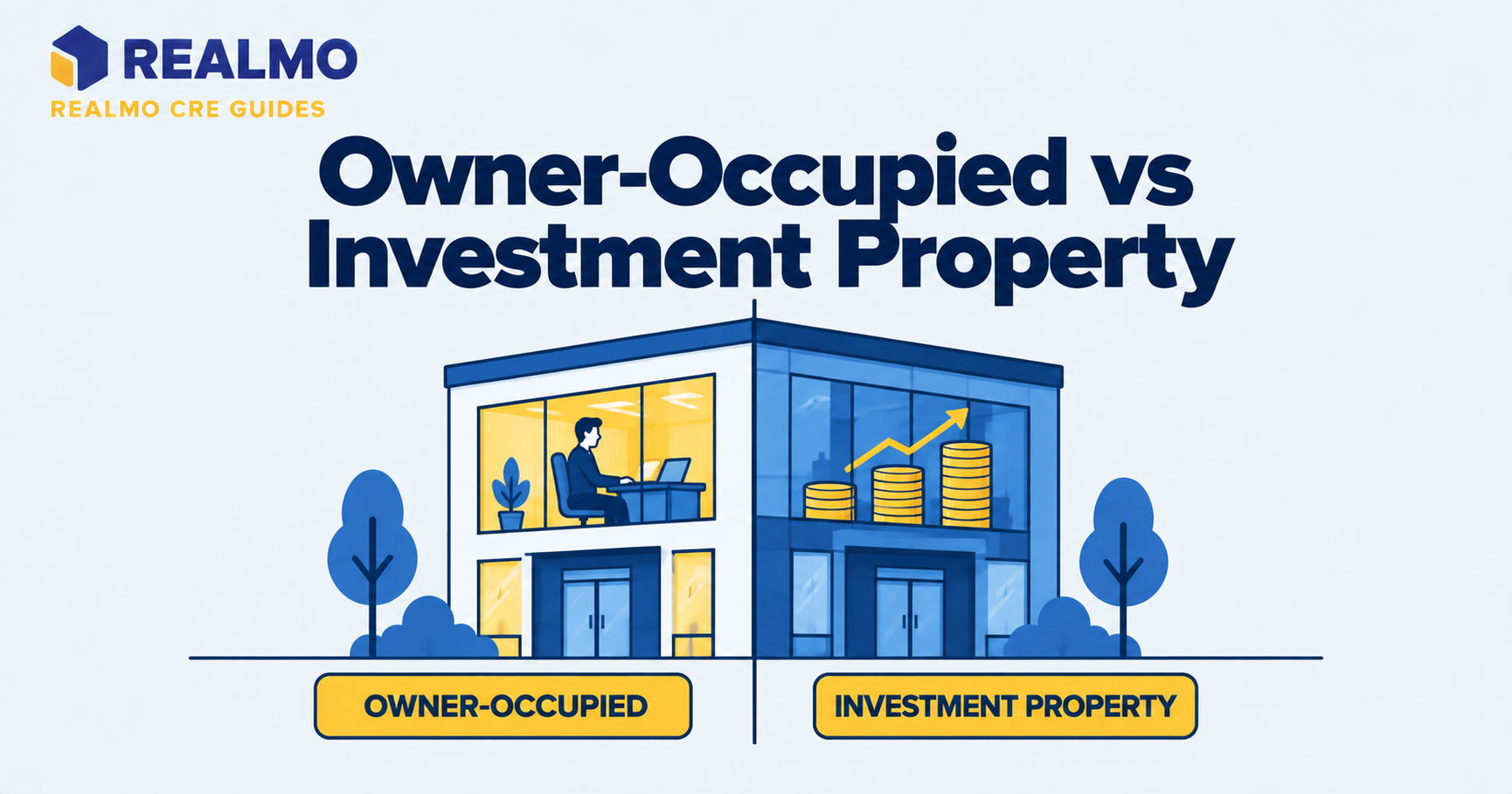
An investor underwrites a building on the strength of someone else’s lease. An owner-user underwrites it on the strength of their own operations, which changes what matters. Tenant credit, lease term, and rollover risk (the core of an investor’s analysis) collapse into a single question: will the company still need this building?
Valuation logic shifts too. Investors price stabilized income, so the cap rate drives the number. Owner-users are usually competing against replacement cost and against the rent they would otherwise pay. That means they can rationally pay more than an investor for the right building. Proximity to labor, clear height, power service, or drive-in access can be worth real money to operations and nothing to a passive buyer.
The exit is also different. An owner-occupied building sold vacant trades at a discount to the same building sold with a lease attached. Owners who plan ahead sometimes get ahead of it. They arrange a sale-leaseback (selling to an investor and leasing back the space), or sign a market-rate lease between the operating company and the property entity well before a sale.
How owner-user financing differs from investor loans
Investment property lenders size loans primarily on the property’s net operating income, using debt service coverage ratio and loan-to-value tests. Owner-user lenders look at global cash flow: the operating business, the pro forma rent it will pay itself, and the principals’ guarantees together.
That has practical consequences. Equity requirements for owner-occupants are usually lower than for investment purchases. SBA-guaranteed programs are available, and the lender is banking a going concern rather than a rent roll. Personal guarantees are close to universal. And underwriting will scrutinize financial statements, tax returns, and customer concentration in the operating business: items that never appear in an investment file.
SBA 504 and 7(a): occupancy rules for owner-users
Both SBA programs exist for owner-occupants, and both turn on occupancy. Under SBA rules, a small business acquiring an existing building must occupy at least 51% of the rentable space. For new construction, the occupancy threshold is higher. The balance can be leased out on a phased basis (SBA, SOP 50 10). The excess space can be rented to third parties, which is how many owner-users cover part of their debt service.
The 504 program pairs a conventional first mortgage from a bank with a subordinate debenture funded through a Certified Development Company. The borrower contributes the remaining equity. The 7(a) program is a single guaranteed loan with broader use of proceeds and usually floating-rate pricing. Program maximums, fees, and rate structures are set by statute and SBA policy notice, and they change over time. Confirm current terms with a lender rather than relying on any published summary. Talk to a licensed lender and your CPA before assuming eligibility.
Why the building belongs in a separate entity
Most owner-users hold real estate in a separate LLC that leases the building to the operating company. The structure separates liabilities and makes the operating business easier to sell without the real estate. It also creates a documented rent stream that supports the property’s value.
It only works if the lease is real: a written lease at a defensible market rent. The operating company should pay taxes, insurance, and maintenance under a triple net (NNN) lease structure. That combination is what makes the arrangement hold up under lender review, buyer diligence, and IRS scrutiny. Rent set arbitrarily high or low invites problems on both sides. Depreciation of nonresidential real property runs over 39 years under the modified accelerated cost recovery system, and land is never depreciable (IRS Publication 946). Allocation between land and improvements is a real decision, not a formality.
Worked example: cost of occupancy, buy vs. lease
Illustrative figures only; round numbers chosen to show the method.
A company needs 20,000 square feet. The building is priced at $4,000,000. Under a 504-style structure, the bank funds $2,000,000, the CDC debenture funds $1,600,000, and the borrower contributes $400,000. Assume an illustrative 7% rate on the first mortgage and 6% on the debenture, both amortizing over 25 years.
- First mortgage debt service: about $169,600 per year.
- Debenture debt service: about $123,700 per year.
- Total annual debt service: roughly $293,300.
- Owner’s operating costs (taxes, insurance, maintenance, reserves) at an illustrative $6.00 per square foot: $120,000.
- Total cash cost of occupancy: about $413,300, or $20.67 per square foot.
The lease alternative at an illustrative $16.00 per square foot NNN is $320,000 in base rent plus the same $120,000 in operating costs, or $440,000.
Interpreting it correctly requires splitting the debt service. In year one, roughly $233,800 of that $293,300 is interest, and about $59,500 is principal (equity build, not expense). So the true year-one cost of ownership is closer to $353,800 against $440,000 of rent. Add a depreciation deduction on the improvements, and subtract the return the $400,000 down payment could have earned elsewhere. Fixed-rate debt service stays flat while the lease escalates annually, so the gap widens across the term.
The common error is comparing gross debt service against net rent and stopping there. That understates ownership by ignoring principal and depreciation. It also overstates it, by ignoring the roof, HVAC, and parking lot that a landlord would have funded and an owner now must reserve for.
Due diligence that owner-users tend to skip
Operating buyers focus on whether the space works and underweight the property risks. A Phase I environmental site assessment, conducted under ASTM E1527, is standard lender-required work, and prior industrial use is worth understanding before you own the dirt. Zoning and permitted use deserve equal attention. Confirm your specific operation is allowed by right, not by variance. Check whether parking counts, loading, and hours-of-operation restrictions match how the business actually runs.
Verify power service, floor load, clear height, and sprinkler classification against your equipment list rather than the listing description. Pull the ownership and permit history, and price deferred capital items from a property condition assessment into the offer. Realmo’s property records and current-versus-suggested-use data are open to check while you are still building a shortlist, before you spend money on third-party reports.
Common mistakes when buying your own building
- Sizing the building to today’s headcount. A footprint that fits exactly at closing forces a relocation in year four, and the equity gets consumed by a second set of transaction costs.
- Skipping the intercompany lease. Without a written market-rate lease, the property entity has no documented income, which weakens refinancing and depresses value at sale.
- Treating the down payment as the only cost. Closing costs, tenant improvements, moving, and downtime routinely add materially to the check, and they compete with working capital.
- Ignoring the vacant-building exit. Selling an owner-occupied building without a lease in place narrows the buyer pool to other owner-users, which is a thinner market than the investor pool.
- Assuming SBA eligibility. Occupancy percentages, use of proceeds, and affiliate rules disqualify more deals than borrowers expect, and the discovery usually comes late.
Related terms
Cap rate · Sale-leaseback · NNN lease · Debt service coverage ratio · Loan-to-value ratio · 1031 exchange · Phase I environmental site assessment · Cost of occupancy
FAQs
How much down payment do I need to buy a building for my business?
Owner-occupant purchases usually require less equity than investment purchases, because SBA-backed structures allow a smaller borrower contribution than conventional commercial mortgages. The exact percentage depends on the program, property type, and whether the business is a startup or has operating history. Budget separately for closing costs, tenant improvements, and reserves.
Can I rent out part of the building I buy?
Yes, and many owner-users do. SBA financing requires the business to occupy a minimum share of rentable space: 51% for an existing building. The remainder is available to lease to third parties. Conventional lenders set their own occupancy thresholds. Rental income from the excess space can help carry debt service.
Should the operating company or a separate LLC own the property?
Most owner-users place the real estate in a separate entity that leases to the operating company. This separates liability, simplifies selling the business without the building, and creates documented rent supporting the property’s value. Structure carries tax and legal consequences that vary by state and entity type; work through it with a licensed attorney and CPA.
Does buying beat leasing for a small business?
Neither is universally better. Ownership converts rent into equity, fixes occupancy cost against escalating rents, and adds depreciation, but it consumes equity, adds capital responsibility, and reduces flexibility. Leasing preserves capital and mobility at the cost of building no equity. The answer depends on how confident you are in the location and footprint over ten years.