Data Center Real Estate: What Investors Should Know
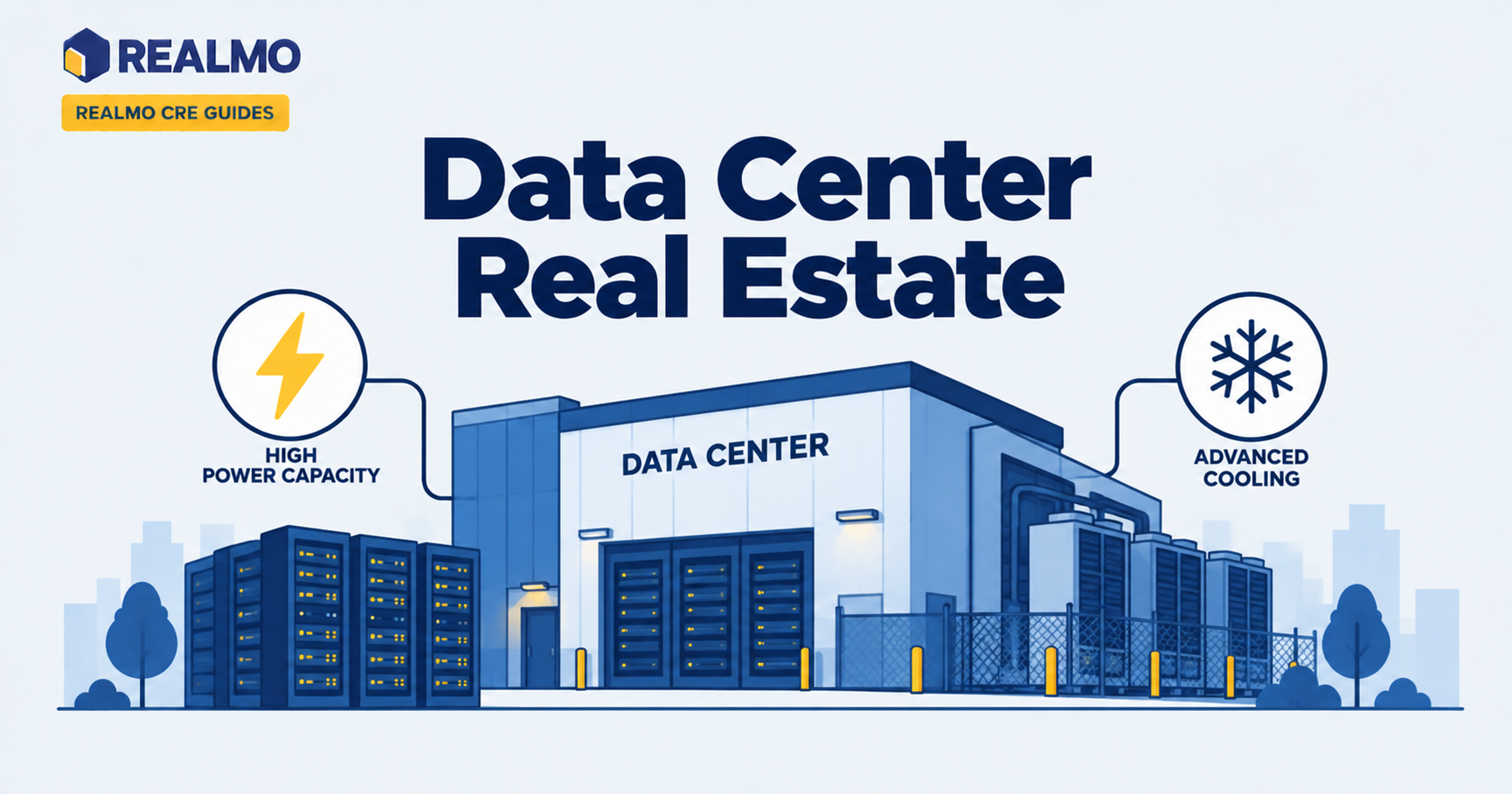
Data center real estate is income-producing property built to house computing equipment. Value derives from delivered electrical capacity, cooling, and connectivity, not usable square footage. Investors are buying the right to serve a contracted critical load. That load is leased to hyperscale, enterprise, or colocation users under long-duration agreements with heavy mechanical and electrical infrastructure attached.
Why mispricing power capacity sinks a data center deal
Picture an investor who buys a stabilized 5 MW facility at a price derived from in-place rent and a comparable-sale cap rate. The rent roll checks out. Three months after closing, the tenant asks to expand into the vacant half of the shell. The utility responds that new capacity at that substation is available only in a future interconnection window, subject to a study the investor didn’t commission.
The vacant square footage that supported the purchase price is now unleasable for years. The same building, same shell, same location. But the sellable product was never floor area. It was amperage. Underwriting that treats a data center like a warehouse with better HVAC produces a price the asset cannot support. The error surfaces at expansion or renewal, not at closing.
Hyperscale, colocation, and powered shell explained
Hyperscale facilities are built for a single large cloud or platform tenant, usually to that tenant’s specification. Many go up on a build-to-suit basis, with a lease term long enough to amortize the improvements. Concentration is total: one credit, one renewal date, one negotiation.
Colocation facilities lease capacity to many customers, commonly by cabinet, cage, or committed kilowatt. Revenue is more diversified and shorter in weighted average term. The landlord behaves more like an operator than a passive owner, since uptime service levels sit inside the contract.
Powered shell is the most real-estate-like format. The owner delivers a building, structural capacity, and utility service to the meter; the tenant installs and owns the generators, UPS systems, chillers, and racks. Powered shell strips out most equipment obsolescence risk and, in exchange, earns a lower rate per kilowatt. Edge sites are small facilities placed close to end users, built to cut latency. They follow the same logic at compressed scale: site control and fiber routes carry the value, not the building.
Why data center real estate trades on power, not area
The industry prices in dollars per kilowatt of critical IT load per month. That is the unit the tenant consumes, and the constraint the landlord cannot cheaply add. Two buildings with identical footprints can differ by a multiple in income if one is provisioned for dense computing and the other is not.
Three definitions do most of the work. Critical IT load is the power available to the servers themselves, distinct from gross utility service, which also feeds cooling and building systems. PUE (power usage effectiveness) is the ratio of total facility energy to IT energy, so a lower ratio means less overhead consumed by cooling. Redundancy notation, N+1 or 2N, describes how much spare equipment stands behind the load. The Uptime Institute’s Tier I–IV classification formalizes those configurations for design and construction.
Higher redundancy raises construction cost per kilowatt and supports a higher rate, but only if the tenant base actually requires it. Building Tier III infrastructure for users who will pay for Tier II capacity converts an engineering achievement into a negative yield on cost.
What a data center lease actually transfers to you
Most single-tenant data center leases are triple net with initial terms long enough to cover specialized improvements, plus renewal options and fixed or index-linked escalators. Read past that summary. Four provisions change the risk profile more than the headline rent.
Power is usually a pass-through billed at cost or at a defined rate. That means the landlord’s income is the capacity charge, not the electricity margin, and utility price moves flow to the tenant. Service level agreements can impose credits against rent for outages, converting a real estate income stream into a partially performance-based one. Ownership of the mechanical and electrical plant determines who funds the replacement cycle, which runs far shorter than the building’s. Expansion and right-of-first-refusal clauses over adjacent capacity can quietly encumber the very growth the investor underwrote.
Tenant credit carries more weight than in most asset classes, because the alternative-use value of a purpose-built facility is thin. Confirm whether the lease is signed by the parent entity or a subsidiary, and whether a guarantee sits behind it.
Risks that never appear on the rent roll
Utility interconnection is the binding constraint in many markets, and queue position is an asset in itself. Transformer and switchgear lead times can stretch a delivery schedule past the point where a development pro forma works. Water rights matter where cooling depends on evaporative systems, and several jurisdictions have added moratoria, zoning overlays, or noise ordinances aimed specifically at large facilities.
Technology risk compounds the physical risk. Rising rack densities have pushed designs toward liquid cooling, which older air-cooled halls may not accommodate without structural and plumbing work. A twenty-year hold assumption on a building designed for one density regime deserves an explicit re-fit reserve rather than an optimistic residual.
Site screening starts long before a power study. Parcel-level ownership records, current and suggested use, and Location Insights on Realmo let you check substation proximity and adjacent industrial inventory. Confirm prior use of a candidate site before you spend money on engineering.
Cost segregation studies frequently separate short-lived equipment from the 39-year recovery period the Modified Accelerated Cost Recovery System (MACRS) assigns to nonresidential real property, which changes depreciation timing materially. Treatment depends on facts and ownership structure. Review it with a licensed tax professional before relying on it.
Worked example: pricing a 6 MW colocation deal
All figures below are illustrative round numbers chosen to show the arithmetic, not market quotes.
Assume a facility with 6,000 kW of contracted critical load and a lease rate of $120 per kW per month. Non-recoverable operating expenses run $1,440,000 per year.
- Annual base revenue: 6,000 kW × $120 × 12 = $8,640,000
- Net operating income: $8,640,000 − $1,440,000 = $7,200,000
- Total project cost: $80,000,000, or $13,333 per kW of critical load
- Yield on cost: $7,200,000 ÷ $80,000,000 = 9.0%
- Exit value at a 7.0% capitalization rate: $7,200,000 ÷ 0.07 = $102,857,000
How to read it: the 200-basis-point spread between the 9.0% yield on cost and the 7.0% exit rate is the development premium. It compensates for construction, commissioning, and lease-up risk, not a return that exists on day one. The $13,333 per kW cost figure is the number that travels across deals, since it normalizes buildings of different sizes and redundancy levels.
The common error here is running the same math on design capacity instead of contracted load. If only 4,000 kW is under contract, revenue falls by a third while cost stays fixed. The yield on cost then drops to roughly 5.7%, a different deal entirely.
Common mistakes investors make with data centers
- Valuing the asset per square foot. A shell priced against industrial comps ignores the electrical infrastructure that consumes most of the budget. The result is a number that is either wildly high or wildly low, with no way to tell which.
- Skipping the utility diligence. Assuming expansion capacity exists because the site is large converts unusable floor area into phantom value, and it can strand a growth thesis for years.
- Ignoring the equipment replacement cycle. Generators, UPS units, and chillers wear out long before the building does; a pro forma without a capital reserve for them overstates long-run NOI.
- Underwriting one tenant’s credit as if it were the market’s. Purpose-built facilities re-tenant slowly, so a downgrade or non-renewal hits harder than the same event at a multi-tenant property.
- Treating a sale-leaseback with an operator as passive income. If service levels sit in the lease, the operator’s performance is inside your cash flow whether or not you manage the building.
Related terms
Cap rate · Net operating income · Yield on cost · Triple net lease · Tenant credit analysis · Industrial real estate · REIT · Sale-leaseback
FAQs
Are data centers considered industrial real estate?
They are commonly grouped with industrial in portfolio reporting because of siting and building form, but they underwrite as their own class. Cost per square foot, tenant improvement logic, and replacement cycles resemble specialized infrastructure far more than they resemble warehouse or light manufacturing space.
How do you value a data center?
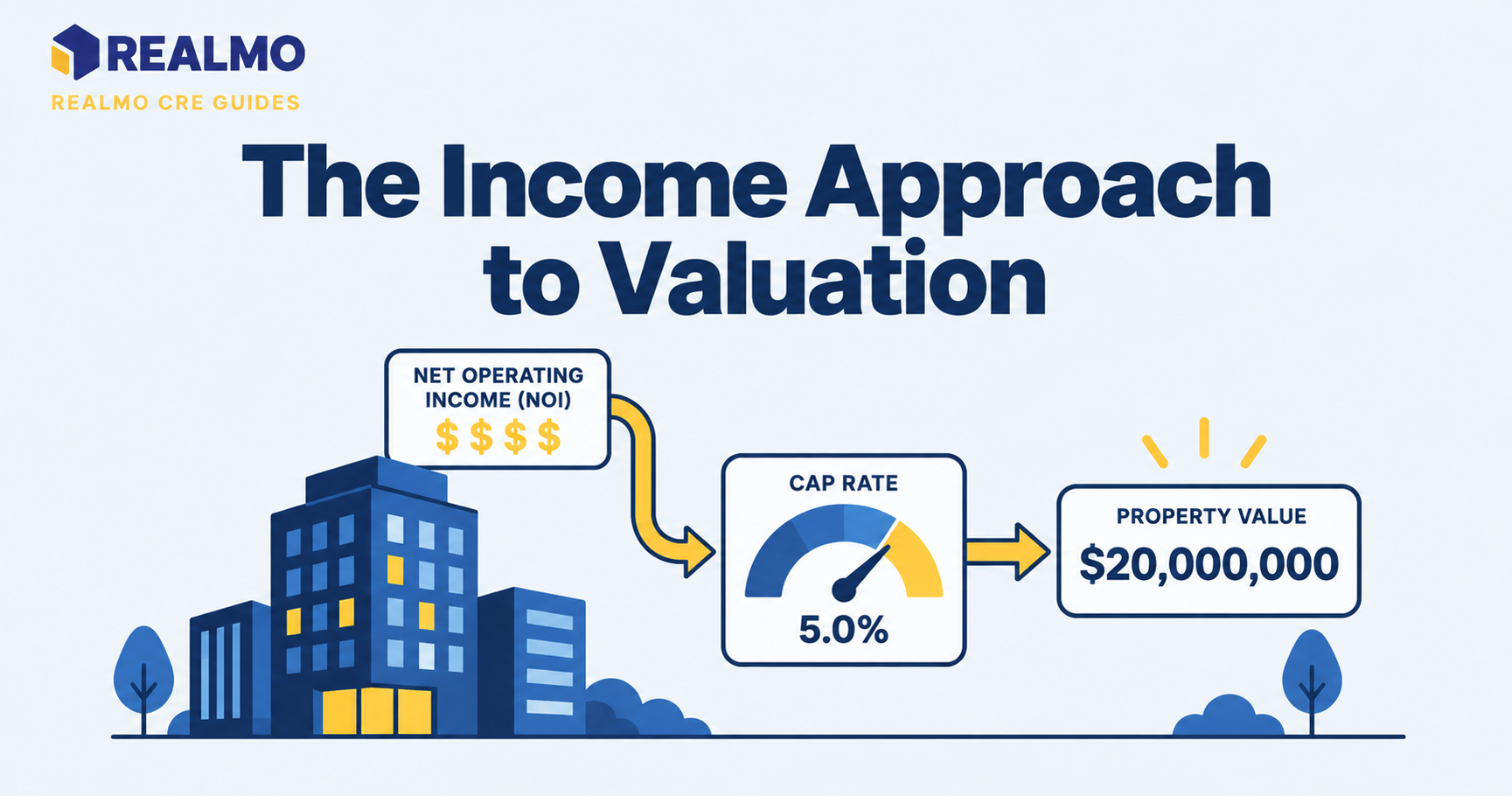
Income approaches dominate: capitalize NOI derived from contracted critical load, then sanity-check against cost and value per kilowatt. Replacement cost analysis matters more than usual, since the equipment share of total cost is high and depreciates on a different schedule than the shell.
Can smaller investors access this sector?
Exposure is available through listed real estate investment trusts (REITs) that own data centers, private funds, and joint ventures with operators. Direct ownership of a powered shell leased to an operator is the format closest to conventional net lease real estate. Site and utility diligence still apply.
What is a powered shell?
A powered shell is a building delivered with structure and utility service to the meter. The tenant installs and owns the cooling, backup power, and IT equipment. The owner sheds most technology obsolescence risk and accepts a lower rate per kilowatt in return.
Why does PUE matter to an owner?
PUE measures how much total energy the facility consumes per unit of IT energy. Lower ratios reduce the tenant’s total occupancy cost, which supports rate and renewal. In leases where the landlord carries some utility exposure, it directly affects recoverable versus non-recoverable expense.