Office Building Investment: How to Underwrite, Finance, and Own Office Assets
Office building investment is the purchase and ownership of commercial property leased to business tenants for administrative, professional, or corporate use. Returns come from rent, net of operating costs. Value can also change at sale. Office underwriting turns on lease structure, tenant credit, and the capital cost of re-leasing space.
Why office is the hardest asset class to underwrite well
An investor moving from small multifamily into office usually gets the first year right and the third year wrong. The rent roll looks stable, the in-place yield looks attractive relative to apartments, and the seller’s broker package shows a clean expense history. Then a 20,000-square-foot tenant, with two years left, decides not to renew. The costs add up fast. The buyer discovers what filling that space costs: a tenant improvement allowance, a leasing commission to two brokers, and several months of free rent. On top of that, the space can sit vacant for six to twelve months, still racking up taxes, insurance, and utilities.
That one event is costly. It can consume more than a year of building-level cash flow. Office is the asset class where the gap between reported net operating income and actual cash available to the owner is widest. That gap is why reserving for rollover matters: it separates investors who hold through a cycle from those who hand the keys back.
How office buildings are classified: Class A, B, and C
Class designations describe a building’s position within its own submarket, not against a national standard. Context sets the grade. A Class A building in a secondary metro would grade as Class B in a gateway central business district. The label is a relative ranking, built from age, finish quality, floor plate efficiency, elevator and HVAC systems, and parking ratio. It also factors in amenities and the credit profile of the existing tenant roster.
Class A assets sit at the top of the local rent range. Institutional capital follows. That capital compresses yields and raises the entry price per square foot. Class A also carries the highest burden: A-quality tenants expect A-quality build-outs, and the cost to deliver a finished suite scales with the rent charged.
Class B buildings are usually older, structurally sound, and priced at a discount to replacement cost. They house professional services firms, regional companies, and government agencies. Value-add lives here. Lobby and restroom renovations, elevator modernization, and a repositioned amenity package can move a building up the local rent ladder without ground-up construction economics.
Class C buildings compete on price alone. Deferred maintenance, obsolete systems, poor floor plates, and inadequate parking limit the tenant pool to price-sensitive users on short terms. Many C-grade assets in weak submarkets are worth more as conversion or redevelopment candidates than as continuing office. That shifts the analysis from income underwriting to land and structural feasibility.
Two variables cut across all three classes. Both deserve separate attention. Floor plate size determines which tenant sizes the building can serve efficiently. Parking ratio matters too, and in suburban markets it is frequently the binding constraint on leasing, regardless of how good the interior looks.
What drives office income: leases, not square footage
Office rent is quoted per rentable square foot per year. Most U.S. markets work this way. Rentable square footage is a constructed number, not a measurement of the tenant’s suite. Rentable area includes the tenant’s usable area plus a proportionate share of common corridors, lobbies, and restrooms, expressed as a load factor or add-on factor. Two buildings quoting identical rents can deliver materially different economics if one loads at a low single-digit percentage and the other loads far above it.
Beyond the quoted rate, four terms decide what the landlord actually collects. Annual escalations set the growth rate of base rent over the term, either as a fixed percentage or tied to an index. Free rent, or an abatement period, delays the start of payment and reduces the effective rate across the term. The tenant improvement allowance is landlord capital spent to build out the suite. Leasing commissions are paid to the tenant’s broker and the landlord’s broker, usually as a percentage of aggregate lease value. Unlike rent, they’re due upfront.
The number that reconciles all of this is net effective rent. It equals total base rent collected over the term, less abatement, less the tenant improvement allowance and commissions, divided by the term. A ten-year lease with twelve months free and a generous build-out can carry a high headline rate but a low net effective rent. It can come in lower than a five-year lease at a lower headline rate with modest concessions. Sellers market headline rents. Buyers should underwrite net effective rents.
How office leases are structured and measured
Office leases differ from the triple net conventions common in single-tenant retail and industrial. Terms vary by form. Three forms dominate: full-service gross, modified gross, and net leases, each allocating operating costs differently between the landlord and the tenant.
Under a full-service gross lease, the landlord pays all operating expenses out of the quoted rent. Tenants get one number and no reconciliation surprises. The landlord absorbs the risk that utilities, insurance, or property taxes rise faster than contractual escalations. Protection comes through a base year expense stop. The tenant reimburses its pro rata share of expenses above the level established in the first year of the lease. A base year set during a period of artificially low occupancy, or a temporary tax abatement, can hurt the landlord. The landlord then under-recovers for the life of the lease. Check this in due diligence. It is a specific item, not a theoretical concern.
Modified gross leases split the categories. Commonly, the tenant pays its own in-suite janitorial and electricity, while the landlord covers taxes, insurance, and structural maintenance. Net leases in office are most common in single-tenant and medical office buildings, where the tenant reimburses operating costs directly. There, the landlord’s exposure narrows toward roof, structure, and capital systems.
Three provisions carry outsized weight for a buyer. Renewal options fix the mechanism, and usually the rate, at which a tenant can extend. An option struck at a below-market rate is an embedded liability. Termination rights let a tenant exit early, sometimes with a fee that rarely covers the landlord’s actual cost of re-leasing the space. Expansion and right-of-first-offer rights constrain how the landlord can lease adjacent space to anyone else. All three survive the sale. They belong in the abstract before the price is agreed, not after.
What to underwrite before an office building investment
Start with the rollover schedule. Lay out every lease by expiration year and square footage, and identify the years where a concentration of space comes due. A building where a third of the rentable area expires in a single year carries a different risk profile than one with evenly staggered maturities. That holds even if both show identical occupancy today. The weighted average lease term summarizes this in one figure. The year-by-year schedule is what actually drives the capital plan.
Next, assess tenant credit at the entity level, not the brand level. A franchisee, a regional subsidiary, or a professional partnership without a corporate guarantee is a different counterparty than the parent. The name on the door isn’t always the counterparty. Request financial statements where the lease allows. Check the security deposit and any letter of credit, and confirm whether a guaranty exists and who signed it.
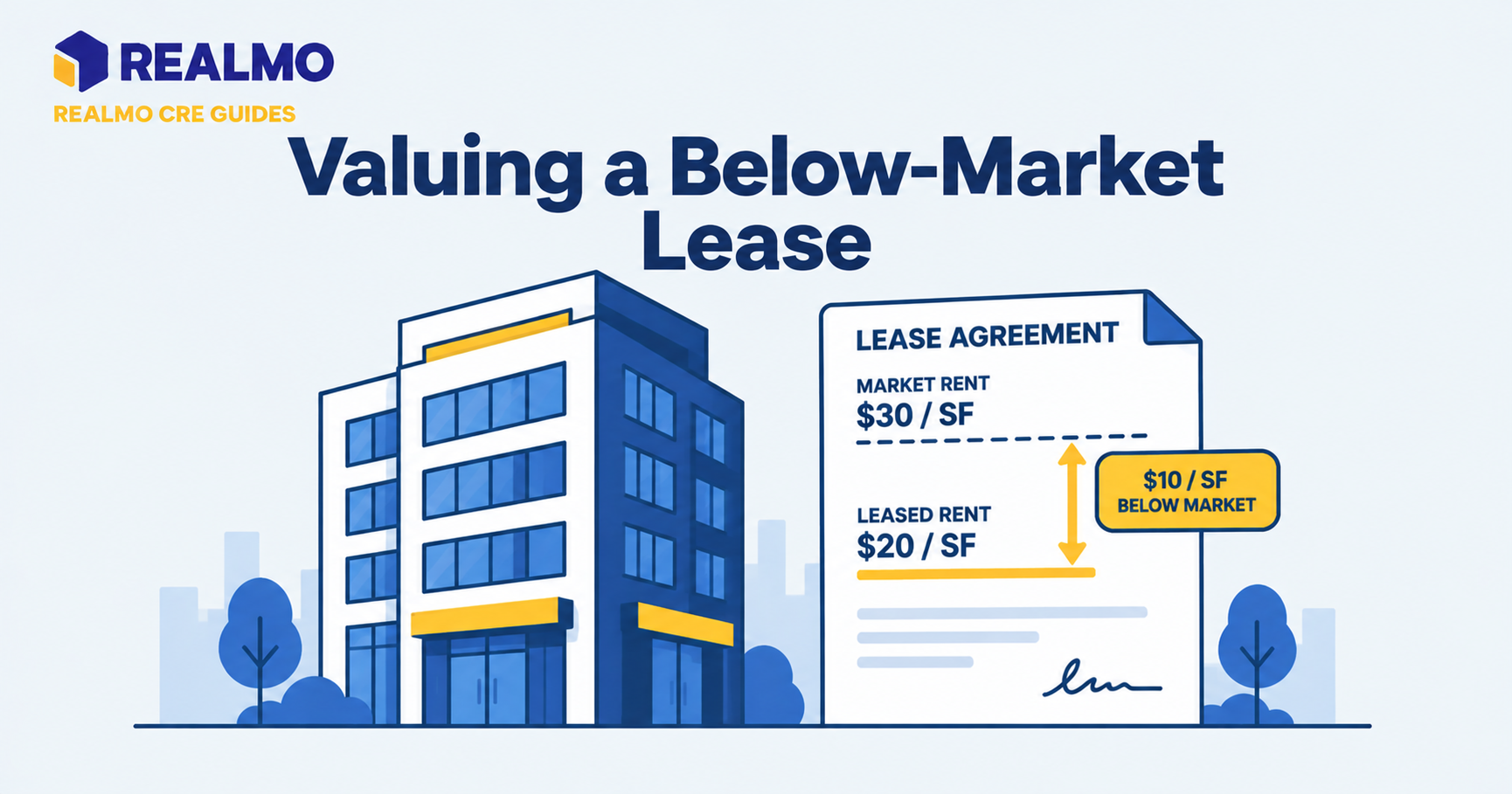
Then compare in-place rents to current market rents, space by space. Below-market leases represent future upside but require patience and re-leasing capital to capture. Above-market leases represent value that expires on a known date. Eventually, it resets. Paying a full-value price for income that will reset downward is one of the more expensive errors in office acquisition.
Underwrite capital expenditures as a recurring cost of operations, not an occasional event. Office buildings consume capital in two recurring streams: tenant-driven costs from every lease event, and building-system costs from major capital work. Roof and HVAC replacement, elevator modernization, parking lot resurfacing, and code-driven upgrades all fall into the second category. A property condition assessment prices the second stream. The rollover schedule prices the first.
Screening the market matters as much as screening the building. Employment composition in the submarket and the direction of sublease space both shape how long a vacant suite will sit. So does new supply. The amount of competing product being delivered or renovated nearby, and the ratio of asking rents to replacement cost, both matter too. Realmo’s property analytics cover ownership records, valuation, and current-and-suggested-use data across 9M+ properties. Use that data to build a comparison set for a submarket before committing to a formal due diligence budget.
How office acquisitions get financed
Office debt terms are set primarily by lease durability rather than by the building itself. Lenders apply the tightest of three constraints. These are loan-to-value, debt service coverage ratio, and debt yield. Debt yield is net operating income divided by loan amount, and it functions as a leverage test independent of cap rate assumptions.
Because office cash flow is exposed to rollover, lenders commonly add structural protections that a first-time office borrower may not expect. Tenant improvement and leasing commission reserves are funded monthly, or held as an upfront escrow. Cash flow sweeps trigger when a major tenant fails to renew by a specified date, or when occupancy or coverage falls below a threshold. Either way, they redirect to the lender. Springing recourse provisions can convert non-recourse debt into personal liability on specific bad acts.
The financing markets differ by profile. Stabilized, well-leased office with staggered rollover attracts life company, agency-adjacent, and CMBS execution on longer fixed terms. Transitional office with vacancy or near-term rollover usually requires bridge debt, which is floating rate and shorter. It’s priced for the risk of a business plan that depends on leasing. Owner-users occupying a majority of the building may qualify for SBA 504 or 7(a) financing, which changes the equity requirement substantially. Program terms and eligibility rules are published by the U.S. Small Business Administration and should be confirmed against current SBA guidance.
How taxes and depreciation work for office assets
Nonresidential real property, which includes office buildings, is depreciated on a straight-line basis over 39 years under the Modified Accelerated Cost Recovery System. That compares with 27.5 years for residential rental property. Land is not depreciable. So the purchase price must be allocated between land and improvements, and the allocation method should be documented at acquisition.
A cost segregation study identifies components that qualify for shorter recovery periods, usually 5-, 7-, and 15-year property. Examples include specialty electrical, certain finishes, and land improvements such as parking lots and landscaped grounds around the building itself. Reclassifying accelerates deductions. Those deductions move into the early years of ownership. Office buildings with substantial tenant build-out usually yield meaningful reallocation. That’s why the study is usually commissioned in the first year of ownership, not later.
Accelerated depreciation is a timing benefit, not a permanent one. On sale, depreciation taken on real property is recaptured under Section 1250 at a rate that differs from the long-term capital gains rate. The portion attributable to personal property recaptures under Section 1245 at ordinary rates. A 1031 exchange can defer that recognition. Timing rules apply. Replacement property must be identified within 45 days of the sale closing. The exchange itself must close within 180 days, with both periods running concurrently and without extension for weekends or holidays. IRS Publication 946 governs depreciation; Publication 544 covers dispositions.
Tax outcomes depend on entity structure, holding period, passive activity status, and state-level rules that vary. Get advice early. Confirm treatment with a licensed CPA or tax attorney before relying on any of the above for a specific transaction.
Worked example: underwriting a 60,000 SF office building
All figures below are illustrative, chosen to make the arithmetic legible. They are not market quotes and do not reflect conditions in any specific submarket.
Inputs. A 60,000 rentable square foot suburban Class B office building, 90% leased (54,000 RSF occupied) on full-service gross leases. Average in-place base rent is $24.00 per RSF. Parking and other income totals $54,000 annually. Operating expenses run $10.50 per RSF across the full 60,000 RSF. Purchase price is $9,000,000, or $150 per RSF.
Step 1: Net operating income.
Base rent: 54,000 × $24.00 = $1,296,000
Other income: $54,000
Operating expenses: 60,000 × $10.50 = ($630,000)
NOI = $720,000
Step 2: Going-in yield. $720,000 ÷ $9,000,000 = 8.0% cap rate. This is the number that appears in the offering memorandum.
Step 3: The rollover event. The rent roll shows 25,000 RSF expiring in year three. Assume a 60% renewal probability. Tenant improvements run $50 per RSF for new tenants and $25 per RSF for renewals, blending to $35 per RSF: 25,000 × $35 = $875,000. Leasing commissions run a blended 4% of total lease value on a five-year term at $25 per RSF (total value $125 per RSF). 25,000 × $125 × 4% = $125,000. Downtime on the 10,000 RSF that does not renew, at six months of lost rent: 10,000 × $25 × 0.5 = $125,000.
Total year-three capital and lost income: $1,125,000, or 12.5% of the purchase price, and more than 18 months of NOI.
Step 4: Economic NOI. Spread that $1,125,000 across a five-year hold as an annual reserve of $225,000.
Economic NOI = $720,000 − $225,000 = $495,000
Economic yield on price = 5.5%, not 8.0%.
Step 5: Leverage. At 60% loan-to-value, the loan is $5,400,000. Using an assumed 6.50% rate on a 30-year amortization schedule, the annual constant is approximately 7.58%, producing debt service of roughly $409,600. That rate is an assumption for the arithmetic, not a market rate.
Debt yield: $720,000 ÷ $5,400,000 = 13.3%
DSCR on reported NOI: $720,000 ÷ $409,600 = 1.76
DSCR on economic NOI: $495,000 ÷ $409,600 = 1.21
How to interpret this. The 8.0% going-in cap rate is real, and so is the 5.5% economic yield. Both describe the same building. Cash flow after debt service looks comfortable at $310,400 before the rollover event. It looks thin at $85,400 once capital is reserved properly, a cash-on-cash return that drops from roughly 8.6% to 2.4% on $3,600,000 of equity. The deal is not necessarily bad. Its returns depend on leasing execution, and it should be priced and financed accordingly.
The common error. Buyers frequently accept the seller’s replacement reserve line, usually a token figure per square foot, as the full capital budget. That line covers roof and mechanical replacement. It does not cover tenant improvements, leasing commissions, or downtime. In office, those are the dominant capital costs, and they must be modeled from the actual rollover schedule.
Common mistakes office buyers make
Buying the occupancy rate instead of the rollover schedule. A 95%-leased building with 40% of its space expiring within 24 months is riskier than an 85%-leased building with staggered maturities. The schedule matters more. The consequence is a capital call in year two that the equity model never contemplated.
Ignoring the base year on full-service leases. The base year sets the baseline for the life of the lease. If it was set in a year with unusually low taxes, low occupancy, or a temporary abatement, the landlord under-recovers for the remaining term. It matters more than it looks. The consequence is expense growth that compresses NOI every year while base rent escalations fail to keep pace.
Treating parking as an amenity rather than a constraint. In suburban submarkets, a low parking ratio disqualifies the building from serving denser office users, no matter how good the interior looks. Parking is not decor. The consequence is a smaller tenant pool, longer downtime, and larger concessions on every lease.
Underestimating downtime. Models frequently assume three months between tenants. Reality usually runs longer. Second-generation space with an inefficient layout can sit far longer, and the landlord keeps paying taxes, insurance, utilities, and management the whole time. The consequence is a cash shortfall precisely when TI and commission dollars are due.
Failing to abstract the leases before pricing. Renewal options at fixed below-market rates, early termination rights, expansion rights, and exclusive-use clauses all transfer with the building. Read them first. The consequence of skipping this step is discovering, after closing, that the upside case in the model is contractually unavailable.
How to exit an office investment
Exit planning starts at acquisition because the buyer’s underwriting will mirror the seller’s. A building sold with short weighted average lease term and a wave of expirations in the following 24 months will be priced accordingly. The next buyer deducts a rollover reserve from NOI, exactly as described in the worked example above. Sellers who extend key leases 12 to 18 months before going to market are buying the durability that the next buyer is paying for.
Refinancing serves as a partial exit when the business plan has been executed but sale pricing is unattractive. Lenders size a refinance against stabilized cash flow, so the same lease-extension work that supports a sale supports a cash-out refinance. Where the office use itself has become obsolete, the analysis shifts to alternative use. Conversion feasibility depends on floor plate depth, window line, column spacing, plumbing stack locations, and zoning. Those constraints are physical rather than financial. Many buildings that pencil as conversions on a spreadsheet fail on floor plate geometry.
Related terms: net operating income · cap rate · debt service coverage ratio · tenant improvement allowance · weighted average lease term · triple net lease · 1031 exchange · cost segregation
FAQs
Is office a good investment for a first-time commercial buyer?
Office demands more active management than most first commercial purchases. Leases are complex, tenant credit varies, and capital costs recur with every lease event. Investors who start in office usually do so with a single-tenant building on a long lease, or as an owner-user occupying part of the space. Both choices reduce the leasing burden materially.
How much capital should I reserve for tenant improvements and commissions?
Reserve based on your actual rollover schedule, not a per-square-foot rule of thumb. Model each expiring lease with a renewal probability, a blended TI allowance reflecting renewal versus new-tenant costs, commissions on aggregate lease value, and realistic downtime. It varies by class and submarket.
What is the difference between a full-service gross and a triple net office lease?
Under full-service gross, the landlord pays operating expenses from the quoted rent and recovers increases above a base year expense stop. Under triple net, the tenant reimburses taxes, insurance, and maintenance directly. Full-service gross dominates multi-tenant office. Triple net is more common in single-tenant and medical office buildings.
Why do office buildings sell at higher cap rates than industrial in the same market?
Pricing reflects the capital intensity and rollover risk of the income stream. Office leases are shorter than industrial leases in most markets, and re-leasing office space requires substantially more landlord capital per square foot. It shows up in the cap rate. Buyers price that difference by requiring a higher going-in yield for equivalent-quality assets.
Can I use a 1031 exchange to move from office into another property type?
Real property held for investment or productive use in a trade or business is usually exchangeable for other qualifying real property. An office-to-industrial swap can qualify. So can office-to-retail. The 45-day identification and 180-day completion deadlines apply. Confirm eligibility and structure with a qualified intermediary and a tax advisor.