How to Calculate Cap Rate on a Commercial Property
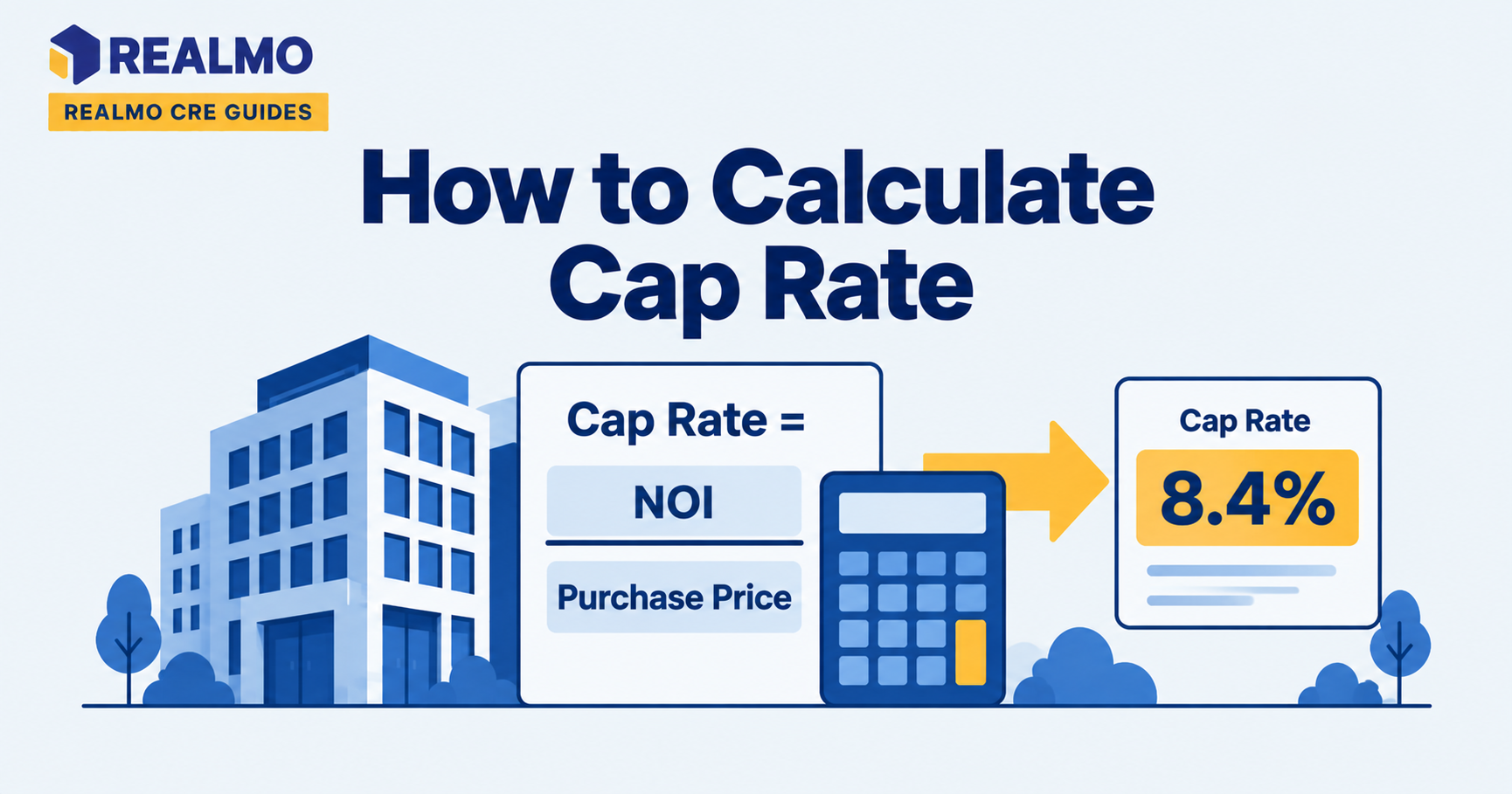
The capitalization rate is a property’s annual net operating income divided by its price or value, expressed as a percentage. Divide twelve months of NOI, rental income minus operating expenses, before mortgage payments and income taxes, by the purchase price. A $400,000 NOI on a $5,000,000 price is an 8.0% cap rate.
Commercial Property Cap Rate Calculator
Calculate net operating income and capitalization rate for a commercial property
Cap Rate
Cap Rate = Net Operating Income ÷ Property Value × 100
Why the input definitions matter more than the math
The hard part of how to calculate cap rate is not the division. It is deciding what belongs in income and what belongs in operating expenses. This is because two analysts can look at the same rent roll and produce cap rates more than a point apart.
Picture an investor comparing two offering memorandums on similar suburban office buildings. One broker built NOI on in-place rents with a 6% vacancy factor, a 4% management fee, and $0.25 per square foot in replacement reserves. The other used fully leased pro forma rents, assumed the owner self-manages for free, and carried no reserves. The second building shows the higher cap rate and looks like the better buy. It is not necessarily better, it is measured differently. An investor who normalizes both to the same expense standard finds the ranking reverses. Every downstream decision, from the loan sizing an underwriter will support to the price at which you can exit. Rests on which version of NOI you trusted.
The cap rate formula and what each term means
Cap Rate = Net Operating Income ÷ Property Value (or Purchase Price)
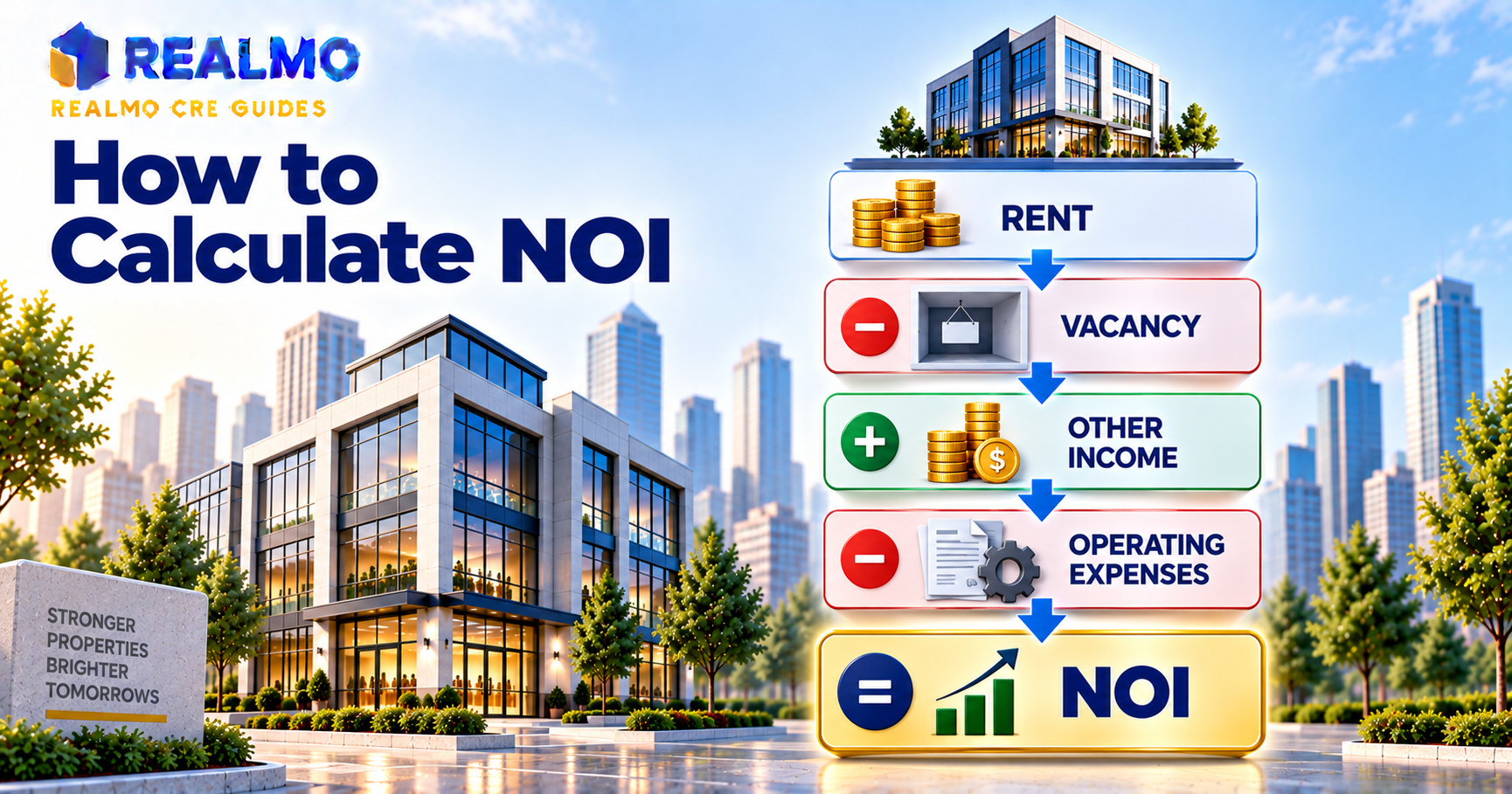
Net operating income is effective gross income minus operating expenses. Effective gross income is gross potential rent plus expense reimbursements and other income, parking, signage, storage, late fees, minus vacancy and credit loss. Operating expenses are the recurring costs of running the building. Property taxes, insurance, utilities not billed back, repairs and maintenance, common area costs, management fees, and administrative expenses.
The denominator is either the price you are paying or an estimate of value. Using price gives you the yield on your specific deal. Using an appraised or market-derived value turns the same equation into the income capitalization approach. Here, a market cap rate is applied to NOI to solve for value instead.
Cap rate is unlevered and pre-tax by construction. It describes the property, not your position in it. Financing terms, entity structure, and depreciation belong in cash-on-cash return and after-tax analysis, not here.
Which expenses belong in NOI — and which don’t
Four items are excluded from operating expenses by convention, and each exclusion has a reason.
Debt service is excluded because it reflects the buyer’s financing, not the building’s performance. Two buyers with different loans would otherwise compute different cap rates for the identical asset. Depreciation and amortization are excluded because they are non-cash accounting entries. Capital expenditures, a roof replacement, a parking lot repave, a new rooftop unit, are excluded because they are lumpy and irregular. Most underwriters instead deduct an annual replacement reserve as a smoothed proxy. Income taxes are excluded because they depend on the owner’s tax situation rather than the asset.
Leasing costs sit in the gray zone. Tenant improvement allowances and leasing commissions are true recurring costs of keeping a building occupied, but standard NOI treats them as below-the-line capital items. That convention makes cap rates comparable across deals while understating the real cash burden of a building with heavy rollover. Underwriters handle this by running a full discounted cash flow alongside the cap rate rather than by redefining NOI.
How to calculate cap rate on a commercial property, step by step
Start with gross potential rent from the rent roll, using contractual in-place rent rather than asking rents. Add expense reimbursements and other income. Subtract vacancy and credit loss, use actual physical vacancy plus a credit allowance, not the seller’s stabilized assumption. Subtract normalized operating expenses, replacing the seller’s actual costs with market-level figures where the seller’s are unrealistic. A below-market management fee, an unreassessed tax bill after a sale, or an owner-occupied space carried at no rent. Divide the resulting NOI by the price.
The normalization step is where most of the analytical work happens. Property taxes deserve particular attention in jurisdictions that reassess on transfer, because the seller’s tax line can understate the buyer’s first-year expense substantially.
Worked example: a 20,000 SF retail strip
All figures below are illustrative and rounded for clarity.
| Line item | Amount |
|---|---|
| Gross potential rent | $480,000 |
| Expense reimbursements (NNN recoveries) | $90,000 |
| Gross potential income | $570,000 |
| Less vacancy and credit loss (7%) | ($39,900) |
| Effective gross income | $530,100 |
| Property taxes | ($70,000) |
| Insurance | ($18,000) |
| CAM, repairs, landscaping, utilities | ($42,000) |
| Management fee (4% of EGI) | ($21,204) |
| Replacement reserves ($0.30/SF) | ($6,000) |
| Net operating income | $372,896 |
At a $5,000,000 purchase price: $372,896 ÷ $5,000,000 = 7.46%.
Interpret that as the unlevered first-year yield on the total capitalization, assuming in-place rents hold and the expense estimates prove accurate. It is not a return forecast, it says nothing about rent growth, rollover in year three, or what the building sells for later.
The common error shows up when the seller’s version arrives. Drop the reserves, drop the management fee on the theory that the buyer will self-manage, and use fully leased income with no vacancy factor, and NOI becomes $440,000 , an 8.80% cap rate on the same $5,000,000 price. Nothing about the building changed. A 134-basis-point spread came entirely from three line-item choices. Always ask which convention produced the number before comparing it to anything.
Going-in, exit, and trailing cap rates compared
A going-in cap rate uses year-one forward NOI over the purchase price. It is the figure most buyers mean in conversation. A trailing cap rate uses the last twelve months of actual NOI. This is useful for verification but backward-looking, it misses a lease that expires next month.
An exit cap rate is applied to the projected NOI in the year of sale to estimate reversion value in a hold-period model. Underwriters commonly set the exit cap above the going-in cap to account for the asset being older and the market being unknowable, and small changes to that assumption swing projected returns more than almost any other input.
A stabilized cap rate uses NOI after lease-up or repositioning is complete. On a value-add deal, the going-in and stabilized figures can be far apart, and quoting only the stabilized number without the timeline and capital cost is where marketing material tends to overstate.
What makes one property’s cap rate lower than another’s
Cap rate is the inverse of a valuation multiple: lower cap rate means higher price per dollar of income. Buyers accept lower cap rates when income is more certain and more likely to grow.
Three factors drive most of the spread. Tenant credit and lease structure come first , a long triple net lease to an investment-grade tenant carries far less income risk than a building of month-to-month local tenants, so it prices tighter. Location and market depth come second: a submarket with constrained supply and many competing bidders supports lower cap rates than a thin market with limited liquidity. Asset condition and remaining useful life come third, since deferred maintenance is a future capital claim on the same income stream.
Property type differences follow the same logic rather than any fixed hierarchy. Industrial prices below retail in the same market because leases run longer and tenant credit is stronger. Older suburban office prices above both because leasing costs and vacancy risk are higher. The relationship holds even when the absolute levels move with interest rates, which is why the reasoning travels better than any quoted figure.
When cap rate is the wrong tool
Cap rate is a single-year snapshot and it assumes income continues indefinitely. It breaks down on ground-up development with no current income, on short-term or seasonal assets like hotels where operations dominate, on land, and on any property whose value comes from a use change rather than in-place cash flow. It also flattens rollover risk: two buildings with identical NOI price the same on cap rate even if one has 60% of its space expiring within two years.
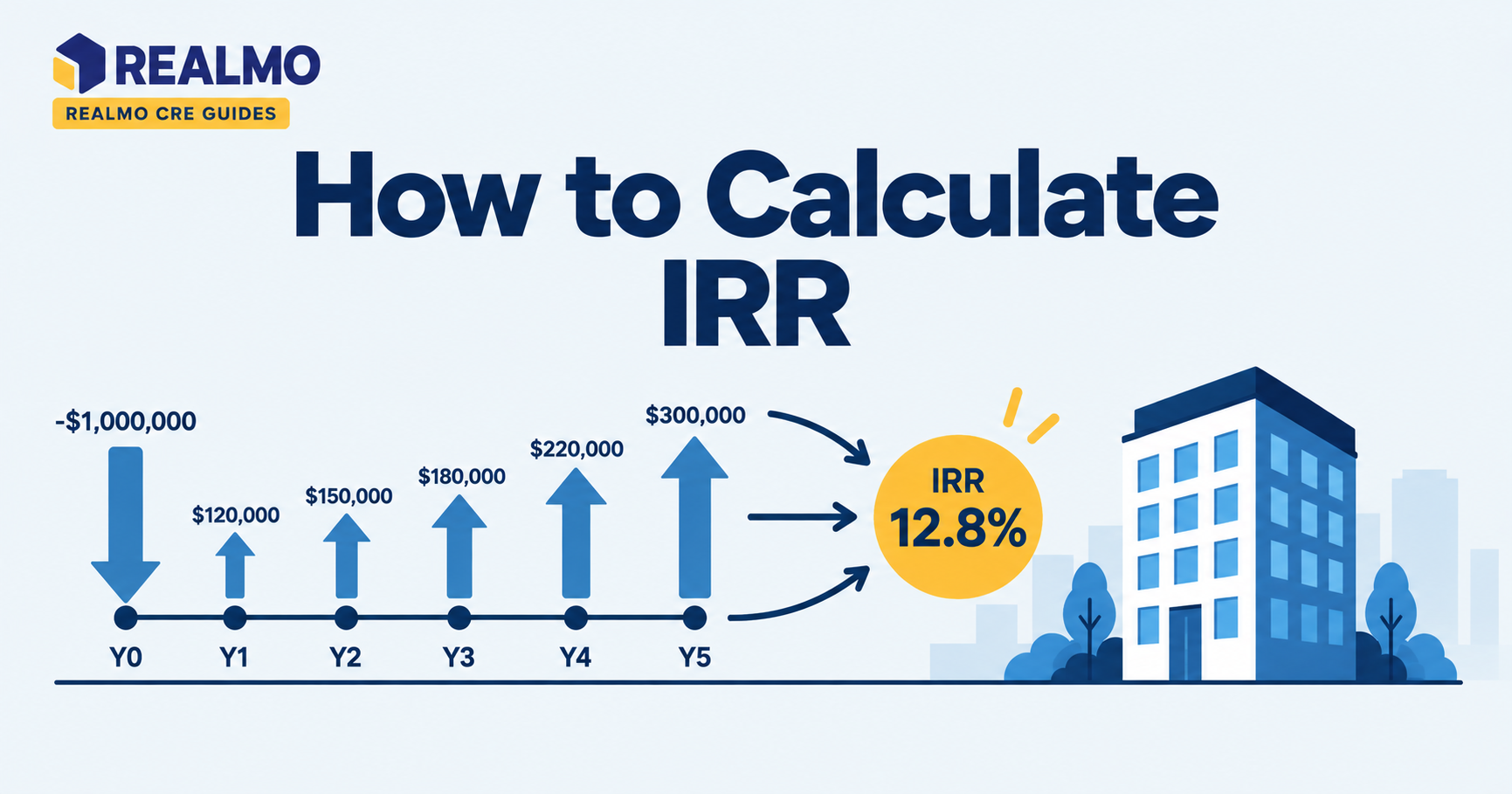
For those situations, investors use IRR, equity multiple, and debt service coverage ratio alongside a full cash flow model. Cap rate remains the fastest screen for stabilized income property and the common language of the market, it is a starting filter, not a verdict.
Common mistakes when calculating cap rate
- Using pro forma rents as if they were in-place. You capitalize income that does not exist yet and pay today for a lease-up you still have to execute and fund.
- Omitting a management fee on a self-managed property. Your labor is a real cost, and the next buyer will underwrite the fee, inflating NOI now creates a valuation gap at exit.
- Using the seller’s property tax line in a reassessment state. First-year taxes can jump on transfer, and the NOI you underwrote never materializes, which can strain a DSCR covenant.
- Comparing cap rates across markets without adjusting for expense conventions. Gross-lease and net-lease markets treat recoveries and expenses differently, so the raw percentages are not comparable.
- Treating cap rate as a return. It ignores financing, taxes, capital expenditures, and resale, so it cannot tell you what you will actually earn.
If you are screening a specific building, Realmo publishes estimated value, cap rate, and ownership records on 9M+ U.S. commercial properties, which gives you a second reference point before you accept the numbers in a marketing package.
Cap rate assumptions interact with property tax appeals, depreciation, and entity-level tax treatment. Confirm any valuation or tax conclusion with a licensed appraiser, CPA, or attorney before acting.
Related terms
- Net Operating Income (NOI)
- Effective Gross Income
- Cash-on-Cash Return
- Debt Service Coverage Ratio (DSCR)
- Exit Cap Rate
- Triple Net Lease (NNN)
- Discounted Cash Flow Analysis
FAQ
There is no universal threshold. A good cap rate is one that compensates you for the risk of that specific income stream. Relative to alternatives in the same market and property type. A lower cap rate on a long-term credit-tenant lease and a higher one on a vacancy-prone multi-tenant building can be equally rational prices.
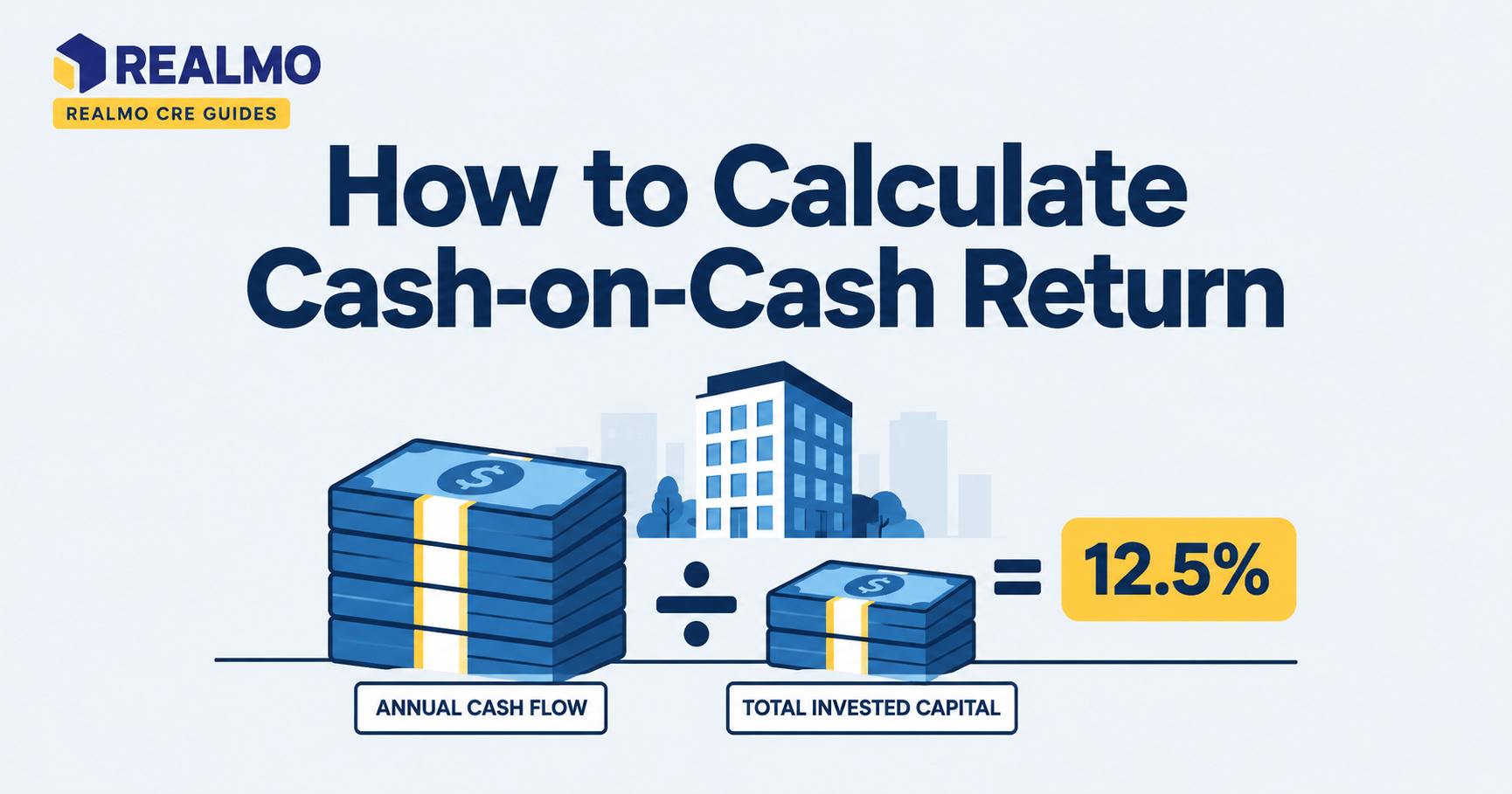
No. Cap rate is unlevered, so debt service is excluded from NOI. This keeps the measure comparable across buyers with different loans. To see the effect of financing on your position, calculate cash-on-cash return, which divides pre-tax cash flow after debt service by the equity invested.
Standard NOI excludes capital expenditures because they are irregular and would distort year-to-year comparability. Most underwriters instead deduct an annual replacement reserve as a proxy, then model actual capital spending separately in a cash flow projection. Ignoring both understates the true cost of ownership.
Impute a market rent for the space the owner occupies. Then build NOI as if the space were leased to a third party at that rate, including a management fee. Without a market rent assumption, the property shows no income and the cap rate is meaningless to a buyer.
Yes, rearranging the formula gives Value = NOI ÷ Cap Rate. This is the direct capitalization method used in the income approach to appraisal. The result is only as reliable as the market cap rate you apply, which should come from recent comparable sales of similar assets.