Valuing a Property With a Below-Market Lease
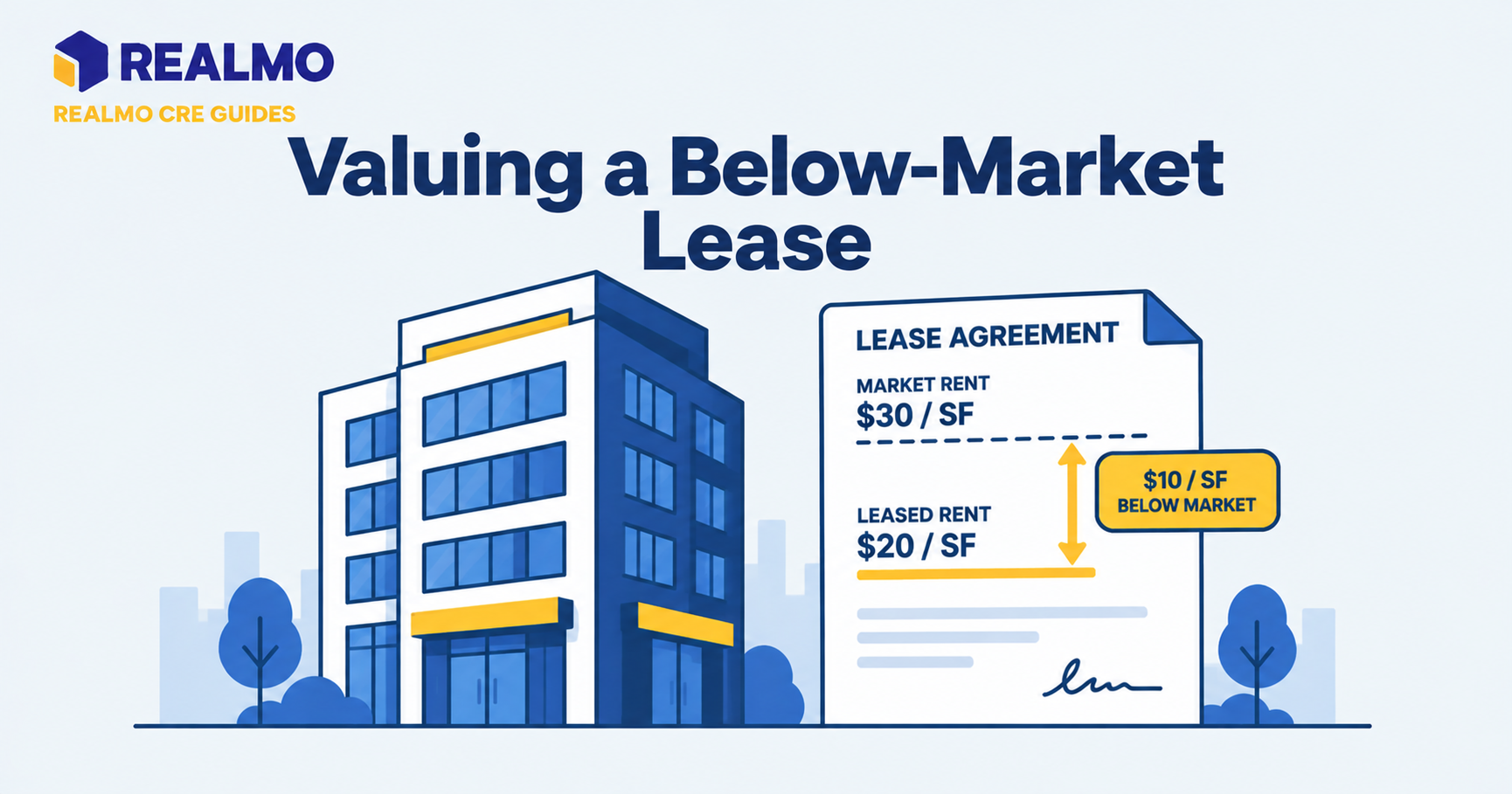
Below-market lease valuation prices a property whose in-place rent sits under market rent for comparable space. The buyer values the leased fee interest rather than fee simple. The rent shortfall is discounted over the remaining term instead of treated as permanent.
Why the rent gap decides your bid
An investor tours a 20,000-square-foot flex building leased to a machine shop that signed eight years ago and has five years left. Asking prices in the submarket imply strong pricing, but the in-place rent is a third under what comparable space leases for today. Two bids will come in far apart. One buyer caps the contract rent and lands low enough to lose the deal. Another values the building as if it were vacant and re-leased tomorrow, then bids a number the cash flow cannot service for five years. The correct price sits between them, and the distance between the two errors on this building runs past $1 million. Using the right method can separate a defensible bid from two costly errors. One is overpaying for patience; the other is missing embedded upside.
What makes a lease below market
A lease is below market when the buyer’s contract rent is less than current rent for comparable space. The comparison must use the same terms. Comparison has to be apples to apples. A $14 gross rent and a $14 triple-net rent are different economics, so convert everything to a net effective basis before calling anything a bargain.
Three adjustments matter most: the expense structure, contractual escalations, and concessions embedded in current market deals. A lease that looks 20% below market on face rent may be closer after free rent and TI are removed from today’s comps. Contractual annual bumps can narrow the remaining gap further. Flat rent in an inflationary period widens the gap every year; 3% annual escalations narrow it.
Establishing market rent is comp work, not intuition. Pull recent signed leases in the same product type, size band, and submarket, then adjust for ceiling height, loading, parking, and build-out. Realmo’s property analytics, including current and suggested use plus location insights, help frame the comparable set before you commission a formal rent study.
Why leased fee value sits below fee simple value
Buying a leased building means buying a leased fee interest. You receive contract rent for the remaining term plus the right to whatever the property produces afterward. Fee simple value assumes the space is available at market rent today. When contract rent is below market, leased fee value falls below fee simple value. The difference roughly equals the present value of forgone rent during the remaining term.
The reverse holds too. A lease above market produces leased fee value above fee simple value, discounted for the risk that the tenant defaults or vacates. Both cases push against the reflex to apply one cap rate to whatever income appears on the rent roll.
Three below market lease valuation methods buyers use
Direct capitalization of in-place net operating income is the fastest approach and the least accurate here. Capping contract NOI at a market cap rate treats a temporary shortfall as permanent. It only holds up when the lease is very long or when fixed-rent renewal options extend the gap far enough that the difference stops mattering.
The rent-loss deduction is the cleanest method for a short remaining term. Value the property at market rent using direct capitalization, then subtract the present value of the annual rent shortfall over the years until rollover. Discount the shortfall at a rate that reflects the tenant’s credit. This is because a shortfall from an investment-grade tenant is a near-certain cash flow while one from a thin private company is not.
A discounted cash flow analysis is the most defensible method and the standard in institutional underwriting. Model contract rent through expiration, then step the space to market. Include downtime, TI, leasing commissions, and a residual value based on stabilized NOI. The DCF handles staggered expirations in multi-tenant buildings, which the deduction method does not.
How lease terms change the size of the discount
Remaining term drives the discount more than the size of the gap. A 40% shortfall with 18 months left is a rounding error; a 15% shortfall with 12 years left is a repricing event. Escalation structure, expense recovery, and any landlord obligations funded out of that below-market rent all move the number.
Some terms can block upside independently of rent. Examples include fixed-price purchase options, rights of first refusal, expansion rights, and sublease clauses that let tenants capture the spread. Read the recapture language. Some leases allow the landlord to take the space back if the tenant tries to sublease at a profit. This converts the tenant’s arbitrage into the owner’s.
Purchase price allocation is a related consequence. Under ASC 805, the U.S. acquisition accounting standard, a below-market acquired lease is recorded as an intangible liability. It is amortized as higher rental revenue over the term, including bargain renewal periods. Confirm treatment and any tax consequences with a licensed CPA before closing.
Why renewal options can lock in the rent gap
Renewal options are one-sided. A tenant exercises when the option rent beats the market and walks when it does not. A fixed-rate option should be underwritten as if it will be exercised whenever it stays below market. A five-year lease with two fixed five-year options is a 15-year rent gap in the tenant-favorable case.
Options priced at fair market rent are far less damaging, but the definition controls the outcome. Language pegging renewal to 95% of market, excluding concessions from the calculation, or resolving disputes through appraisal arbitration all shift value. Value the property under the exercise scenario, not the expiration scenario, and treat the difference as the price of the option.
Worked example: a five-year gap on a flex building
All figures below are illustrative and rounded for clarity.
A 20,000-square-foot single-tenant flex building leases at $12.00 per square foot triple net, producing $240,000 of NOI. Market rent for comparable space is $18.00, or $360,000. Five years remain, with no renewal options and no escalations.
At an illustrative 7% cap rate, value at market rent is $360,000 ÷ 0.07, or about $5.14 million. The annual shortfall is $120,000. Discounted at an illustrative 8% over five years, the present value of that shortfall is roughly $479,000. Leased fee value is about $4.66 million.
Interpretation matters more than the arithmetic. That $4.66 million price implies a going-in cap rate of 5.15% on in-place NOI. This is why below-market deals look expensive on year-one yield and reasonable on stabilized yield. Capping $240,000 at 7% gives a naive value of $3.43 million. It understates value by more than $1.2 million because it treats a five-year gap as permanent.
The common error at this step is double-counting. Rollover downtime, tenant improvements, and commissions belong in the model, but they would be incurred at expiration whether or not the lease was below market. Deduct them once, in the DCF or as a separate reserve, not inside the rent-loss calculation.
Mistakes that distort a below-market lease price
- Capping contract NOI at a market cap rate. Treats a finite shortfall as perpetual and produces a bid that loses competitive deals outright.
- Comparing face rents across different expense structures. A gross lease measured against net comps can manufacture a gap that does not exist, leading to overpayment for phantom upside.
- Ignoring fixed-rate renewal options. Underwriting to expiration when the tenant holds bargain options can extend the gap a decade past the modeled date.
- Using the same discount rate regardless of tenant credit. A shortfall from a weak tenant is not a certain cash flow, and pricing it as one overstates the deduction’s reliability.
- Assuming the tenant will vacate on schedule. Holdover, negotiated extensions, and blend-and-extend deals frequently push the mark-to-market date later than the model assumes.
Frequently asked questions
Does a below-market lease always lower a property’s value?
It lowers value relative to the same building leased at market, but not relative to a vacant building. A below-market lease still delivers occupancy, expense recovery, and credit. Compare it against the realistic alternative, which usually includes months of downtime and substantial leasing costs.
How do you estimate market rent for this analysis?
Use recently signed leases for comparable product type, size, and submarket, adjusted to a net effective basis after free rent and improvement allowances. Asking rents overstate achievable rent. Many buyers commission a third-party rent study when the gap drives a meaningful share of value.
Can a buyer pay a tenant to terminate a below-market lease?
Buyouts happen and are priced against the value the tenant gives up. The economics work when the present value of the rent gap plus faster access to market rent exceeds the buyout, downtime, and re-leasing cost. Tenants with relocation constraints price their leasehold aggressively.
Does a below-market lease affect financing?
Lenders size loans from in-place NOI. Lower contract rent constrains debt service coverage and proceeds even when the appraisal reflects future upside. Buyers frequently bridge the gap with additional equity or shorter-term debt sized to a refinance after rollover.
Related terms
- Leased fee interest
- Mark-to-market rent
- Net effective rent
- Discounted cash flow analysis
- Tenant improvement allowance
- Lease renewal option
- Direct capitalization