Terminal Value and Reversion in a Real Estate DCF
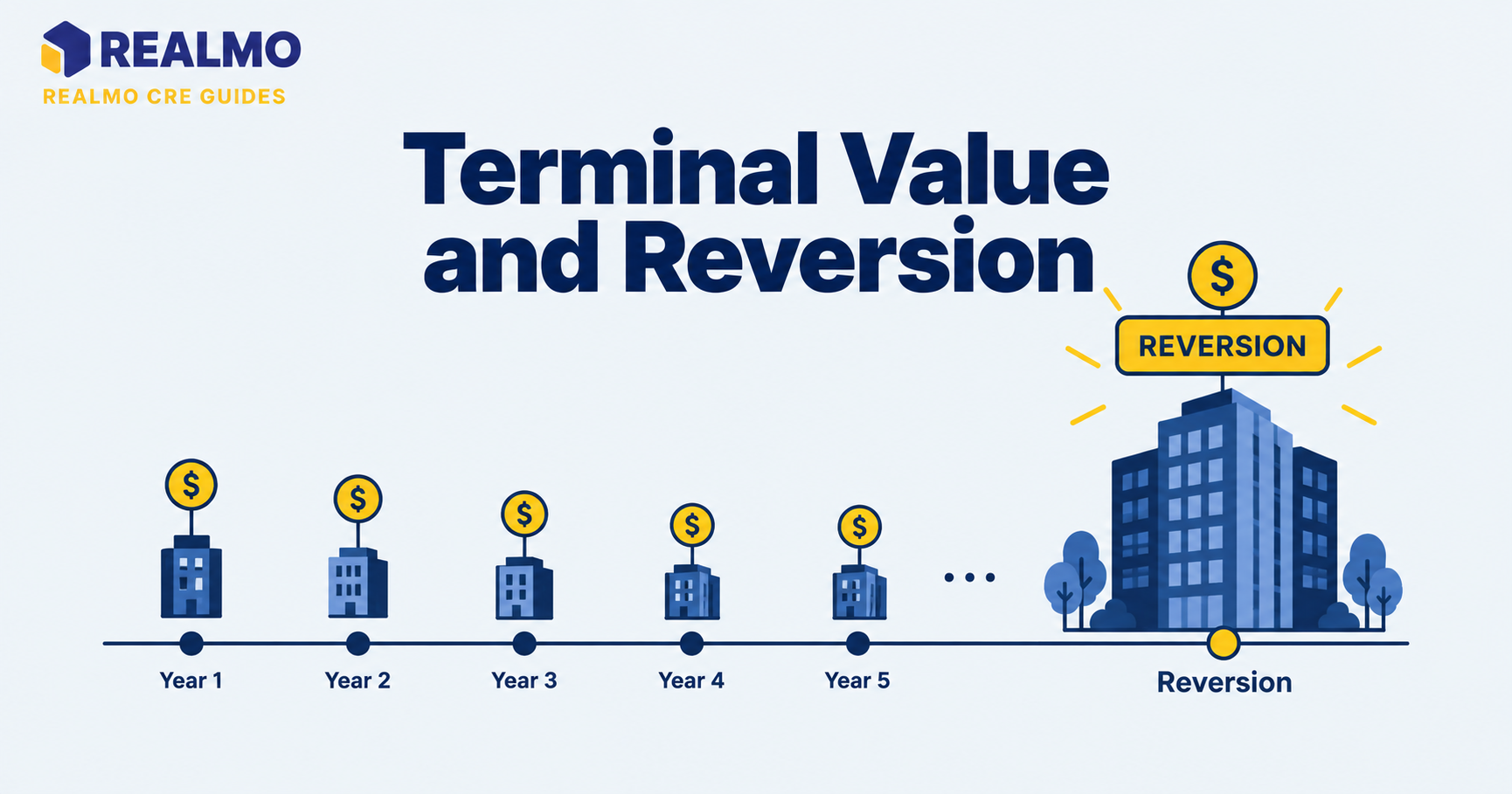
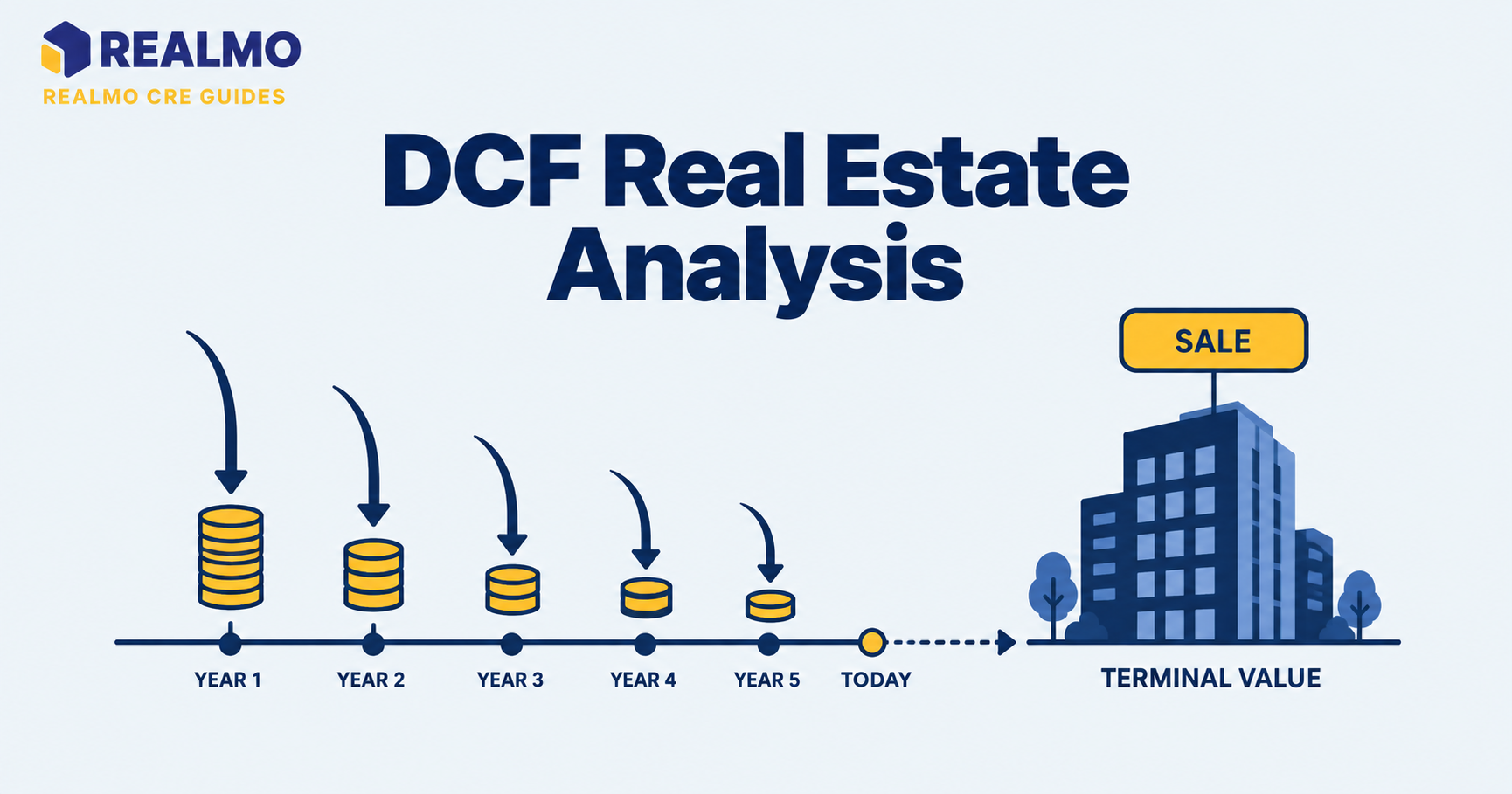
Terminal value in real estate is the estimated worth of a property at the end of a DCF hold period. Capitalized from the following year’s net operating income. Reversion is that value after selling costs and loan repayment. The cash an owner actually collects at exit, discounted back to today alongside the annual cash flows.
Why one assumption decides your whole underwriting
An investor models a five-year hold on a single-tenant industrial building. Rent steps, a mid-term roof replacement, and a leasing commission in year four all get careful attention, each one debated line by line. Then the exit cap rate gets typed in at the same number as the going-in cap. This is because that felt neutral, and the model returns an IRR that clears the target.
That single cell usually carries more of the answer than every operating assumption combined. In a typical five- to ten-year hold, the discounted reversion accounts for the majority of total present value. Move the exit cap rate by a quarter point and the IRR moves more than a full year of rent growth would. An investor who stress-tests operations but treats terminal value as a formality has audited the small half of the model.
What terminal value measures at the end of a hold
Terminal value stands in for everything that happens after the model stops. A property does not expire in year five; a buyer at that point is purchasing the next decades of cash flow. Rather than forecasting forty years of leases, discounted cash flow analysis truncates the projection and replaces the remaining life with one lump sum at the horizon.
Because that sum represents future income, it must be capitalized from forward-looking income, not from the last year modeled. A buyer in year five underwrites year six. Using year five net operating income understates value by a full year of growth and is one of the most common errors in analyst-built models.
Direct capitalization vs. perpetuity growth
Two methods dominate. Direct capitalization divides the first forecast year beyond the hold by an exit cap rate:
Terminal Value = NOI (Year N+1) ÷ Exit Cap Rate
This is standard in commercial real estate because it mirrors how the asset will actually trade. Buyers quote cap rates, brokers market on cap rates, and appraisers reconcile to them.
The perpetuity growth method, borrowed from corporate finance, divides forward cash flow by the discount rate minus a long-run growth rate:
Terminal Value = CF (Year N+1) ÷ (r − g)
The two are algebraically linked: the implied cap rate equals r minus g. The perpetuity form appears in ground lease analysis, long-dated net lease work, and academic valuation, but it is fragile. Small changes in g swing the result violently, and real estate has no equivalent of a stable corporate growth rate. Direct capitalization keeps the assumption in a unit the market can check.
How to choose the exit cap rate you underwrite to
The exit cap rate reflects what a buyer will pay for a five-years-older asset with a shorter weighted average lease term. A common underwriting convention is to expand the going-in cap rate by roughly 25 to 50 basis points per five years of hold, on the reasoning that physical depreciation and lease rollover risk accumulate. That convention is a discipline, not a forecast. It forces the model to earn its return from operations instead of from assumed pricing improvement.
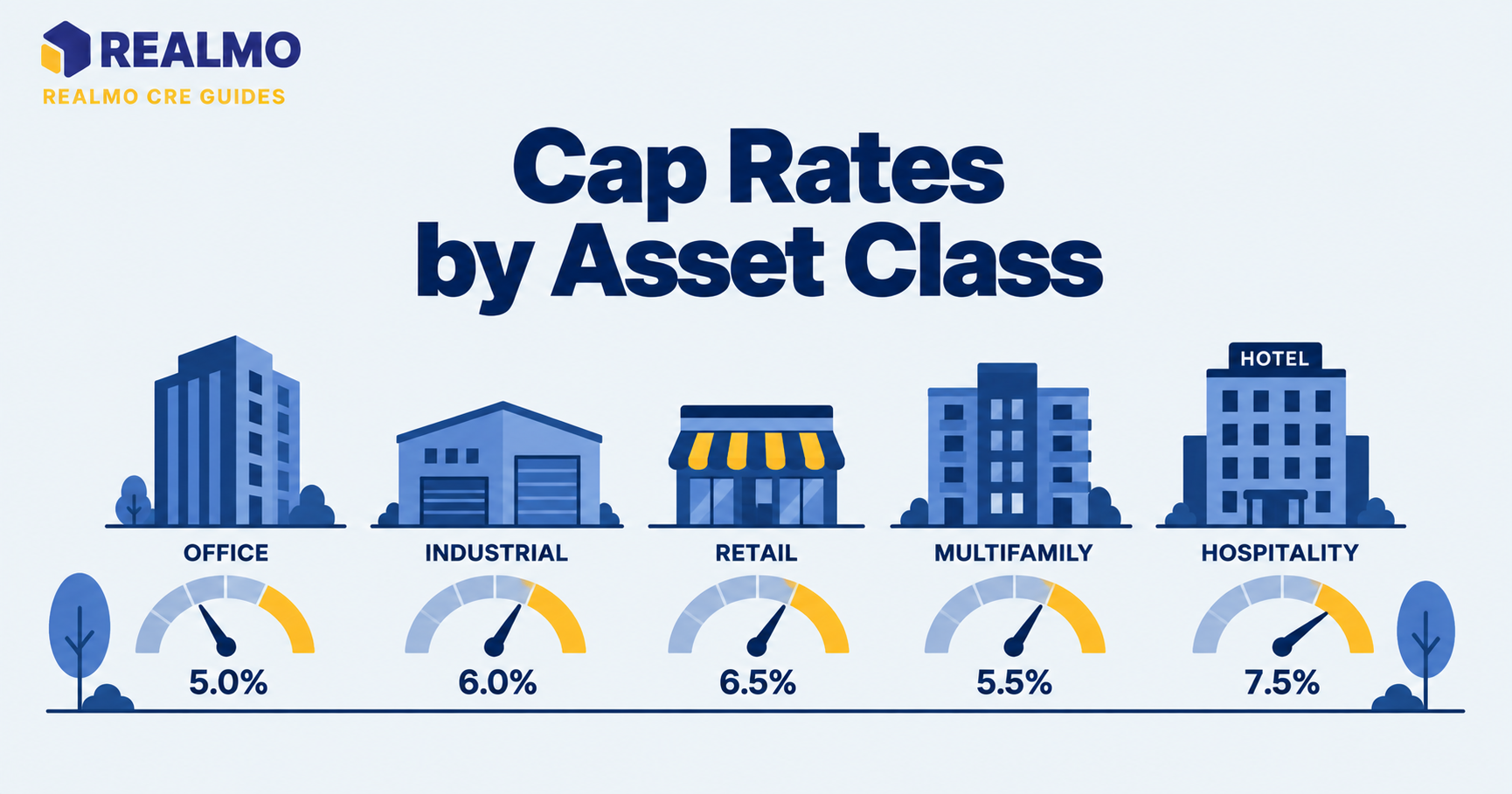
Three adjustments matter more than the convention. Assets whose capital needs arrive after the hold period deserve wider expansion, since the buyer prices that spending. Assets rolling into a longer, stronger lease structure may justify compression, because credit and duration are what compress cap rates in the first place. And property type matters: sector spreads persist for structural reasons, so a stabilized asset with long leases and investment-grade credit exits tighter than one with annual rollover in the same submarket.
Ground your assumption in observed pricing rather than instinct. Ownership records, sale history, and cap rate estimates across Realmo’s coverage of 9M+ properties let you check. What comparable assets in the submarket actually traded at before committing to a number.
From gross terminal value to net reversion
Terminal value is a headline price. Reversion is what reaches the owner. Subtract, in order: disposition costs, then debt.
Disposition costs include the brokerage fee, transfer and recording taxes where applicable, legal and title work, and any escrow holdback. Underwriters carry a combined figure of one to three percent of sale price. Varying widely by state transfer tax regime and deal size. Debt repayment covers the outstanding loan balance plus any prepayment penalty, yield maintenance (a make-whole penalty), or defeasance (collateral substitution) cost. This on a fixed-rate loan sold before maturity can be substantial.
The result is net sale proceeds. Discount it at the same rate applied to operating cash flows for unlevered analysis, or at the levered discount rate when the reversion is already net of the loan payoff. Mixing the two is how models quietly double-count debt.
Worked example: reversion on a five-year hold
Illustrative figures, rounded for clarity.
A retail building is acquired for $15,000,000. Year five NOI is projected at $1,020,000, growing 3% to $1,050,600 in year six. The underwriter sets the exit cap rate at 6.50% and the unlevered discount rate at 8.00%. Selling costs run 2.0%, and the loan balance at exit is $9,000,000.
Gross terminal value is $1,050,600 ÷ 0.065 = $16,163,077. Selling costs of 2.0% take $323,262, leaving unlevered net sale proceeds of $15,839,815. Discounted five years at 8.00% (divide by 1.4693), the present value of the reversion is $10,780,000. Levered proceeds to equity are $15,839,815 less the $9,000,000 payoff, or $6,839,815.
Read it this way: if the discounted operating cash flows contribute roughly $3.5 million of present value, the reversion supplies about three-quarters of the total. The return is a sale story, not an operations story, and the model should be labeled as such.
The frequent error appears if you capitalize year five NOI instead of year six. That produces $15,692,308 in gross terminal value, understating the exit by roughly $471,000 before costs, and it compounds through every sensitivity you run.
Why terminal value dominates real estate DCF results
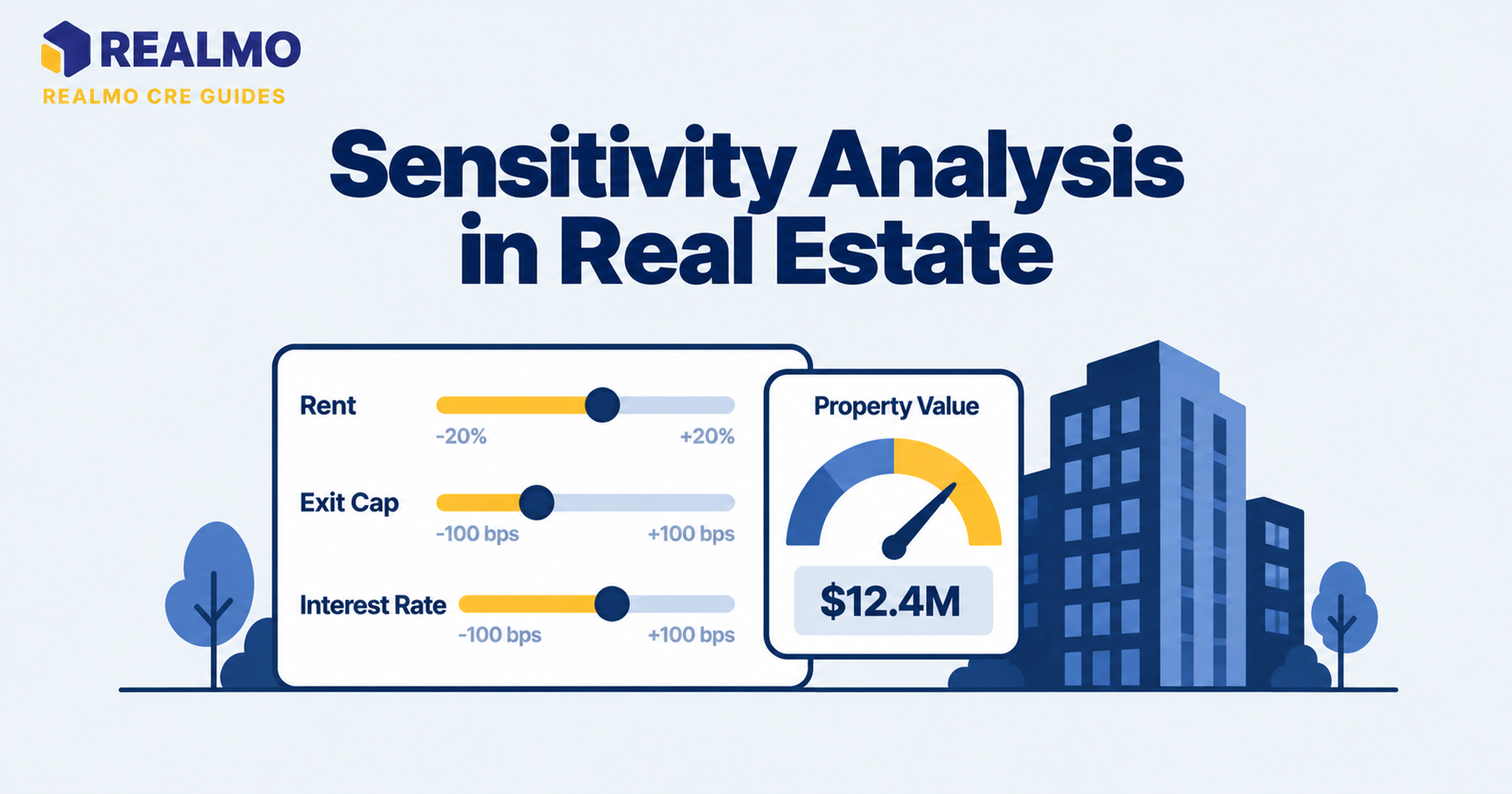
Run a two-way sensitivity analysis on exit cap rate against hold period before you run one on rent growth. Shorter holds concentrate more value in reversion, because fewer years of operating cash flow have accumulated to dilute it. Longer holds reduce the terminal share but extend forecast risk into years no one can see.
Present the internal rate of return as a range across exit cap scenarios rather than a point estimate. A deal that clears its hurdle only at a compressed exit is not an underwriting outcome; it is a bet on pricing.
Common mistakes in terminal value assumptions
- Capitalizing trailing instead of forward NOI. Systematically understates the exit and makes marginal deals look worse than they are, or hides the error inside an offsetting optimistic cap rate.
- Setting the exit cap equal to the going-in cap without a stated reason. Reads as neutral, but embeds an assumption that five years of age and rollover cost nothing.
- Leaving capital expenditure out of the year N+1 NOI. A buyer underwrites reserves, downtime, and rollover. Capitalizing an unburdened NOI produces a price no buyer will pay.
- Ignoring defeasance or yield maintenance. On fixed-rate debt sold mid-term, the prepayment cost can consume a meaningful share of equity proceeds and never appears in the gross terminal value line.
- Discounting levered reversion at the unlevered rate. Inflates equity present value and misstates the risk actually being taken.
Related terms
- Discounted cash flow analysis
- Exit cap rate
- Going-in cap rate
- Net operating income
- Internal rate of return
- Equity multiple
- Hold period
- Disposition costs
FAQ
What is terminal value in a real estate DCF?
It is the estimated sale price of the property at the end of the modeled hold period. Calculated by dividing the next year’s projected NOI by an assumed exit cap rate. It substitutes for all cash flow beyond the forecast horizon so the model does not need to project decades of leases.
What is the difference between terminal value and reversion?
Terminal value is the gross property value at exit. Reversion is the net proceeds after selling costs and, in levered analysis, repayment of outstanding debt including any prepayment penalty. Reversion is the figure discounted back and added to the operating cash flows.
Should the exit cap rate be higher than the going-in cap rate?
Most underwriters expand it, reflecting an older asset with more accumulated rollover and capital need. Expansion is a conservatism convention rather than a market prediction. Assets exiting into longer leases with stronger tenant credit can justify a flat or tighter exit, provided the reasoning is documented.
Which NOI year do I capitalize for terminal value?
The first year after the hold ends. For a five-year hold, capitalize year six NOI. A buyer at that moment is pricing forward income, so using year five NOI understates the exit by a full year of growth.