Choosing a Hold Period in Real Estate
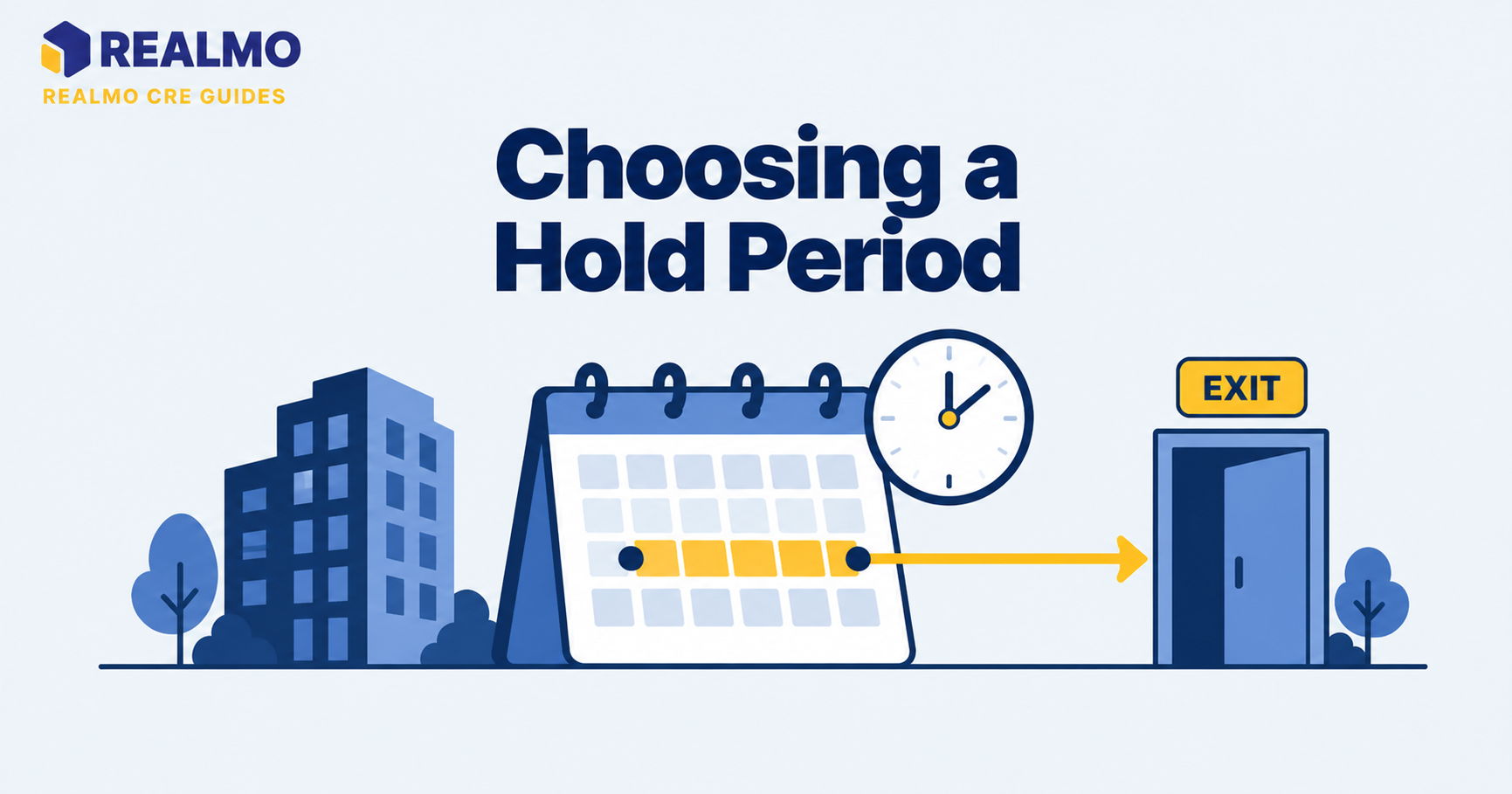
A hold period in real estate is the span of time an investor owns a property between closing and disposition. Choosing one means fixing a target exit window before you buy, then testing it against the business plan, the loan maturity, and the tax cost of selling , rather than defaulting to five years because the model has five columns.
Why the Exit Date Belongs in the Underwriting
An investor buys a 40,000-square-foot flex building with two tenants rolling in year three. The plan is to re-lease at market, stabilize, and sell. The debt is a five-year loan with a prepayment penalty through year four. That combination has already written the hold period: renewals land in year three, stabilization takes twelve months, and the penalty burns off just as the asset is showing clean trailing income. Selling in year two means paying to break the loan and marketing a property with unresolved rollover. Holding to year eight means refinancing into whatever rate environment exists then.
The hold period is not a preference stated at the end of a deal memo. It is the variable that determines which exit cap rate assumption you are exposed to, how much capital sits idle, and whether returns are measured on speed or on total dollars.
What the Business Plan Sets as a Floor
Every strategy carries a minimum time to execute. Core assets that are already leased to credit tenants on long terms have no repositioning to complete, so the hold length is driven by fund life or estate planning rather than by property work. Value-add strategies need enough runway to complete capital projects, backfill vacancy, and produce twelve months of stabilized operating history that a buyer’s lender will underwrite , a sale before that history exists forces the buyer to underwrite pro forma income, and they will discount it.
Ground-up development adds entitlement and construction time before the leasing clock even starts. The floor is mechanical: count the months to finish the work, add the lease-up period. Add a year of trailing performance, add six months to market and close. Anything shorter is a bet that a buyer will pay you for work you have not finished.
Debt Terms That Force an Exit Date
Loan structure frequently overrides intent. A maturity date is a hard deadline: at that point the borrower sells, refinances, or defaults. Prepayment structures set the earliest sensible exit , yield maintenance and defeasance on fixed-rate commercial mortgage-backed securities (CMBS) debt can make an early sale expensive enough to erase the gain that motivated it, while bridge loans commonly price prepayment more loosely because they expect an early takeout.
Interest-only periods matter too. Cash flow drops when amortization begins, which changes both debt service coverage and the cash-on-cash return a buyer sees. Aligning the target exit with the end of the loan term, but before maturity pressure becomes visible to the market, keeps you from negotiating as a forced seller.
Hold Period Real Estate Returns: IRR vs. Multiple
Time works in opposite directions on the two headline metrics. Internal rate of return is time-weighted, so it rewards getting capital back quickly and decays as the same profit is spread over more years. Equity multiple is not time-sensitive at all; it simply totals the dollars returned per dollar invested and rises for as long as the asset produces distributions.
A short hold can post a high IRR and a mediocre multiple. A long hold can do the reverse. Neither number is the right one on its own, which is why an investor with a stated preference , a fund promoting on IRR hurdles, or a family office compounding without pressure to recycle capital , will pick a different hold period from the same set of cash flows.
The Tax Consequences of the Exit Year
Selling triggers capital gains treatment on appreciation and depreciation recapture on the deductions taken during ownership. Because commercial buildings depreciate over 39 years and residential rental over 27.5 under the Modified Accelerated Cost Recovery System (MACRS), recapture exposure grows the longer you hold, even as the asset’s cash flow improves. A 1031 exchange, permitted under Internal Revenue Code Section 1031, can defer both, but it imposes its own timeline: 45 days to identify replacement property and 180 days to close, which means the next acquisition has to be sourceable in the market conditions that exist at your exit.
Refinancing instead of selling pulls capital out without triggering the tax event, at the cost of higher leverage and a new maturity date. That trade-off , refinance or sell , is usually the real decision behind an extended hold. Tax outcomes vary by entity structure and state; confirm the treatment of any exit with a licensed CPA or tax attorney before acting.
Reading the Cycle Without Trying to Time It
Cap rates move with capital costs and with the risk premium buyers demand, and neither can be forecast with confidence at acquisition. The practical response is to widen the exit assumption rather than sharpen it. Underwrite an exit cap rate above your going-in cap rate. Then check whether the deal still clears its hurdle if the exit slips two years past plan.
Longer holds reduce the weight of any single pricing moment because more of the return comes from operations rather than from the sale. Short holds concentrate the outcome in one transaction. This raises the value of flexibility, an assumable loan, a partner without a fixed liquidity date, or an asset with multiple buyer pools. Comparable sales and ownership history for a submarket are visible on Realmo without a subscription. This is useful when you are testing how assets like yours actually trade.
Worked Example: Five-Year vs. Ten-Year Hold
All figures below are illustrative and rounded to show the mechanics, not to represent current pricing.
- Purchase price: $10,000,000; equity $3,500,000; interest-only debt $6,500,000
- Annual debt service: $390,000
- Year 1 NOI $600,000, rising to $780,000 by year 5 after re-leasing
- Exit at the same cap rate used at purchase; selling costs of 2%
Five-year hold. Cash flow after debt service runs $210,000, $250,000, $360,000, $375,000, and $390,000. A year-five sale at $13,000,000 nets $12,740,000, leaving $6,240,000 of equity after loan repayment. Total distributions of roughly $7,825,000 on $3,500,000 produce a 2.24x multiple and an IRR near 19%.
Ten-year hold. Assume NOI grows modestly through year 10 to about $861,000 and the exit price rises accordingly to roughly $14,350,000. Cumulative distributions plus sale proceeds total about $11,337,000, a 3.24x multiple, but an IRR closer to 15.5%.
The longer hold returns $3.5 million more in absolute dollars and a lower annualized return. Interpreting this correctly requires knowing what the freed capital would earn in the five years between the two exits, net of transaction costs and taxes. The frequent error is comparing the IRRs alone and treating the shorter hold as better, when the re-deployment it assumes has not been underwritten.
Common Mistakes When Setting a Hold Period
- Choosing five years by habit. A default timeline embeds an exit assumption no one examined, and the model’s precision hides that the date was never tested against the loan or the rent roll.
- Ignoring prepayment structure until the offer arrives. Defeasance costs can consume the premium a buyer is offering, turning an attractive early exit into a lateral move.
- Underwriting an exit cap rate equal to the going-in rate. The asset is older at sale, and pricing may not cooperate; a compressed exit assumption manufactures returns on paper.
- Planning a 1031 exchange without a replacement pipeline. The 45-day identification window does not pause for a thin market, and a failed exchange leaves the full tax bill due.
- Treating a partnership’s liquidity date as flexible. Operating agreements set the outer bound of the hold period regardless of what the property would justify.
Related Terms
Exit cap rate · Internal rate of return (IRR) · Equity multiple · Depreciation recapture · 1031 exchange · Debt service coverage ratio · Value-add real estate strategy
FAQ
What is a typical hold period for commercial real estate?
Does a longer hold period always mean lower returns?
No. A longer hold usually lowers IRR, because the same profit is annualized over more years, while raising the equity multiple as distributions accumulate. Which outcome is preferable depends on whether the capital has a better use elsewhere after tax and transaction costs.
Does a longer hold period always mean lower returns?
Should hold period be decided before or after acquisition?
Before. The exit assumption drives the loan structure, the capital budget, and the partnership terms you negotiate at closing. Revisiting it later is normal; discovering it for the first time at year four is what creates forced sales.
Can I sell before my loan term ends?
but the prepayment provision determines the cost. Yield maintenance and defeasance are designed to make the lender whole and can be substantial in some rate environments; step-down penalties decline over time. Assumable loans allow a sale without prepayment if the buyer qualifies.
How does a 1031 exchange affect the hold period?
It extends the effective holding horizon by deferring tax across successive properties, but it compresses the transaction timeline. 45 days to identify replacements and 180 days to close. Investors planning an exchange begin sourcing replacement property before listing. Confirm eligibility with a qualified intermediary and tax advisor.
Should hold period be decided before or after acquisition?
Before. The exit assumption drives the loan structure, the capital budget, and the partnership terms you negotiate at closing. Revisiting it later is normal; discovering it for the first time at year four is what creates forced sales.