Opportunity Zone Investing Strategy
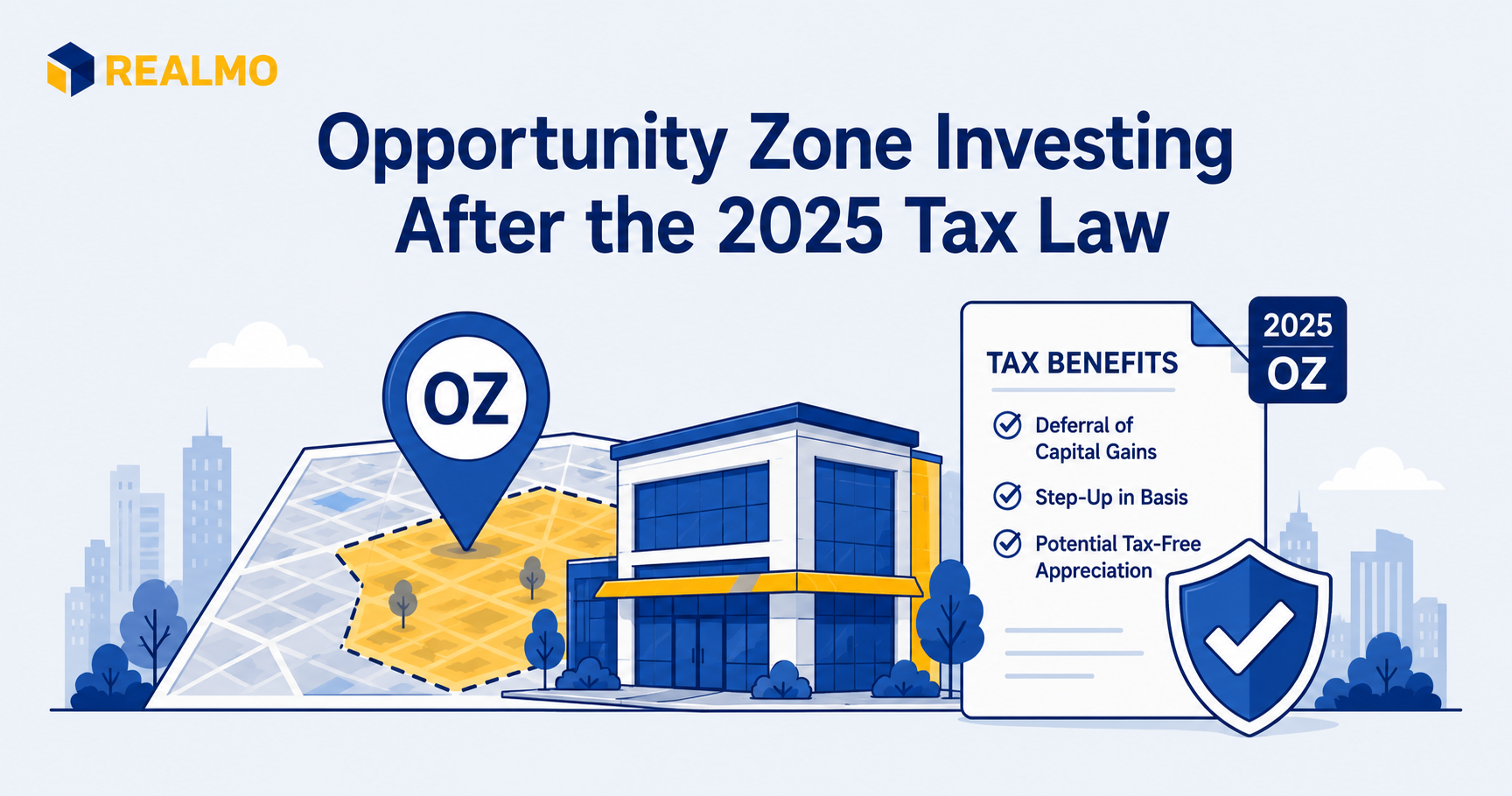
Opportunity zone investing is no longer a temporary tax idea with an expiration date. After the 2025 tax law, the opportunity zone program became a permanent part of the tax code, with new rules coming in 2027.
The incentive was created by the 2017 Tax Cuts and Jobs Act to spur economic development and job creation in distressed communities. For investors with realized capital gains, the appeal is pretty straightforward:
- Defer the original tax bill
- Reduce part of that gain
- Potentially pay zero federal capital gains tax on new appreciation after a 10-year hold
In this guide, we’ll break down how the benefits work, what changed under OZ 2.0, and how to think about timing your investment under the new rules.
How Opportunity Zone Investing Works: The Three Core Tax Benefits
Defer your capital gains
The first benefit is deferral. When you realize an eligible capital gain, you can reinvest that gain into a qualified opportunity fund, or QOF, and defer federal income tax on it. Eligible gains can come from many places:
- Selling stock
- Real estate
- Crypto
- A business
- Another appreciated asset
The IRS also includes qualified 1231 gains, which usually come from certain business property sales. Under the original OZ 1.0 rules, eligible gains generally had to be recognized before January 1, 2027, and invested into a QOF within the required window. Deferral gets you into the program, but it’s not the biggest prize.
Reduce the gain through a basis step-up
The second benefit is a partial reduction of the deferred gain. Under the original opportunity zone rules, investors who held a QOF investment for at least five years received a basis step-up. This basis increase reduced the gain they eventually had to recognize.
The old version also included a larger reduction for a seven-year hold, but that timing has mostly aged out for new investors under OZ 1.0. This is also one of the areas OBBBA changed for OZ 2.0: the new version keeps a five-year step-up, but simplifies the percentage. More on that below.
The 10-year tax-free appreciation
The 10-year benefit is the reason many investors look at opportunity zones in the first place. If the QOF investment is held for at least 10 years, the investor may be able to exclude the appreciation on that QOF investment when it’s sold or exchanged.
The mechanics are easiest to see in a simple example:
Say an investor sells stock, realizes a $500,000 capital gain, and rolls that gain into a qualified opportunity fund. The original gain is deferred, and later taxed under the applicable rules. But if the QOF investment itself grows from $500,000 to $900,000 and is held for at least 10 years, that $400,000 of appreciation may be excluded from federal capital gains tax. That’s the real engine of the opportunity zone tax benefit: creating a path to tax-free growth rather than just delaying tax.
What Changed Under the 2025 Tax Law: OZ 2.0
Permanent, with zones redrawn every 10 years
The One Big Beautiful Bill Act made the opportunity zone program permanent, and that’s the headline. OZ 2.0 creates a recurring system with census tracts reviewed and redrawn every 10 years instead of winding down after the original 2017-era incentive. New designations are expected to become effective on January 1, 2027.
The map also gets tighter. Under the new rules, the low-income community threshold is reduced from 80% to 70% of area or statewide median family income, and contiguous tracts are removed from eligibility. In other words, fewer areas should qualify, and the program is meant to aim more directly at lower-income communities. Existing OZ 1.0 zones remain valid through December 31, 2028, which creates a two-year overlap between the old map and the new OZ 2.0 map.
The new deferral and step-up rules from 2027
The old program used a fixed deferral deadline: deferred gains are generally recognized no later than December 31, 2026. OZ 2.0 changes the rhythm. For gains invested after December 31, 2026, the deferral becomes a rolling five-year period that starts when the investor makes the QOF investment.
The step-up also changes. Instead of the old five-year and seven-year tiers, the new standard rule gives investors a 10% basis step-up after five years. The 10-year tax-free appreciation benefit stays, but with a 30-year outer limit: basis is effectively frozen at fair market value at the 30-year mark.
OBBBA also adds new reporting requirements for QOFs, so fund transparency should become a bigger part of due diligence.
Keep in mind that there’s one important limit during the transition: gains triggered from old OZ 1.0 investments generally can’t simply be rolled into OZ 2.0 while preserving the old holding-period benefits.Gary Lubarsky, CEO of Realmo
A new incentive for rural investment
The standout sweetener in OZ 2.0 is the qualified rural opportunity fund, or QROF:
- A standard QOF gets a 10% basis step-up after five years under the new rules
- A QROF gets 30%, which is a much larger reduction of the deferred gain for investors willing to place capital into rural opportunity zone projects
There’s another rural-friendly change: the substantial-improvement threshold for certain rural property is cut from 100% to 50%. That’s a big one for real estate since it can make renovation or redevelopment deals easier to qualify. Unlike many OZ 2.0 changes that start in 2027, this 50% rural substantial-improvement rule took effect on July 4, 2025.
The Mechanics: How to Invest
The QOF, the 180-day window, and the 90% test
You don’t invest directly into an opportunity zone and automatically get the tax benefit. The investment flows through a qualified opportunity fund. A QOF is generally organized as a corporation or partnership for the purpose of investing in qualified opportunity zone property.
The timing is key here.
- Investors generally have 180 days from realizing an eligible gain to invest it into a QOF.
- The fund then has its own compliance job: it must hold at least 90% of its assets in qualified opportunity zone property. That property can include:
- qualified opportunity zone stock
- a qualified partnership interest
- qualified opportunity zone business property located in an opportunity zone
Active vs. passive, and who should invest
There are two common paths.
- Active investors may create their own QOF, usually as the general partner or sponsor behind a specific real estate or business deal. This route can make sense for investors with a larger gain, often around $250,000 or more, because legal, tax, accounting, and compliance costs add up quickly.
- Passive investors usually come in as limited partners in a third-party fund. Minimums vary, but many private funds start around $50,000 and are available only to accredited investors. Either way, this isn’t a short-hold strategy.
Opportunity zone investing fits high-net-worth investors who can handle illiquidity, fund risk, and a 10-year horizon without needing the money back early.
Timing Your Move: Invest in 2026 or Wait for 2027?
The 2025 law definitely made planning more interesting:
Under OZ 1.0, deferred gains come due on December 31, 2026, with the tax generally paid on the 2026 tax return filed in 2027. But the richer OZ 2.0 framework doesn’t begin until January 1, 2027. This creates an awkward 2026 decision window.
- Investing in 2026 may offer certainty because today’s zones are already known
- Waiting until 2027 may give access to the new rolling five-year deferral, the refreshed map, and the rural QROF rules
The catch is that the 2027 census tracts won’t be fully useful to investors until they’re certified. So there’s really no universal answer here. If you’re sitting on a meaningful gain, model the sale date, recognition date, fund options, and holding period with a tax advisor before making the move.
Conclusion
Opportunity zone investment still comes down to three tax benefits: defer the original capital gain, reduce part of that deferred gain, and potentially eliminate federal capital gains tax on QOF appreciation after a 10-year hold. The 2025 tax law made opportunity zone investing permanent, added a stronger rural incentive, and reset the rules for 2027. The next steps are to:
- Map the timing of your gain.
- Review eligible funds.
- Decide whether OZ 1.0 or OZ 2.0 gives you the better path.