Multifamily Real Estate Investing by State: Where to Buy Duplexes, Triplexes and Apartment Buildings in 2026
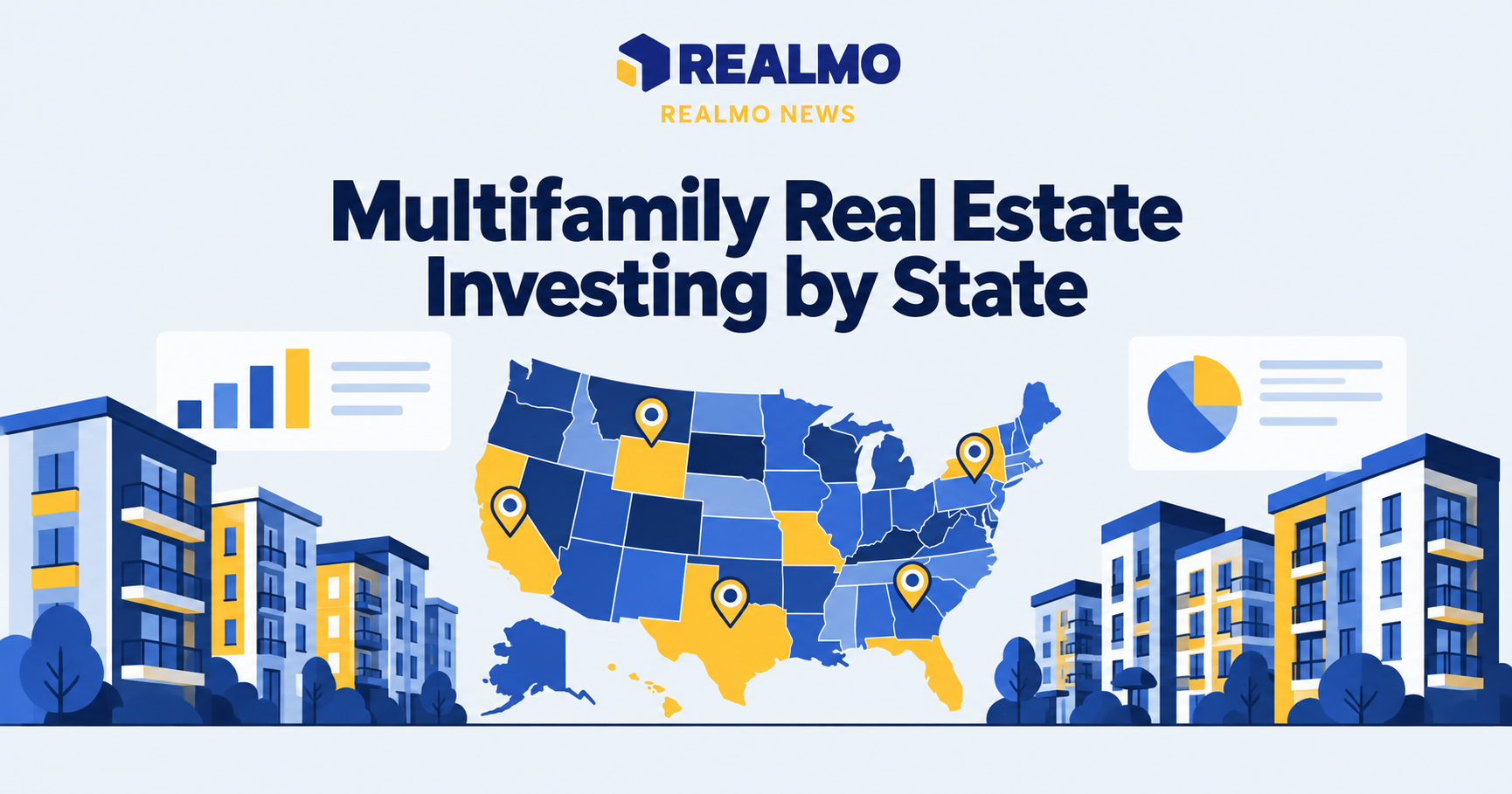
Realmo carried more than 86,000 active multifamily listings across all 50 states as of October 2026, with an average asking price of $957,485 and a range running from $30,000 to $125 million. You can see the full national picture on the U.S. multifamily properties page. The inventory covers four property types: duplexes, triplexes, quadplexes (fourplexes), and apartment buildings with five or more units.
Supply is concentrated. New York, California, Florida, Texas, and Pennsylvania together account for close to 40,000 of those listings, while states like North Dakota and Delaware have barely a hundred each. This guide covers how each property type works, how financing changes at the four-unit line, how to buy your first multifamily property, and which states are worth a closer look for multifamily real estate investing this year. There’s a full 50-state directory at the end, too.
What Counts as a Multifamily Property?
A multifamily property is a single building, or a single parcel, that contains two or more separate housing units, each with its own entrance, kitchen, and bathroom. The legal and financial dividing line sits at four units. Properties with two to four units are treated as residential real estate and can be bought with standard home loans, including FHA and conventional mortgages. Once a building reaches five units, it moves into commercial (or “multifamily”) lending, where the property’s income matters more than the buyer’s personal paycheck.
That one boundary shapes almost everything else: the down payment, the interest rate, the appraisal method, even who is likely to bid against you. A first-time buyer competes for duplexes. A syndicator with a 1031 exchange deadline competes for 24-unit buildings. Different game entirely.
Renters, for what it’s worth, are already mostly in this kind of housing. According to the 2023 American Housing Survey from the U.S. Census Bureau and HUD, 61.0% of renter households live in buildings with two or more apartments, and the median renter household income is $49,540.
Realmo groups all four property types under a single multifamily category, so the national multifamily listings page is the quickest way to compare them side by side before narrowing down by unit count or state.
Duplex (2 Units)
A duplex is a residential building with two separate dwelling units, either side by side or stacked one above the other. It’s the most common entry point into multifamily investing, and also the largest category on Realmo, where duplexes listed for sale across the U.S. averaged $598,663 as of October 2026.
Triplex (3 Units)
A triplex is a residential building with three separate units. It still qualifies for residential financing, but FHA applies an extra rental-income test to three- and four-unit buildings (covered below). The national triplex inventory on Realmo averaged $819,400 in October 2026.
Quadplex / Fourplex (4 Units)
A quadplex, also called a fourplex, is a residential building with four separate units, and it’s the largest property you can finance with a residential mortgage. That makes it a popular “maximum leverage” purchase for owner-occupants. Quadplexes on Realmo averaged $907,449 nationally as of October 2026.
Apartment Buildings (5+ Units)
An apartment building, in investment terms, is a residential property with five or more units, financed with commercial or agency multifamily loans and valued mostly on its net operating income. The apartment buildings category on Realmo averaged $2,193,932, with listings ranging from $34,900 to $86 million.
| Property type | Units | Typical financing | Who it suits | Average price on Realmo (Oct 2026) |
|---|---|---|---|---|
| Duplex | 2 | FHA, conventional (Fannie Mae / Freddie Mac), VA, DSCR | First-time buyers, house hackers | $598,663 |
| Triplex | 3 | FHA (with self-sufficiency test), conventional, DSCR | House hackers wanting more cash flow | $819,400 |
| Quadplex / fourplex | 4 | FHA (with self-sufficiency test), conventional, DSCR | Owner-occupants maximizing leverage, small investors | $907,449 |
| Apartment building | 5+ | Commercial bank, agency multifamily, bridge, DSCR | Experienced investors, 1031 exchange buyers | $2,193,932 |
| All multifamily | 2+ | Varies by unit count | All segments | $957,485 |
Duplex vs Triplex vs Quadplex: Which Is the Better Investment?
There’s no universally better choice. A duplex is usually easier to finance and manage, while a triplex or quadplex spreads vacancy risk across more units and generates more rent per dollar of land. Which multifamily investment wins depends on whether you plan to live in the property, how much cash you have, and how much of the work you’re willing to do yourself.
Cash Flow and Vacancy Risk
More units means more income streams, and that’s the core argument for going bigger. In a duplex, one vacancy wipes out half your rental income. In a quadplex where you rent all four units, one vacancy costs you 25%. That arithmetic is why many investors who start with a duplex end up wanting a fourplex next.
Price per unit tends to drop as unit count rises, though it doesn’t always. On Realmo’s national averages for October 2026, a duplex works out to roughly $299,000 per unit, a triplex about $273,000, and a quadplex about $227,000. These are rough numbers, since the mix of markets differs by category, but the direction is consistent.
House Hacking
House hacking means buying a 2–4 unit property, living in one unit, and renting the others to cover some or all of the mortgage. It’s the reason “is a duplex a good investment” is such a common question. For an owner-occupant, a duplex often is a good investment, because the tenant’s rent offsets housing costs and the buyer gets access to low-down-payment residential loans.
The trade-off is lifestyle. You’re living next to your tenant, sometimes sharing a wall or a driveway. Some people love it; others find it wears thin after a year or two. Worth thinking about honestly before you make an offer.
Buying a Duplex: What First-Time Investors Should Check
Buying a duplex is mostly about two numbers: what the other unit actually rents for, and what your total monthly payment will be once taxes and insurance are added. Get the current lease and a rent estimate before you make an offer, rather than relying on the listing’s “potential rent” figure. Check whether the units have separate utility meters too. Shared meters mean you pay the bill, and that cost comes straight out of the rent you collect.
Management Burden
A duplex with one tenant is something most owners manage themselves. Three or four units start to look more like a small business: more turnover, more maintenance calls, more bookkeeping. Third-party property management typically costs a percentage of collected rent, and on a small building that fee can make or break the numbers.
Financing at the 2–4 Unit Line
Financing for a duplex, triplex, or quadplex is broadly similar, with one notable difference: FHA’s self-sufficiency test applies only to three- and four-unit properties, which can make a triplex or fourplex harder to qualify for than a duplex. Conventional loan limits also climb with unit count. The FHFA’s 2026 baseline conforming loan limits are $1,066,250 for two units, $1,288,800 for three, and $1,601,750 for four.
So, duplex vs triplex? If you’re a first-time buyer with limited reserves, the duplex is the safer starting point. If you can pass the FHA rental test or put down a conventional 5%, a triplex or quadplex usually produces stronger cash flow from day one. In the triplex vs duplex decision, the extra unit tends to matter more for income than for price.
How to Buy a Multifamily Property in 7 Steps
Buying a multifamily property follows the same basic path as buying a house, with three extra layers: you’re underwriting income, you’re inheriting tenants, and you’re often dealing with a more involved inspection. Here’s how it typically goes.
Step 1: Decide on Owner-Occupied or Investment Use
This single decision determines your loan options. Owner-occupied 2–4 unit buyers can use FHA and low-down-payment conventional loans. Pure investors generally need 15–25% down on conventional financing, or a DSCR or commercial loan.
Step 2: Financing a 2–4 Unit Property
FHA loans are the most accessible option for owner-occupants, and most FHA loan multifamily purchases are house hacks. According to HUD, FHA down payments can be as low as 3.5% and the program is available on 1–4 unit properties. The FHA Single Family Housing Policy Handbook requires at least one borrower to occupy the property as a principal residence, and for three- and four-unit properties the monthly payment (PITI) divided by the net self-sufficiency rental income may not exceed 100%. In plain terms, the building’s projected rents, after a vacancy and maintenance deduction, have to cover the full mortgage payment on their own.
FHA also caps loan size. HUD’s 2026 FHA loan limits run from $693,050 to $1,599,375 for two-unit properties, $837,700 to $1,933,200 for three units, and $1,041,125 to $2,402,625 for four units, depending on the county.
Conventional financing became far more competitive in late 2023. Fannie Mae raised its maximum loan-to-value ratio for 2–4 unit principal residences to 95% on November 18, 2023, which means 5% down, compared with 15% for two units and 25% for three or four units previously. The change excludes high-balance loans, cash-out refinances, and manually underwritten loans. Freddie Mac’s 2–4 unit mortgages cover owner-occupied primary residences, require a minimum 620 credit score in most cases, and let lenders count rental income from the other units toward qualifying income.
For non-owner-occupied purchases, DSCR (debt service coverage ratio) loans qualify the property rather than the borrower. The lender divides the property’s rental income by its debt payments and sets a minimum ratio. Rates are usually higher than conventional, but there’s no personal income verification, which helps self-employed investors and anyone scaling past a few properties.
Step 3: Calculate NOI and Cap Rate
Net operating income (NOI) is a property’s annual rental income minus operating expenses such as taxes, insurance, repairs, management, and utilities the owner pays. It excludes mortgage payments. The multifamily cap rate is NOI divided by the purchase price.
Quick example: a fourplex priced at $900,000 collects $96,000 a year in rent. After $36,000 in expenses, NOI is $60,000, and the cap rate is $60,000 ÷ $900,000, or about 6.7%. Then compare it to your financing cost: Freddie Mac’s 30-year fixed average was 7.03% in the week of September 24, 2026, so this deal would carry negative leverage at today’s rates, and cash flow will be thin unless rents rise. You can run these numbers, along with comparable sales and different scenarios, in the Cap Rate tool in Realmo’s Analytics Center.
Cash-on-cash return is the other number most small investors watch. It’s the annual pre-tax cash flow divided by the cash you actually put in, and it tells you more about your personal return than the cap rate does.
Step 4: Review the Rent Roll and Leases
The rent roll lists every unit, its current rent, lease dates, deposit, and any arrears. Ask for it early, and then ask for the leases themselves, because the two don’t always match. Check for below-market rents that can’t legally be raised quickly (this matters a lot in rent-regulated states), and for units the seller occupies or leaves vacant.
Step 5: Inspect the Property
Multifamily inspections should cover each unit plus shared systems: roof, foundation, electrical service, plumbing stacks, and separate or shared meters. Older two- and three-family homes in the Northeast and Midwest often have deferred maintenance that only shows up in the basement. A sewer scope is usually money well spent.
Step 6: Verify Local Rules
Check landlord-tenant law, rent increase limits, rental registration or licensing requirements, and the property tax bill after reassessment. These vary sharply by state and sometimes by city, and they directly affect NOI. More on this in the state sections below.
Step 7: Close and Take Over
At closing, you’ll receive security deposits, signed estoppel certificates if you requested them, and keys. Send tenants a formal notice with the new payment details, set up insurance as a landlord policy rather than a homeowner’s policy, and keep a reserve for the first few months. Something always breaks in the first few months, it seems.
Best States for Multifamily Investing in 2026
Best States for Multifamily Investing in 2026
The best states for multifamily investing combine enough supply to choose from, prices that leave room for cash flow, and rules that don’t erase returns. We looked at five criteria: average asking price on Realmo, local rent levels, tenant-protection and rent-increase laws, property taxes, and listing volume. The state ranking below follows Realmo’s listing volume as of October 2026. No single state is the best state to buy multifamily properties for every investor, so each section focuses on what’s different about the market.
A brief note on the numbers: all listing counts and average prices below come from Realmo’s state pages as of October 2026 and will be refreshed quarterly.
Northeast
The Northeast has the country’s densest stock of small multifamily housing, especially two- and three-family homes built before World War II. Prices are high in coastal metros and noticeably lower inland.
New York. New York has the largest multifamily inventory on Realmo, with more than 10,000 properties and an average asking price of $1,184,399 as of October 2026. Browse New York multifamily listings and you’ll see the spread between Buffalo or Rochester and the five boroughs; Brooklyn alone had 2,612 listings averaging $1,844,795. Small buyers have the deepest selection of duplexes for sale in New York, at roughly 7,000 listings averaging $850,444. Larger investors should study rent rules first: in New York City, rent stabilization generally covers buildings with six or more units built between 1947 and 1973, which affects many New York apartment buildings on the market.
Pennsylvania. Pennsylvania offers a large, relatively affordable market, with 4,930 multifamily properties in Pennsylvania averaging $540,019 in October 2026. Philadelphia accounts for about a third of that inventory, followed by Pittsburgh, Scranton, and Allentown. Entry prices are low: Pennsylvania duplex listings averaged $315,071, and three-unit buildings in Pennsylvania averaged $441,522. For investors wanting a bit more scale, there are also more than 400 four-unit options in the state.
New Jersey. New Jersey had 3,492 multifamily listings averaging $921,474 as of October 2026, concentrated in Newark, Jersey City, Paterson, and Elizabeth. You can browse New Jersey listings to compare those cities, or start with Newark, where 455 listings averaged $796,347. The state is strong on small buildings, with 2,131 two-unit properties in New Jersey and 497 triplexes for sale in New Jersey. One caveat: New Jersey has no statewide rent cap, but municipalities may adopt rent control ordinances, so check the town before you underwrite 5+ unit properties in New Jersey.
Massachusetts. Massachusetts is a high-price, supply-constrained market, with 2,384 listings averaging $1,290,642 as of October 2026. Investors comparing Massachusetts multifamily properties for sale will find the classic triple-decker well represented: Massachusetts triplex listings numbered 586, averaging $1,092,866. Boston averaged $2,198,136, while Worcester and Springfield are where cash flow tends to pencil. The state’s Rent Control Prohibition Act bars cities and towns from enacting rent control, a point that matters for larger income properties in Massachusetts. There are also 147 Massachusetts quadplex listings.
Connecticut. Connecticut had 1,408 listings averaging $736,210 in October 2026, with Bridgeport, Hartford, Waterbury, and New Haven leading supply. That’s noticeably cheaper than neighboring Massachusetts for similar housing stock. Buyers searching for multi-family homes for sale in CT can find duplex homes in Connecticut averaging $537,464, and 81 fourplexes for sale in Connecticut. Connecticut requires towns with 25,000 or more residents to have a fair rent commission, which can review rent increases tenants consider excessive.
Rhode Island. Rhode Island is small but active, with 894 multifamily listings averaging $911,648 as of October 2026. Over a third are in Providence, where 344 listings averaged $853,974. Rhode Island multifamily listings skew toward small buildings: there were 427 properties in the current duplex inventory and 226 three-unit buildings in Rhode Island, against 143 apartment complexes in Rhode Island. The state’s minimum listing price was $65,000, higher than most.
Two other Northeast states deserve a look. Maine had 1,010 multifamily properties in Maine averaging $709,434, and Maine duplex listings cover Portland, Lewiston, and Bangor. New Hampshire is smaller, with 561 listings averaging $811,298; you can browse New Hampshire listings or narrow down to New Hampshire triplex listings.
Midwest
The Midwest is where small multifamily still tends to cash flow on paper. Average prices in Ohio and Michigan are less than half the national figure.
Ohio. Ohio had 3,486 multifamily listings averaging $412,607 as of October 2026, at an average of $97 per square foot. If you see what’s on the market in Ohio, Columbus, Cleveland, and Cincinnati lead the list; Columbus had 615 listings averaging $485,608. Duplexes for sale in Ohio averaged just $240,243, among the lowest of any large state. There were also 324 four-unit properties in Ohio and 441 Ohio apartment buildings.
Illinois. Illinois had 3,066 listings averaging $657,990 as of October 2026, and more than half of them are in Chicago, where 1,728 listings averaged $783,318. Chicago’s two- and three-flats make up much of the multifamily properties in Illinois and the 423 Illinois triplex listings. The state’s Rent Control Preemption Act prohibits local governments from controlling rents, though repeal bills have been introduced. The 731 apartment buildings for sale in Illinois averaged $1,224,888, and there were 1,232 two-unit properties in Illinois.
Michigan. Michigan offers the lowest average price among the top 12 states, with 2,644 listings averaging $463,356 as of October 2026. Detroit had 761 listings averaging $338,595, followed by Grand Rapids and Kalamazoo. Investors browsing Michigan multifamily properties for sale will find Michigan duplex listings averaging $242,671 and 208 Michigan quadplex listings. For more scale, 377 5+ unit properties in Michigan averaged $1,143,851.
Elsewhere in the region, Wisconsin had 1,670 Wisconsin multifamily listings averaging $496,665, with Milwaukee’s duplex stock driving much of the supply of duplex homes in Wisconsin. Missouri had 1,543 multifamily properties in Missouri averaging $616,032, and Missouri apartment buildings in St. Louis and Kansas City attract out-of-state buyers. Indiana is one of the cheaper markets, at $435,247 on average across 1,265 multi-family homes for sale in IN, including four-unit properties in Indiana. Minnesota had 1,074 listings averaging $528,755; see what’s on the market in Minnesota or filter for three-unit buildings in Minnesota.
South
The South combines population growth with landlord-friendly law, though property insurance costs, especially in coastal Florida and Louisiana, can take a large bite out of NOI.
Florida. Florida had 7,361 multifamily listings averaging $1,083,802 as of October 2026, the third-largest inventory on Realmo. Buyers searching for multi-family homes for sale in FL will see Miami, Cape Coral, Orlando, and Fort Myers at the top; Miami alone had 930 listings averaging $1,630,263. Small buildings dominate, with 3,491 duplex homes in Florida and 551 triplexes for sale in Florida. Florida law prohibits local governments from imposing rent controls, which supports pricing for apartment complexes in Florida, averaging $2,780,977.
Texas. Texas combines volume with below-average prices: 6,435 listings averaging $639,530 as of October 2026. Texas multifamily listings are led by Houston, San Antonio, and Dallas, and Houston averaged just $526,920 across 663 properties. There were 2,803 two-unit properties in Texas averaging $435,925 and 1,072 fourplexes for sale in Texas. Under Texas Local Government Code §214.902, a city can adopt rent control only during a disaster-related housing emergency with the governor’s approval. The trade-off is property tax, since Texas has no state income tax and leans heavily on local levies, which matters for larger income properties in Texas.
Several other Southern states have meaningful supply. Louisiana had 1,761 Louisiana multifamily listings averaging $582,852, with New Orleans triplexes for sale in Louisiana a distinctive part of the stock. Georgia had 1,719 Georgia multifamily listings averaging $756,840, and buyers looking for duplexes for sale in Georgia will find most around Atlanta. North Carolina had 1,322 multifamily properties in North Carolina averaging $795,884, plus apartment complexes in North Carolina in Charlotte and the Triangle.
Tennessee’s 1,141 multi-family homes for sale in TN averaged $890,059, with Tennessee quadplex listings concentrated in Nashville, Memphis, and Knoxville. Kentucky had 941 multi-family homes for sale in KY at $651,988 on average, plus 5+ unit properties in Kentucky in Louisville and Lexington. South Carolina’s average was higher, at $985,432 across 781 South Carolina multifamily properties for sale, and there are South Carolina duplex listings around Charleston and Greenville. Virginia had 710 multifamily properties in Virginia averaging $668,977, including four-unit properties in Virginia. Maryland, with 682 listings averaging $551,053, is mostly a Baltimore story; browse Maryland listings or look at two-unit properties in Maryland.
West
The West has the highest prices and, in several states, the strictest rent rules. Cap rates tend to be lower, and the investment case leans more on long-term appreciation than on day-one cash flow.
California. California had 9,722 multifamily listings averaging $1,817,359 as of October 2026, second only to New York in volume. California multifamily properties for sale are led by Los Angeles, which had 2,526 listings averaging $1,797,007, followed by San Diego and San Francisco. California duplex listings averaged $1,202,497, while four-unit properties in California averaged $1,561,147. Under California Civil Code §1947.12, annual rent increases on most rental housing older than 15 years are capped at 5% plus inflation, up to 10%, which is central to underwriting California apartment buildings.
Washington and Oregon have both adopted statewide rent caps, and both rank among the top 12 states for apartment buildings on Realmo. Washington had 1,335 multifamily properties in Washington averaging $1,506,515, and 395 Washington apartment buildings averaging $3,054,686; the state’s 2026 maximum rent increase is 9.683%. Oregon had 297 apartment buildings for sale in Oregon averaging $3,205,595, plus Oregon triplex listings mostly in Portland; Oregon’s 2026 cap is 9.5%.
Colorado had 1,450 Colorado multifamily listings averaging $1,280,528, with duplex homes in Colorado concentrated around Denver and Colorado Springs. Arizona’s 978 listings averaged $844,049; see what’s on the market in Arizona or go straight to fourplexes for sale in Arizona in Phoenix and Tucson.
How We Compiled This Data
Listing counts, average prices, and price ranges come from active listings on Realmo’s state and city pages (“Market Trends and Statistics” section), extracted on October 1, 2026. Where a page displays a rounded figure (for example, “10,000+”), we report it as a minimum. The national total of more than 86,000 listings is the sum of all 50 state multifamily pages, and every directory link was checked for at least one active listing, including the Duplexes and Quadplexes pages for Wyoming, North Dakota, South Dakota, Delaware, Hawaii, and Alaska. Financing and legal facts come from HUD, FHFA, Fannie Mae, Freddie Mac, the U.S. Census Bureau, and official state legislative or agency websites. State figures are updated quarterly.
FAQ
What is a duplex?
A duplex is a residential building with two separate dwelling units, each with its own entrance, kitchen, and bathroom. Duplexes qualify for residential financing, including FHA loans with 3.5% down for owner-occupants.
What is a triplex?
A triplex is a residential building with three separate units. It is the middle option among 2–4 unit properties and can be financed with FHA or conventional residential mortgages, subject to FHA’s rental self-sufficiency test.
What is a quadplex?
A quadplex, or fourplex, is a residential building with four separate units. It is the largest property that can be bought with a residential mortgage; five or more units require commercial financing.
Can you buy a fourplex with an FHA loan?
Yes. FHA insures loans on 1–4 unit properties as long as one borrower lives in a unit as a primary residence. For three- and four-unit buildings, HUD’s handbook requires the property’s net rental income to cover the full monthly mortgage payment. The 2026 FHA limit for four units ranges from $1,041,125 to $2,402,625, according to HUD.
What is a good cap rate for multifamily?
A good multifamily cap rate is one that is higher than your borrowing cost and in line with recent sales of similar buildings nearby. With Freddie Mac’s 30-year fixed rate averaging 7.03% in late September 2026, a financed small multifamily purchase needs a cap rate of roughly 7% or more to avoid negative leverage. Cap rates are lower in high-price, high-regulation markets like California and higher in lower-cost Midwest markets, so compare within the same city and property size rather than against a national number.
Which states have the most multifamily listings?
New York, California, Florida, Texas, and Pennsylvania had the most multifamily listings on Realmo as of October 2026. New York had more than 10,000, California 9,722, Florida 7,361, Texas 6,435, and Pennsylvania 4,930.
Start Your State Search
Choose a state from the directory above, filter by property type, and use Save Search to get notified when new duplexes, triplexes, fourplexes, or apartment buildings come on the market there. Prices, rent rules, and taxes vary far more between states than most investors expect, so running the numbers locally is the step that actually matters in multifamily real estate investing. If you’re a seller or broker, you can post a listing on Realmo to reach buyers searching multifamily inventory in your state.