How to Calculate NOI Step by Step
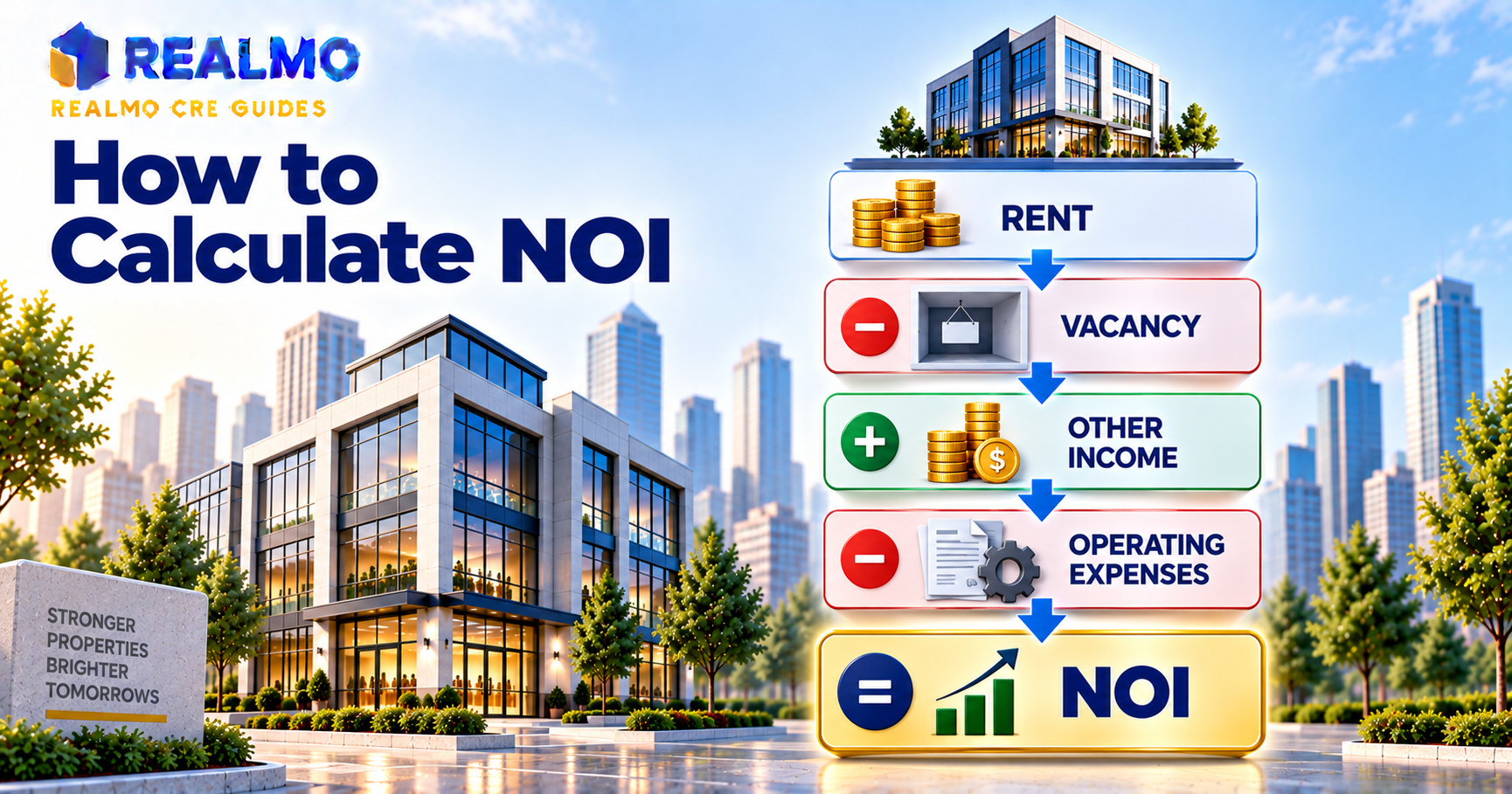
Net operating income (NOI) is a property’s annual income after operating expenses but before debt service, capital expenditures, and income taxes. To calculate NOI, subtract operating expenses from effective gross income. Owners need to know how to calculate NOI because that single number drives appraised value, cap rate, and loan sizing.
Net Operating Income (NOI) Calculator
Calculate Effective Gross Income, total operating expenses, and NOI for income-producing real estate
Effective Gross Income
Net Operating Income (NOI)
Why NOI decides what your building is worth
Say you own a 12,000-square-foot neighborhood retail strip and you’re refinancing. You hand the lender a spreadsheet showing NOI of $195,000. The lender’s underwriter rebuilds it: strips out the $9,000 roof repair you expensed. Adds a 4% management fee even though you self-manage, applies market vacancy instead of your actual 2%, and adds a replacement reserve. Your NOI comes back at $178,000.
That $17,000 difference isn’t an accounting quibble. Divided by a 7% cap rate, it’s roughly $243,000 of appraised value, which can move your loan proceeds by six figures. The same arithmetic runs in reverse at sale, when a buyer’s analyst rebuilds your operating statement line by line. Owners who calculate NOI the way lenders and appraisers do stop getting surprised at the worst possible moment.
What NOI includes and what it leaves out
NOI measures the property, not the owner. Two people can buy the same building with different loans, different tax situations, and different depreciation schedules, and the property still produces the same NOI. That’s the whole point: it isolates operating performance so buildings can be compared and priced against each other.
Everything a tenant pays for occupancy belongs above the line: base rent, percentage rent, expense reimbursements, parking, storage, signage and rooftop antenna income, late fees. Everything required to keep the building open and leased belongs in operating expenses. Everything tied to how the deal was financed, structured, or owned stays out.
How to calculate NOI step by step
Start with potential gross income (PGI): contract rent for every occupied space, plus market rent for vacant space, plus recurring other income. Underwriters usually build this on an annualized basis from a current rent roll rather than from last year’s collections.
Subtract vacancy and credit loss. Apply the deduction to reimbursements as well as base rent, since a vacant suite pays neither. Owners commonly use their trailing twelve-month experience; lenders substitute a market vacancy assumption when actual occupancy runs tighter than the submarket. The result is effective gross income (EGI).
Subtract operating expenses to reach NOI. Use a stabilized, recurring expense figure, not whatever happened to hit the checkbook last year. A property tax bill that reset after a sale, or an insurance renewal that jumped. Should be reflected at the going-forward number rather than the historical one.
Two conventions on presentation are both defensible. Appraisers and most institutional buyers use a direct capitalization model with a stabilized year. Owners work from a twelve-month trailing statement. Neither is wrong, but mixing them, such as trailing expenses against forward rents, produces a number nobody can rely on.
Which operating expenses belong in the calculation
Property taxes, insurance, utilities not billed to tenants, repairs and maintenance, janitorial and landscaping, snow removal, security, on-site payroll, administrative and legal costs, marketing, and a management fee. The management fee goes in even when you self-manage, because a buyer would have to pay someone to run the building. Standard practice is a percentage of EGI in the low-to-mid single digits, varying by asset type and property size.
Replacement reserves are the genuine gray area. Appraisers and most lenders deduct a per-square-foot or per-unit reserve above the line so NOI reflects long-run roof, HVAC, and parking-lot replacement. Many brokers and sellers present NOI without reserves, which produces a higher number and a higher price at the same cap rate. Neither camp is dishonest; the two conventions simply coexist. When you compare properties, confirm which convention each operating statement uses before you compare cap rates.
Under net leases, reimbursements appear as income and the underlying costs appear as expenses. Netting them out understates both sides and distorts the operating expense ratio. This reviewers use as a first sanity check on whether a statement is complete.
Why debt service and capital costs stay out
Mortgage principal and interest are financing, not operations. Leaving debt service out is what allows a cap rate derived from one sale to price another building with an entirely different capital structure. Cash flow after debt service is a separate, useful number, but it isn’t NOI.
Capital expenditures stay out for a different reason: they’re episodic. A new roof, a parking-lot resurfacing, a lobby renovation, tenant improvement allowances, and leasing commissions all get treated as capital or as below-line items, even though they consume real cash. Depreciation and amortization stay out because they’re non-cash tax constructs governed by the Modified Accelerated Cost Recovery System (MACRS), and income taxes stay out because they belong to the owner, not the building. Owner-specific costs, such as your accountant’s personal return or a vehicle registered to the LLC, don’t belong either.
Worked example: a small multi-tenant retail strip
All figures below are illustrative and rounded for clarity.
| Line item | Amount |
|---|---|
| Base rent (12,000 SF, occupied and market rent for vacant) | $240,000 |
| CAM and tax reimbursements | $48,000 |
| Signage income | $6,000 |
| Potential gross income | $294,000 |
| Vacancy and credit loss at 5% | ($14,700) |
| Effective gross income | $279,300 |
| Property taxes | $38,000 |
| Insurance | $9,000 |
| Repairs, maintenance, and CAM services | $26,000 |
| Common-area utilities | $7,000 |
| Management fee (4% of EGI) | $11,172 |
| Administrative, legal, and marketing | $5,000 |
| Replacement reserves ($0.20/SF) | $2,400 |
| Total operating expenses | $98,572 |
| Net operating income | $180,728 |
The operating expense ratio here is about 35% of EGI. This lands in a normal band for multi-tenant retail with meaningful recoveries and gives a reviewer confidence the statement isn’t missing a line.
Two interpretation points. First, the management fee is calculated on EGI, not PGI. Running it on PGI overstates the expense by roughly $735 in this example and by much more on a property with real vacancy. Second, drop the reserve and NOI becomes $183,128. At an illustrative 7% cap rate, that $2,400 line moves indicated value by about $34,000. This is why the reserve convention deserves a direct question rather than an assumption.
The most common error at this scale: applying vacancy to base rent only. Reimbursements are contingent on occupancy too, and forgetting that inflates EGI on every vacant square foot.
How lenders and appraisers rebuild your NOI
Underwriters normalize before they lend. They mark rents to market where leases are above market or expiring soon. Substitute market vacancy for an owner’s optimistic figure, insert a market management fee, add reserves. Reset taxes to the reassessed basis after a sale, and remove anything non-recurring. Then they run debt service coverage ratio and debt yield off the adjusted number.
You can anticipate most of this. Keep a clean rent roll reconciled to your operating statement, code capital work separately from repairs during the year rather than at underwriting, and document any expense you expect to argue is non-recurring. If you’re checking your own NOI against how comparable buildings in your submarket are performing and priced, Realmo’s property analytics show valuation, cap rate, and ownership records across 9M+ properties without a paywall.
Common mistakes that quietly inflate NOI
- Expensing capital work. A roof replacement booked as maintenance depresses NOI in the year it happens and, worse, invites an underwriter to question every other line. The consequence is a lower value conclusion than the property deserves.
- Omitting the management fee when self-managing. NOI looks stronger by several thousand dollars, then gets adjusted down in underwriting. The consequence is a valuation gap you didn’t budget for.
- Using budget instead of actuals for taxes and insurance. Post-sale reassessment and hard-market insurance renewals are the two lines most likely to break a pro forma. The consequence is a DSCR shortfall in year one.
- Counting a security deposit or a lease termination fee as rental income. Deposits are liabilities; termination fees are non-recurring. The consequence is capitalized income that doesn’t exist, meaning an inflated asking price a buyer will catch.
- Comparing an NOI with reserves against a cap rate derived from statements without them. The consequence is a mispriced offer in either direction.
NOI feeds directly into how to calculate cap rate and into the income approach to valuation, so an error here compounds into every downstream number. Treatment of specific line items for tax reporting differs from treatment for underwriting; consult a licensed CPA or appraiser for your property.
Related terms
Effective gross income · Operating expense ratio · Cap rate · Debt service coverage ratio · Triple net lease · Replacement reserves · Cash flow before taxes · Pro forma
FAQ
Before. NOI stops at operating expenses and excludes principal and interest entirely. Subtracting debt service from NOI gives cash flow before taxes, a different metric. Keeping financing out is what lets a cap rate derived from one transaction price a building owned free and clear or leveraged to 75%.
It varies by property type and lease structure. Net-leased industrial and single-tenant assets run low because tenants pay most costs directly; multifamily and full-service office run substantially higher because the owner carries utilities, staffing, and turnover. Compare a ratio only against properties with the same lease structure.
It depends on the convention. Appraisers and lenders deduct a reserve so NOI reflects long-term capital replacement. Many broker offering memoranda exclude it. Both appear in the market, so identify which convention a statement uses before comparing two properties or two cap rates.
Use market rent for vacant space in potential gross income, then apply a vacancy. And credit loss deduction reflecting the time and cost to lease it. For a property well below stabilized occupancy, direct capitalization of a single-year NOI is unreliable, and buyers switch to a discounted cash flow model.
It varies by property type and lease structure. Net-leased industrial and single-tenant assets run low because tenants pay most costs directly. Multifamily and full-service office run substantially higher because the owner carries utilities, staffing, and turnover. Compare a ratio only against properties with the same lease structure.