Investing in Industrial and Warehouse Property
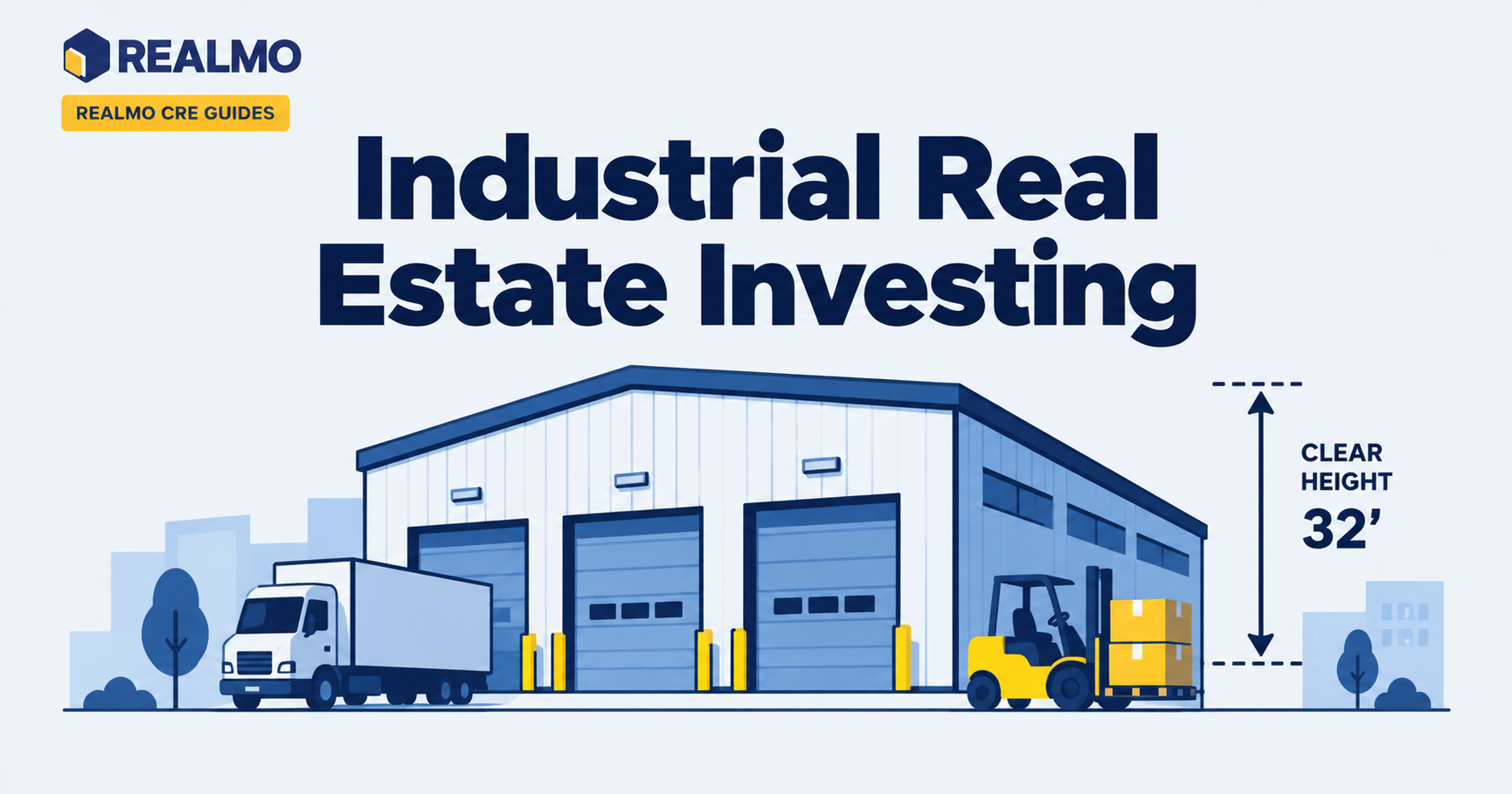
Industrial real estate investing means buying warehouses, distribution centers, manufacturing plants, and flex buildings to earn rent and build equity. Returns come from tenants who use the space for storage, fulfillment, production, or service work. Value tracks how well the box functions: clear height, loading, power, truck access. That matters far more than finish quality.
Why Investors Move Capital Into Industrial
Picture two deals priced the same. One is a small strip retail center with six tenants and a parking field to seal. Its landlord repaints suites and pays leasing commissions every time a nail salon fails. The other is a 40,000-square-foot warehouse leased to a plumbing supply distributor on a triple-net lease with fixed annual bumps.
The warehouse produces less drama. That holds per dollar of rent. Tenant improvement costs run low because tenants want a clean slab, working dock doors, and adequate power, not a designed interior. Capital expenditures concentrate in the roof, the paving, and the HVAC serving a small office area. That operating profile is why industrial attracts investors who want durable cash flow without a full-time management burden. It also carries a specific risk: when a single-tenant building goes dark, income drops to zero, not by a sixth.
What Counts as Industrial Property
Industrial is a family of building types, and the differences matter more than the label. Bulk distribution buildings run large, tall, and dock-heavy, serving regional or national logistics networks. Light industrial buildings are smaller and shallower. They usually serve contractors, suppliers, and small manufacturers who need a few dock or grade doors and a modest office. Flex and R&D buildings carry a higher office finish ratio and sometimes storefront glass. That puts them halfway between industrial and office in both rent and risk.
Manufacturing buildings are built around a process. That means heavy power service, floor pits, cranes, ventilation, and sometimes reinforced slabs. Those improvements are worth a lot to one occupant, and close to nothing to the next tenant who takes the space. That gap is why manufacturing assets commonly trade at higher yields than a plain box in the same submarket.
Cold storage sits at the specialized end. Refrigeration systems, insulated envelopes, and dock seals cost multiples of dry warehouse construction, and the equipment carries a shorter useful life than the shell. Investors underwrite cold storage as an operating-intensive asset, not a passive one.
Industrial outdoor storage (a yard with a small building, used for trailer parking, equipment, materials, or contractor fleets) behaves differently again. The value sits in the land and the entitlement to store outside, which many municipalities no longer grant. Buyers underwrite the zoning first and the building second.
Last-mile fulfillment describes a location more than a construction type. Infill buildings near dense population are usually older and functionally compromised, valued for drive time rather than clear height. Screening by current versus suggested use and ownership records narrows a target list faster than driving submarkets does. That kind of parcel-level data is exactly what Realmo publishes without a paywall.
Building Specs That Drive Rent and Value
Clear height is the first number an industrial broker quotes, because racking is vertical. Older infill product commonly runs 16 to 22 feet clear; modern regional distribution product is usually built in the low 30s and up. A building that cannot rack four or five levels high competes for a smaller tenant pool. That shows up in both rent and days on market.
Loading determines who can occupy the space. Dock-high doors with levelers serve tractor-trailers; grade-level drive-in doors serve box trucks and vans. A shallow building with two dock doors and one drive-in fits a contractor, not a third-party logistics operator. Truck court depth (the paved area behind the docks) decides whether a 53-foot trailer can maneuver at all, and shared courts between buildings create disputes. Those surface during due diligence, not after.
Column spacing and bay depth control how efficiently a tenant can lay out racking and forklift aisles. Tight columns in an older building waste floor area the tenant still pays for, which pushes effective rent down even when quoted rent looks competitive.
Power service is the quiet deal-killer. Amperage, voltage, and three-phase availability determine whether a fabricator, food processor, or automated fulfillment tenant can operate. Upgrading service can require utility coordination on a timeline measured in quarters, and the cost lands on the landlord in a competitive leasing market.
Two more items belong on the list. Sprinkler type and density govern what can be stored, and how high. An ESFR (Early Suppression Fast Response) system supports high-piled storage that an older wet-pipe system may not, and insurance underwriters ask about it. Slab thickness and condition govern forklift traffic and racking loads. Cracked, undersized slabs are expensive to remediate, and they commonly show up as a price adjustment during the inspection period.
Office finish ratio rounds out the picture. Warehouse tenants pay warehouse rent for warehouse space, and excess office from a prior occupant usually becomes a demolition line item, not a rent premium.
How Industrial Leases Are Structured
Most stabilized industrial leases are triple net: the tenant reimburses real estate taxes, insurance, and common area maintenance on top of base rent. Industrial gross and modified gross structures still exist, especially in older multi-tenant parks, and they shift operating expense inflation back to the landlord. Two buildings at the same quoted rent per square foot can produce very different net income depending on which structure applies. That is why the lease abstract drives the underwriting, not the rent roll summary.
Escalations matter more over a long term than starting rent does. Fixed annual increases compound predictably. Increases tied to an inflation index shift purchasing-power risk to the tenant, but they introduce volatility and, in many leases, a floor and a ceiling. Flat rent through a long term is a real concession dressed as a clean lease. It erodes value at exit because a buyer capitalizes in-place income.
Term length in industrial tends to run longer than in retail or office, particularly where the tenant installed racking, cranes, or process equipment. Long term cuts rollover risk, but it freezes rent. That is why buyers of long-leased buildings look hard at whether in-place rent sits above or below what a new tenant would pay today. A below-market lease is upside on renewal; an above-market lease is a repricing event waiting at expiration.
Read the recovery language closely. Caps on controllable expenses, exclusions for roof and structure, and base-year stops in modified structures all shape the landlord’s real exposure. So does whether capital repairs may be amortized and passed through. Also check the surrender and restoration clause. A tenant that installed a mezzanine, a paint booth, or refrigeration may or may not be obligated to remove it, and removal costs land somewhere.
Guaranties are the last piece. A lease signed by a thinly capitalized operating entity behaves differently from the same lease backed by a parent guaranty. It behaves differently still when backed by a personal guaranty with verified net worth.
Tenant Credit and Rollover Risk
Industrial income concentrates. A single-tenant building carries binary occupancy, full or empty, and a downtime period of several quarters is realistic for specialized space in a thin submarket. Multi-tenant parks trade some of that risk for higher management intensity and more frequent, smaller re-leasing costs.
Credit analysis for private industrial tenants rarely involves a rating. It involves financial statements, tax returns, bank references, years in operation, and how central the location is to the business. A distributor whose entire regional inventory sits in the building has strong practical incentive to renew regardless of what a credit model says. A tenant using the space for overflow storage does not.
Rollover timing deserves its own schedule. Stacked expirations in a single year concentrate risk in a way that a weighted average lease term hides. Underwrite each expiration with a downtime assumption, a leasing commission, a tenant improvement allowance, and free rent. Then check the result against the debt service coverage covenant in your loan. A deal that pencils at stabilization and breaches covenant during a re-leasing gap is a financing problem before it is a real estate problem.
Specialization cuts both ways. Purpose-built improvements support rent from the current tenant and depress the pool of replacement tenants. Price that asymmetry in the exit assumption rather than assuming the next occupant pays for someone else’s equipment.
Environmental and Zoning Due Diligence
Industrial sites carry use histories. A Phase I Environmental Site Assessment prepared to the ASTM E1527 standard reviews historical records, aerial photographs, regulatory databases, and site conditions. The goal is to identify recognized environmental conditions. Common findings on industrial parcels include former underground storage tanks, floor drains connected to unknown outfalls, and metal plating or degreasing operations. Adjacent dry cleaning uses can also create vapor intrusion questions.
The report is also a legal instrument. CERCLA, the federal Comprehensive Environmental Response, Compensation, and Liability Act, conditions certain purchaser defenses to cleanup liability on having conducted all appropriate inquiries before acquisition. That is why lenders and experienced buyers order a Phase I even on clean-looking property. A finding does not kill a deal; it triggers a Phase II subsurface investigation, a scope, a cost, and a negotiation over who bears it.
Zoning and entitlements deserve equal attention. Confirm that the current use is permitted rather than legal nonconforming. A nonconforming use can be lost after a period of vacancy or a casualty, which changes what the property is worth. Verify outdoor storage rights explicitly if the tenant parks trailers or stores materials in the yard. Check truck routing, hours-of-operation restrictions, and loading orientation relative to any residential boundary, since those constraints limit the tenant pool.
Confirm environmental, zoning, and title questions with a qualified environmental professional and a licensed attorney in the property’s jurisdiction before you waive contingencies.
How Industrial Deals Get Financed
Small and mid-size industrial acquisitions are financed largely by banks and credit unions. Life insurance companies and debt funds are active on larger or more complex assets. Agency programs that serve apartments do not apply here, so pricing and structure vary more by lender relationship and property quality than in multifamily.
Lenders size loans on two constraints and take the lower result. One is a loan-to-value ceiling based on appraised value; the other is a debt service coverage floor based on underwritten net operating income. Coverage usually binds first when interest rates are elevated relative to cap rates. That is why a deal that clears the value test can still come back with less proceeds than the buyer modeled. Amortization schedules and rate reset provisions on bank paper shape the actual cash flow more than the headline rate does.
Recourse is standard on smaller bank loans. Nonrecourse terms usually require larger loan size, institutional sponsorship, and a stabilized rent roll. They still carry carve-out guaranties for fraud, environmental liability, and voluntary bankruptcy filings.
Owner-users occupy a separate lane. SBA 504 and 7(a) programs, backed by the Small Business Administration (SBA), finance buildings the borrower’s own business will occupy, subject to SBA occupancy rules. For an existing building, the operating company must occupy a majority of the space (SBA). That structure allows a business owner to acquire a building with a lower down payment than conventional investment financing usually requires. It also allows the owner to lease the remainder to third parties.
On the tax side, nonresidential real property is depreciated over 39 years under the Modified Accelerated Cost Recovery System (MACRS). A cost segregation study can reclassify site improvements and certain building components into shorter recovery periods. Investors selling appreciated industrial property commonly examine a 1031 exchange, permitted under Internal Revenue Code Section 1031, which imposes a 45-day identification window and a 180-day closing window. Tax outcomes depend on individual circumstances; consult a licensed CPA or tax attorney.
What Makes Industrial Real Estate Investing Different
Compared with retail and office, industrial carries lower recurring capital cost per square foot. Tenants usually do not require the interior buildout that offices demand, and leasing a warehouse rarely involves the merchandising judgment that anchors retail leasing. That reduces the landlord’s cash drag between leases and makes net operating income convert to free cash flow more reliably.
The trade-off is concentration and obsolescence. Retail centers spread risk across tenants; a single-tenant warehouse does not. Office buildings age mostly in appearance, while industrial buildings age functionally. A 20-foot clear building where new construction goes taller loses tenants to buildings that let them store more inventory per dollar of rent.
Land content changes the downside. In infill locations, the site itself usually carries meaningful value relative to the improvements. That value still puts a floor under the asset and creates redevelopment optionality that a suburban office park may lack. That same dynamic is what makes industrial outdoor storage attractive despite minimal building value.
Demand drivers also differ. Industrial absorption follows goods movement: consumption, inventory strategy, trade flows, and supply chain design. Office follows employment; multifamily follows household formation. Supply responds with a lag measured in years, since entitlement, site work, and construction take time. That lag is what produces the sector’s alternating tight and loose conditions. Rather than anchoring to a published vacancy figure, track the local ratio of space under construction to existing inventory and the pace of net absorption. Those two series tell you which direction rent negotiating power is moving.
Worked Example: Underwriting a 40,000 SF Warehouse
All figures below are illustrative and rounded for clarity. They are not market quotes.
Inputs. A 40,000-square-foot single-tenant warehouse, 24-foot clear, four dock doors and one drive-in, 10% office finish. In-place triple-net base rent of $9.00 per square foot with 3% annual increases and six years remaining. Tenant reimburses taxes, insurance, and CAM. Landlord retains roof and structure.
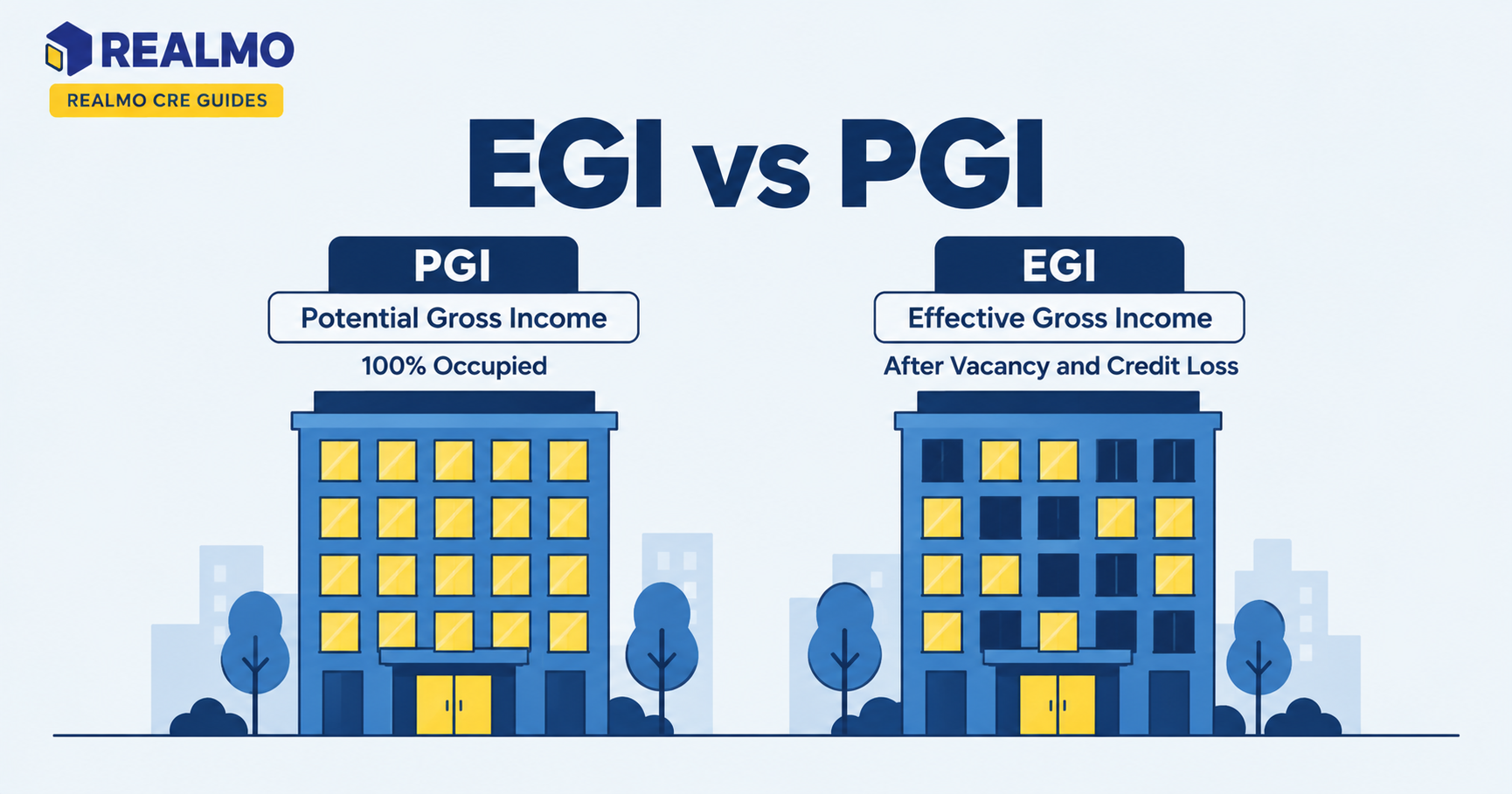
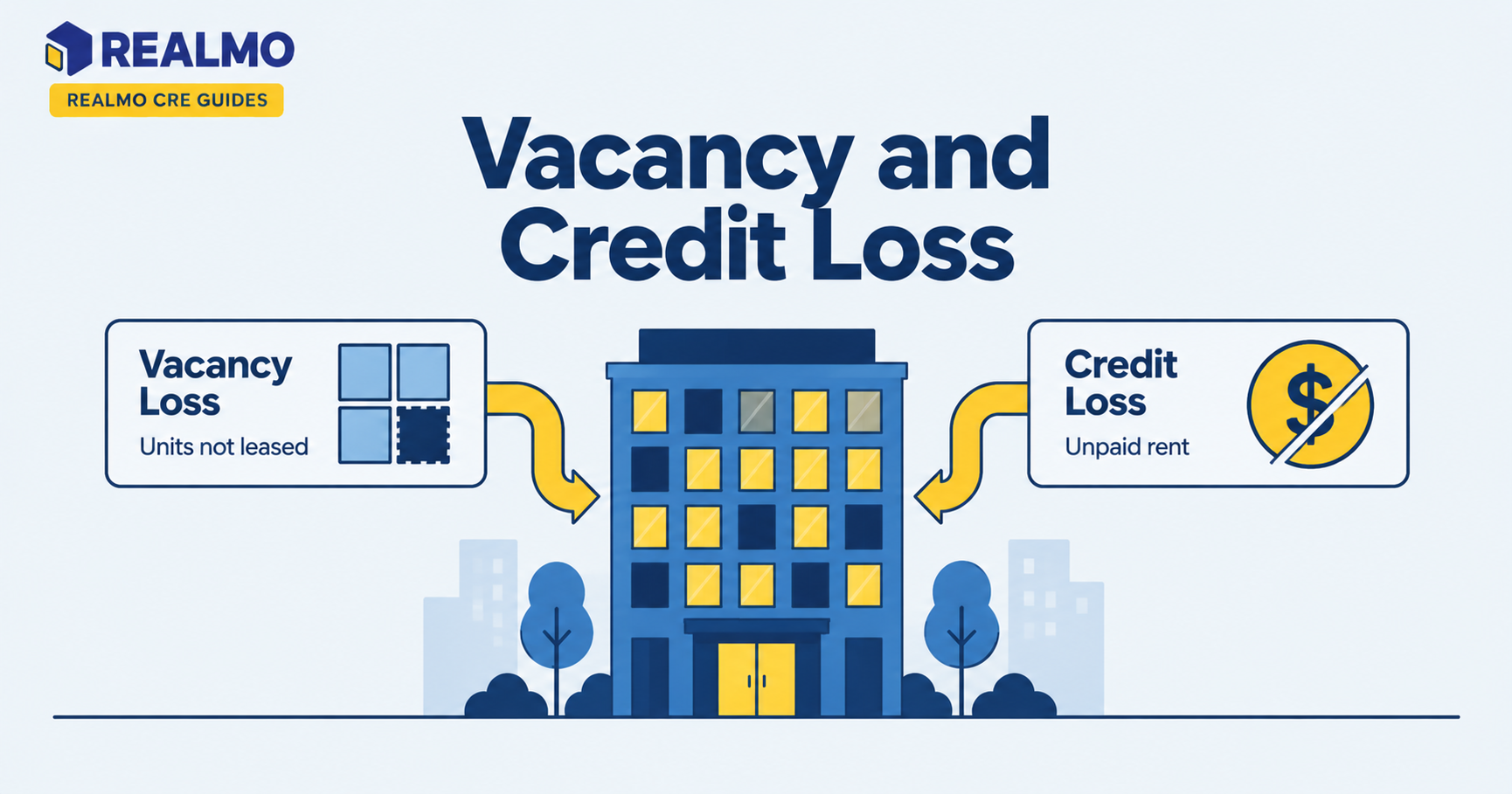
Step 1: Effective gross income. Base rent equals 40,000 × $9.00 = $360,000. Apply a 5% vacancy and credit loss allowance even though the building is fully leased. The buyer is capitalizing income in perpetuity, so full vacancy risk still applies: $360,000 × 0.95 = $342,000. Reimbursements offset recoverable expenses and net to approximately zero in this structure.
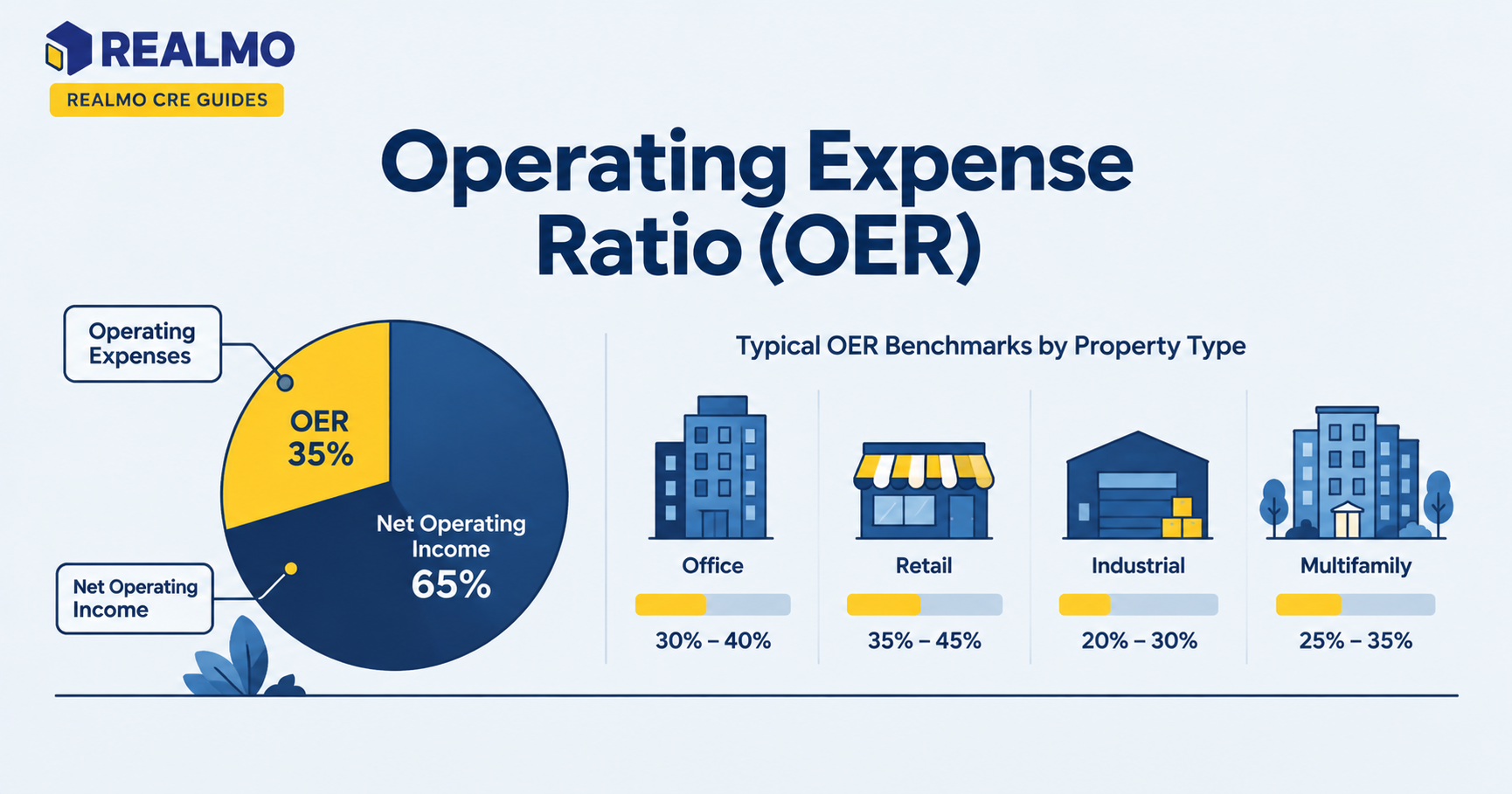
Step 2: Operating expenses borne by the landlord. Management fee at 3% of effective gross income: $10,260. Non-recoverable structural reserve at $0.15 per square foot: $6,000.
Step 3: Net operating income. $342,000 − $10,260 − $6,000 = $325,740.
Step 4: Value at an assumed capitalization rate. Using an illustrative 7.0% cap rate: $325,740 ÷ 0.07 = $4,653,429, or roughly $116 per square foot. At an illustrative 6.5%, value rises to about $5.01 million; at 7.5%, it falls to about $4.34 million.
How to interpret it. A 100-basis-point swing in the capitalization rate moves value by roughly 15% here, which dwarfs the effect of the reserve assumption or the management fee. That is why the capitalization rate applied at exit, not the operating detail, dominates return outcomes on stabilized industrial. Test the deal at a rate above your entry assumption before you commit.
One error to avoid. Buyers frequently model triple-net recoveries as if they continue during vacancy. They do not. When the tenant leaves, the landlord pays taxes, insurance, and CAM on an empty building while also funding leasing commissions and any improvement allowance. Model a downtime scenario with full expense burden and confirm the loan still covers.
Mistakes That Sink Industrial Acquisitions
Buying rent instead of buying a building. An above-market lease inflates net operating income and therefore price. At expiration the rent resets to what the market pays for a building with that clear height and loading. The buyer absorbs the difference in value permanently.
Skipping or shortcutting environmental work. Acquiring an industrial parcel without a current Phase I forfeits purchaser liability protections that depend on pre-purchase inquiry. It also leaves the buyer holding remediation exposure that can exceed the equity in the deal.
Ignoring functional obsolescence. A low-clear, tight-column building may lease well while the market is tight and sit vacant when tenants have choices. Underwriting a long-term hold on a building the market is aging out of transfers that risk from seller to buyer at full price.
Assuming outdoor storage is permitted. Yard use is the value driver for many contractor and fleet tenants. Many jurisdictions restrict or prohibit it. That risk is easy to miss during due diligence. Discovering after closing that the yard is not an approved use eliminates a rent component the purchase price already paid for.
Underestimating re-leasing cost and downtime. Leasing commissions, allowances, free rent, and several months of carrying costs on a vacant building routinely total more than a year of net rent. A model without those line items overstates return and understates the equity the property will actually consume.
Related Terms
- Capitalization rate
- Net operating income
- Triple net lease
- Debt service coverage ratio
- Phase I Environmental Site Assessment
- Clear height
- Industrial outdoor storage
- 1031 exchange
Questions Investors Ask About Industrial Property
Is industrial a good first commercial property to buy?
Many first-time buyers start with small light industrial. The leases are simple, tenant improvement costs are modest, and management demands less time than retail or apartments. The offsetting risk is concentration: with one or two tenants, a single vacancy removes most of the income. Reserve capital for downtime before you close.
How much does a warehouse cost per square foot?
Price per square foot varies widely by market, clear height, loading, land-to-building ratio, and lease structure, so a national figure would mislead you. Value it instead by capitalizing net operating income and cross-checking against recent sales of buildings with comparable specifications in the same submarket.
What is a good cap rate for industrial property?
There is no fixed answer, and any number published today ages quickly. Industrial capitalization rates usually sit below retail in the same market because leases run longer and re-leasing costs less. They usually sit above the rate on comparable-quality multifamily, too, in most cycles. Judge a quoted rate against the building’s functionality and tenant credit, not against a benchmark.
Can I buy a warehouse for my own business?
Yes. Owner-users commonly finance acquisitions through SBA 504 or 7(a) programs, which require the operating company to occupy a majority of an existing building (SBA). The structure usually allows a smaller down payment than investment financing. Loan terms and eligibility depend on the lender and the business; confirm details with an SBA-approved lender.
How long do industrial leases usually run?
Terms commonly run three to ten years, with longer terms where the tenant installs racking, cranes, refrigeration, or process equipment. Longer term reduces rollover risk but locks in rent. So review the escalation structure and how in-place rent compares to what a replacement tenant would pay.