An Out-of-Area & Foreign Investor’s Guide to U.S. Commercial Real Estate
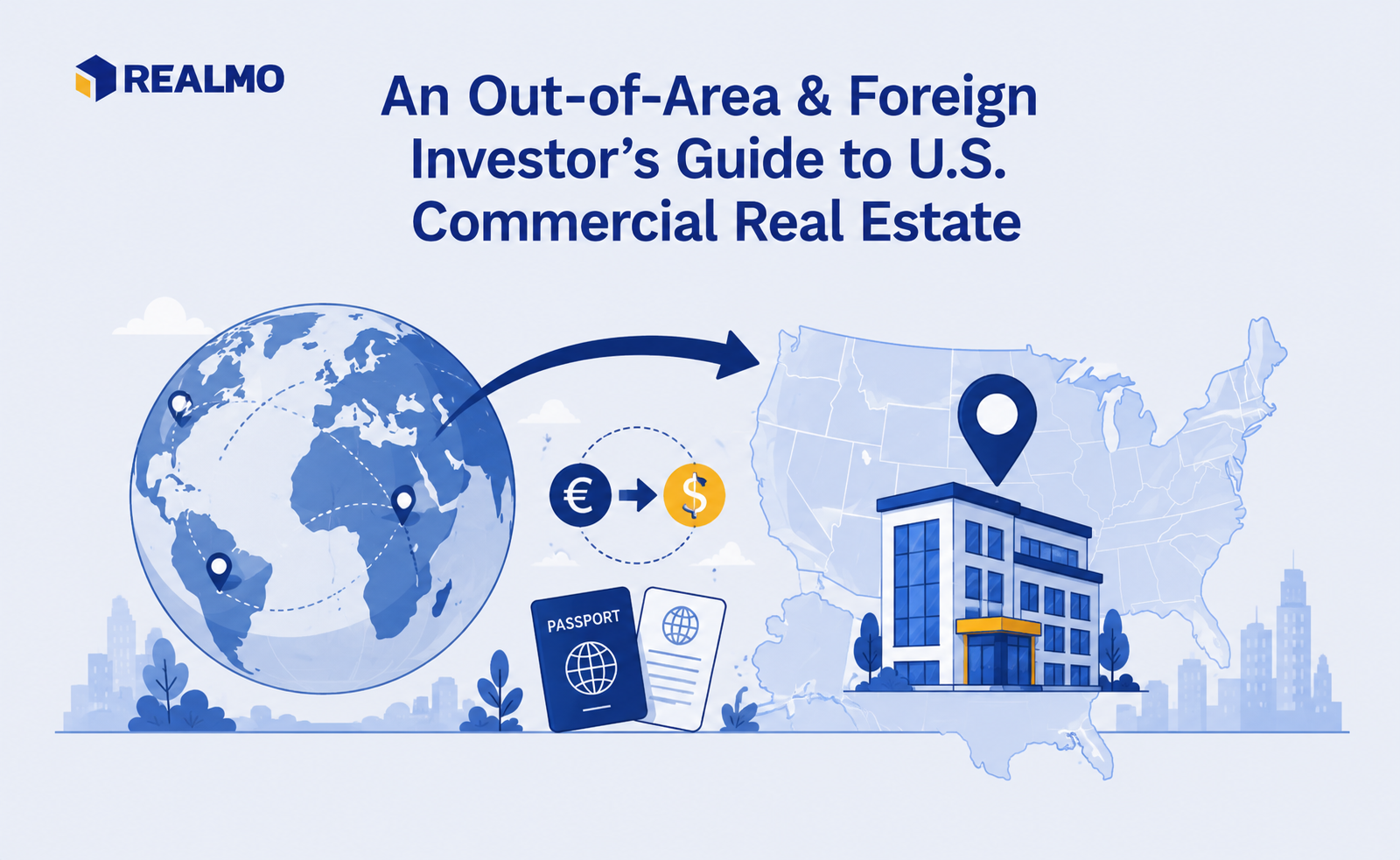
Here is a situation that used to be far more common than it should have been: an investor with genuine capital, a clear strategy, and real interest in U.S. commercial real estate ends up buying something two miles from their house – not because it was the best opportunity available, but because it was the only one they felt confident enough to act on.
That is not a knock on local investing. Sometimes the best deal genuinely is nearby. But more often, proximity was a proxy for comfort rather than a reflection of actual fundamentals. Investors stayed local because going anywhere else felt complicated, opaque, and risky in ways that were difficult to quantify. So they defaulted to familiar ground and hoped the market cooperated.
That dynamic has changed considerably. Not completely – local knowledge still matters, and we will get into why – but the barriers that once made out-of-state and international investing genuinely difficult have been significantly lowered. The question worth asking now is not whether you can invest in an unfamiliar market. It is whether you have the right process to do it well.
The Distance Problem Is Mostly Solved
Think about what remote investing actually required ten years ago. You needed personal relationships in the target market to surface deals. You reviewed physical documents sent by post or fax. You flew out to walk properties before you had any real sense of whether the market deserved your attention. And you relied heavily on whoever you happened to know locally, because there was no straightforward way to verify what they were telling you independently.
None of that is gone entirely, but most of it has been transformed. A buyer sitting in London or Tokyo today can spend a morning comparing industrial vacancy trends in Texas with population growth data in Florida, review aerial imagery of three shortlisted properties, and get on a video call with a local broker who already knows what they are looking for – all before lunch. AI-powered search platforms, centralized property databases, digital due diligence workflows, and cloud-based collaboration tools have quietly removed the friction that kept capital tethered to familiar ZIP codes.
What this has changed, more than anything, is decision quality. Investors who once stayed in their home market out of practical necessity can now genuinely compare regions based on real economic data. Employment growth, demographic trends, tax environments, infrastructure investment, and long-term appreciation potential are all measurable and comparable across markets. That is a genuinely different world from the one where you invested locally and hoped you had picked the right city.
Why the Right Market Matters More Than the Right Building
Most investors start their search by looking for a property. Experienced investors tend to do something closer to the opposite. They identify markets with strong long-term fundamentals first, then narrow down to specific assets within those markets. The logic is straightforward: a well-priced building in a weakening market will fight headwinds every year of your hold period, while a fairly ordinary asset in a market with genuine momentum will benefit from forces that have nothing to do with what you paid for it.
This market-first approach matters even more when you are investing somewhere unfamiliar. Without an existing feel for local conditions, you need the data to do more of the work – and that means understanding the broader economic environment before you start evaluating individual listings.
The United States is one national economy and fifty highly distinct local ones. Every state has its own combination of population trends, industry composition, regulatory environment, tax structure, and business climate. Two properties that look nearly identical on paper can produce very different results depending on which side of a state line they sit on.
Sustained population growth is one of the clearest things to look for. Areas attracting new residents tend to generate stronger and more durable demand across almost every commercial property type – retail, industrial, multifamily, healthcare, office – because businesses follow people. Economic diversity matters equally. A market supported by multiple industries is more resilient than one that depends on a single employer or sector. And regulatory and tax conditions affect operating costs in ways that are easy to underestimate from a distance but show up clearly in the numbers over time.
Investors researching fast-growing markets often find themselves comparing commercial opportunities in North Carolina – where technology employment, life sciences, and financial services have reshaped several cities over the past decade – alongside the sheer scale and variety of California’s commercial property market, where technology, agriculture, logistics, and entertainment create demand drivers unlike anywhere else in the country. Neither is universally better. The right answer depends entirely on what you are trying to accomplish.
What Foreign Investors Specifically Need to Sort Out
If you are coming to U.S. commercial real estate from outside the country, the opportunity is real and the access is genuinely more open than many investors expect. But there are a few things worth getting straight before you start browsing listings.
Ownership structure comes first. Most international investors purchase through a U.S. limited liability company or another legal entity that separates personal liability, aligns with financing requirements, and fits their long-term tax planning. The right structure depends on your specific situation – nationality, home country tax treaties, investment timeline, and intended use of income – and it should be decided with qualified legal and tax advisors before you make any offer, not after you have already found a property you want.
Financing is the second thing to address early. Some U.S. lenders are set up to work with international buyers and have clear processes for it. Others have stricter documentation requirements, higher equity thresholds, or simply less experience with cross-border transactions. Knowing your borrowing capacity and your realistic transaction costs before you start market research gives you an accurate picture of what you can actually acquire – and saves you the frustration of identifying something promising and then discovering the financing does not work on the timeline required.
The third thing – and this is the one that tends to be underestimated – is assembling an advisory team before you need them. A local commercial broker, a U.S. commercial real estate attorney, a CPA with international client experience, and a property manager with a track record in your target market are not people you want to be searching for after you have a deal under contract. They are people you want introduced, vetted, and ready to go before you start making offers. We will come back to how to find and evaluate each of them later in this guide.
The upside for foreign investors today is genuine market transparency. Reliable data, sophisticated analytics, and centralized listing platforms make it possible to browse commercial real estate across Massachusetts, compare office fundamentals in Maryland, or evaluate industrial demand in Georgia using objective metrics rather than having to rely on whoever happens to pick up the phone. That transparency does not replace the need for local expertise – but it dramatically improves the quality of the questions you bring to the experts you hire.
Choosing the Right State Before Choosing the Right Property
There is a version of market research that looks thorough but is mostly just browsing. You pull up listings in a city you have heard good things about, glance at a few cap rates, and decide the market seems fine. That is not analysis – it is confirmation bias with extra steps. The investors who consistently make good decisions in unfamiliar markets do something more deliberate: they compare economic fundamentals across multiple regions before they ever look at a single building.
The goal is not to find the universally “best” state. That concept does not really exist in commercial real estate, because different investors need completely different things from their markets. What you are actually looking for is a region whose long-term fundamentals support the specific strategy you are pursuing. That distinction matters more than it might seem.
The Economic Indicators Worth Actually Looking At
GDP growth is a useful starting point, but it rarely tells the whole story. A regional economy can be expanding while commercial vacancy rates are rising and the working-age population is quietly leaving for somewhere cheaper. The indicators that more reliably predict commercial real estate demand tend to be more granular.
Employment growth across multiple industries – not just one dominant employer – is one of the strongest signals available. When jobs are being created consistently and broadly, businesses expand, workers relocate, spending increases, and demand for commercial space follows. Diversified job creation makes a market resilient in ways that single-sector growth simply cannot replicate. A city where five industries are all hiring moderately is a fundamentally safer bet than one where a single company is doing all the heavy lifting.
Business formation rates tell a related but distinct story. New businesses need space – office, retail, warehouse, light industrial. Markets where entrepreneurial activity is genuinely growing generate organic demand that does not depend on one big tenant signing one big lease every few years.
Infrastructure investment is worth tracking too, though it plays out over a longer horizon. Highway expansions, port improvements, freight rail projects, and airport upgrades often reshape commercial markets years before their full economic impact becomes visible. The investor who catches that signal early – before the institutional money arrives – tends to look very smart a decade later.
Population migration deserves particular attention right now because it has been actively redrawing the commercial real estate map. People have been leaving expensive, high-tax coastal markets and moving toward states with lower costs of living and friendlier business climates. Businesses follow people. Commercial demand follows businesses. The ripple effects show up in occupancy, rents, and land values – sometimes quickly, sometimes slowly, but reliably.
How Different Markets Serve Different Strategies
The right market for a logistics investor looks nothing like the right market for a multifamily buyer. Comparing markets well means comparing them against your specific investment objectives – not some abstract ranking of desirability.
Take industrial real estate. A buyer looking at distribution assets in Pennsylvania is usually drawn by a simple geographic argument: the state sits between two of the most densely populated corridors on the East Coast, and the last-mile logistics demand that creates does not depend on which direction the broader economy is moving. That kind of structural logic is hard to argue with.
Retail investors follow households. Right now, parts of the Carolinas are seeing exactly the kind of setup that produces good retail outcomes – new residential development, rising household incomes, and consumer spending that is outpacing available retail supply in several growing corridors. When demand is real and supply has not caught up yet, the fundamentals do a lot of the work for you.
Office is a more nuanced conversation. The question is not just whether a market is growing – it is which industries are growing there and whether those industries actually need office space. Investors who have followed Virginia commercial real estate for years keep returning to the same observation: the government and defense contractor ecosystem around D.C. produces some of the most durable office demand in the country. It is not a headline-grabbing story, but consistency has real value in office real estate right now.
Multifamily buyers focus on where people are moving and why. Atlanta – part of a broader story playing out across Georgia – has absorbed enormous population inflows while continuing to add jobs across multiple sectors. The residential and mixed-use sectors have reflected that consistently and show little sign of reversing.
Smaller Markets Are Underrated
The gravitational pull toward gateway cities is understandable. More data, more liquidity, easier benchmarking. But some of the most compelling commercial real estate sits in mid-size markets where institutional competition is lower, entry pricing is more attractive, and local fundamentals are quietly strong.
Columbus, Ohio has become one of the better Midwest stories – a university city that has attracted technology employers and logistics operations drawn by its central highway position. It does not generate the buzz of Nashville or Austin, but the underlying numbers have been telling a consistent story for years.
Kansas City tells a similar tale. Missouri commercial real estate – particularly in the industrial and distribution sectors – gets far less national attention than comparable coastal markets despite sitting at the intersection of several major interstate corridors. Buyers willing to do the work often find pricing that simply would not exist somewhere with equivalent demand and more investor competition.
Then there are the markets that changed almost without warning. A decade ago, very few out-of-state investors were paying serious attention to Idaho. Boise’s emergence as one of the fastest-growing metros in the country has since created commercial demand across retail, office, industrial, and multifamily – in a market that most institutional capital was not watching until the story was already well underway.
Some of the most overlooked opportunities are in genuinely small states. New Hampshire sits close enough to Boston to capture business spillover from one of the most expensive commercial markets in the country, while offering a tax environment that makes it meaningfully cheaper to operate. Investors who understood that dynamic early found real opportunities that wider competition simply was not chasing. Neighboring Connecticut offers a different angle – a commuter-linked economy with significant corporate presence and healthcare anchors that have kept commercial demand stable through cycles where other northeastern markets have struggled.
Why Thinking Across Regions Actually Matters
Diversifying across states is not just about spreading risk – it is about building a portfolio that does not depend on the same economic conditions performing well simultaneously. A technology correction that softens Oregon office demand may barely register in a market driven by healthcare or logistics. A consumer slowdown hurting retail in one region can run parallel to industrial expansion in another.
An investor building a resilient portfolio might balance a high-growth Sun Belt asset with something steadier in Michigan – where Detroit’s recovering core and the automotive supply chain are producing opportunities with completely different risk characteristics from a fast-growing southern suburb. That intentional contrast tends to hold up better through volatility than a collection of assets all depending on the same tailwinds.
Nevada gets reduced to Las Vegas in most conversations, but the light industrial and logistics activity growing around Reno – driven largely by companies seeking cost-effective alternatives to California – is a completely different commercial story. Both can coexist in the same portfolio and behave very differently through the same economic cycle. Similarly, Washington State offers technology demand in Seattle, port logistics around Tacoma, and agricultural processing further east – three distinct demand drivers within the same state border, each relevant to different investment strategies.
Some investors find the diversification argument pulling them somewhere they never initially considered. New Mexico has developed genuine industrial and logistics activity alongside its energy sector, while Oklahoma offers energy-related commercial demand that behaves very differently from coastal tech or retail cycles. Neither is a mainstream choice, but that is partly the point – lower competition, more transparent pricing, and fundamentals that are genuinely understandable rather than inflated by narrative.
The consistent lesson regardless of where you end up: the market conversation needs to happen before the property search begins. Once you know which regions genuinely fit your strategy and risk tolerance, finding the right assets within them becomes far more focused – and you spend considerably less time chasing deals that were never quite right for you in the first place.
Not All Commercial Property Is the Same Animal
One of the more common mistakes out-of-state and foreign investors make is treating “commercial real estate” as a single asset class. It is not. An office building and a cold storage warehouse and a grocery-anchored strip center might all technically fall under the same umbrella, but they respond to completely different economic forces, attract completely different tenants, and require completely different things from the people managing them. Getting clear on which property type actually fits your goals – before you start evaluating individual deals – saves an enormous amount of time and prevents the kind of acquisition you spend years trying to unwind.
Office: More Nuanced Than the Headlines Suggest
Office real estate has had a complicated few years, and the national narrative has not always distinguished carefully between what is actually happening in individual markets. Hybrid work has genuinely reduced demand in some sectors and some cities. In others, office-using employment has kept growing and quality space has continued absorbing. The difference between those two outcomes often comes down to which industries are driving the local economy.
Markets with strong healthcare, government, legal, financial services, or life sciences employment tend to show more durable office demand than those over-indexed to technology or media, where remote work adoption has been deepest. Investors who understand that distinction have continued finding solid office opportunities while others have written the entire sector off.
Massachusetts is a good example. The life sciences and university ecosystem around Boston has kept commercial office and lab space demand unusually strong relative to the national picture. Someone who looked at the national office narrative and avoided the market entirely would have missed a category that has been performing well for specific, identifiable reasons.
Industrial: The Sector Everyone Wants, Not Everywhere for the Same Reasons
Industrial real estate has attracted more investor attention over the past several years than almost any other commercial property type – and with good reason. E-commerce growth, supply chain restructuring, nearshoring, cold storage expansion, and last-mile logistics have all driven demand for warehouse and distribution space in ways that show no signs of reversing.
But industrial is not a monolith either. A last-mile distribution center serving a dense urban population needs to be in a completely different location than a bulk distribution hub serving a regional supply chain. A food processing facility has different infrastructure requirements than a light manufacturing building. An investor who buys industrial real estate without understanding which specific demand driver they are underwriting is making a much less informed bet than they might realize.
South Carolina has developed a genuine industrial story around port access and automotive manufacturing that attracts a very specific tenant profile. Indiana serves a different logic – central highway position, lower operating costs, and a manufacturing base that generates steady demand for flex and warehouse space from mid-size businesses that rarely make national headlines but sign long leases and pay reliably. These are both industrial opportunities, but they are almost entirely different investments.
Retail: The Gap Between the Narrative and the Reality
Retail has been declared dead so many times that investors who actually looked at the fundamentals have been finding good opportunities in the gap between perception and reality for years. The category that has genuinely struggled – big box retail, enclosed malls, discretionary apparel – has been well-documented. The category that has been quietly performing – grocery-anchored neighborhood centers, service-oriented retail, daily-needs destinations – has been consistently undervalued because the negative headlines have painted the whole sector with the same brush.
The variables that actually drive retail performance are relatively consistent regardless of where you are looking: population density, household income, traffic counts, the strength and necessity of the anchor tenant, and how much new supply is coming into the submarket. A well-located grocery-anchored center in a growing suburb of Florida with limited new supply in the pipeline is a fundamentally different investment from a regional mall in a shrinking market, even though both technically show up under “retail” in a property search.
Multifamily: Following People, Not Markets
Apartment demand is ultimately a demographic story. People need housing. When more people are moving to a market than leaving it, and when housing supply is not keeping pace with that demand, rents tend to rise and vacancy tends to stay low. That dynamic plays out with reasonable consistency across different economic cycles, which is part of why multifamily has attracted so much capital.
The risk is that too much of that capital has chased the same markets simultaneously, compressing yields and creating oversupply in places that were growing fast but not fast enough to absorb the amount of new inventory developers delivered. Colorado – Denver specifically – has gone through this cycle in recent years, with a significant new apartment pipeline running ahead of net absorption in some submarkets. That does not make it a bad market, but it means the underwriting needs to account for near-term supply pressure that does not exist in markets where the development pipeline is thinner.
Investors who look past the most competitive markets often find better risk-adjusted entry points. Parts of Louisiana, Kentucky, and Alabama have seen genuine population and employment growth without the corresponding flood of institutional capital that has compressed yields in higher-profile Sun Belt cities. That creates opportunities for buyers who are willing to do the market-level work rather than following the crowd to the same handful of metros.
Hospitality: The Most Operations-Intensive Category
Hospitality sits at the intersection of commercial real estate and operating business in a way that no other property type quite matches. Hotel performance depends not just on the building but on occupancy, average daily rates, revenue management, and the operational quality of whoever is running the property day to day. Buying a hotel without a clear plan for who is operating it – and how – is a genuinely different risk than buying a warehouse with a ten-year lease already in place.
Location specificity is extreme in hospitality. A Hawaii resort and a highway corridor motel in Kansas are both hotel investments, but the demand drivers, the management requirements, and the risk profile are so different that they barely belong in the same conversation. Understanding exactly what is generating occupancy at a specific property – and whether that demand source is durable – is the most important question in hospitality underwriting.
Technology Has Changed What Remote Investing Actually Looks Like
Distance used to mean disadvantage. An investor evaluating a market three states away had slower access to information, weaker local relationships, and less ability to move quickly when something interesting came up. That gap has narrowed considerably – not eliminated, but narrowed enough that out-of-state and international buyers can now compete meaningfully with local investors in most markets.
AI-powered search platforms have changed the front end of the process most visibly. Instead of filtering by price and square footage and hoping the results are relevant, investors can now describe what they are actually trying to accomplish – the demand driver, the tenant profile, the market characteristics – and surface opportunities that match the underlying strategy rather than just the surface specifications. A buyer looking for logistics properties near growing distribution corridors in Texas can search on that basis rather than manually reviewing every industrial listing in the state.
Market analytics platforms have changed the research phase just as significantly. Demographic data, employment trends, vacancy rates, rent growth, new supply pipelines, infrastructure investment, and comparable transaction history are all available through centralized platforms that allow investors to evaluate multiple metros side by side using consistent metrics. The analysis that once required weeks of manual data gathering can now be done in an afternoon – which means investors spend less time collecting information and more time actually interpreting it.
Remote due diligence has also become genuinely functional in ways it was not even five years ago. Virtual property tours, drone footage, satellite imagery, digital document sharing, and cloud-based collaboration between brokers, attorneys, lenders, and inspectors mean that a significant portion of the acquisition process can happen before anyone boards a plane. New Jersey commercial real estate, for instance, can be meaningfully evaluated from overseas – financials reviewed, comparable sales analyzed, local broker relationships established – well before a physical site visit becomes necessary.
The important caveat is that technology accelerates and improves the process; it does not replace the people. Data can tell you that a market is growing and that a property’s financials look solid. It cannot tell you that the building has a drainage issue that does not show up in any document, or that the anchor tenant three doors down is quietly planning to relocate, or that the local permitting office runs six months behind schedule. Those things require people who are actually there.
Building a Local Team Without Living There
Every experienced remote investor says the same thing eventually: the team matters more than they expected going in. The technology does a lot, but at some point every acquisition comes down to people on the ground who know the market, know the players, and know what questions to ask that the data did not think to raise.
Finding the Right Broker
A good commercial broker does far more than send you listings. An experienced local broker understands neighborhood dynamics, upcoming supply additions, which landlords are motivated, how deals actually get done in that specific market, and where the bodies are buried in terms of properties that look better on paper than they perform in practice.
For remote investors, that local perspective is worth a significant amount. A broker who has been active in Maryland commercial real estate for fifteen years can tell you things about specific submarkets around Baltimore and D.C. that no analytics platform will surface. A specialist working Minnesota industrial knows which tenants are expanding, which buildings have deferred maintenance issues the sellers are hoping buyers will not notice, and which pockets of the market are genuinely undersupplied.
When you are interviewing brokers, the questions that matter most are not about their marketing materials. Ask them what has gone wrong on recent transactions and how they handled it. Ask them what they would not buy in their market right now and why. Ask them how they communicate with clients who are not local and cannot just drop by the office. The answers tell you a lot more than a credentials presentation ever will.
The Attorney and the CPA
These two are not interchangeable and both are genuinely necessary. An attorney with commercial real estate experience in the specific state you are buying in reviews purchase agreements, title commitments, lease documents, financing terms, easements, and zoning issues. They identify legal risks that financial analysis does not catch and that physical inspections do not reveal. For international buyers in particular, entity formation, regulatory compliance, and ownership documentation can involve requirements that differ substantially from home-country practice – and finding that out during closing is a very expensive way to learn.
The CPA’s job starts before the acquisition and runs well past it. Depreciation, operating expense treatment, entity taxation, capital improvements, and long-term planning all affect the actual after-tax return on a commercial investment in ways that are genuinely different from what the pre-tax cash flow numbers suggest. International buyers add another layer: cross-border reporting, withholding requirements, currency considerations, and coordination between U.S. and home-country tax obligations. A CPA who handles this regularly is not a luxury – they are one of the most important people on the team.
Property Management Is Not an Afterthought
Remote investors who underestimate property management tend to learn that lesson the hard way. A good property manager handles tenant communication, maintenance oversight, lease administration, vendor relationships, rent collection, and capital improvement planning. They are the reason your investment performs the way the underwriting said it would – or the reason it does not.
For investors holding assets across multiple states, management quality and consistency often become the defining variable between portfolios that compound well and those that spend their time dealing with preventable operational problems. Whether you are holding something in Rhode Island or Nebraska, the question is the same: who is there every day making sure the asset is being looked after, and do they have the systems and the accountability to do it well?
Technology has made remote oversight meaningfully easier – online dashboards, digital maintenance tracking, automated reporting – but it has not changed the fundamental requirement for capable, accountable people on the ground. That requirement does not diminish with distance. If anything, it becomes more important the further away you are.
The Mistakes That Actually Cost People Money
Every experienced commercial real estate investor has a version of the same story: the acquisition that looked excellent on paper, moved quickly through due diligence, and then revealed its real character about six months after closing. Sometimes it is a structural issue that the inspection technically flagged but nobody took seriously enough. Sometimes it is a tenant who seemed stable until they were not. Sometimes it is a market assumption that was reasonable at the time but did not survive contact with reality.
These things happen to experienced local investors too. But they happen more often – and tend to be more expensive – when the buyer is coming from outside the market and does not have the accumulated instinct to recognize when something feels slightly off. Understanding the most common failure modes before you encounter them is the closest thing to a shortcut available.
Confusing a Good Market With a Good Deal
This is probably the most common mistake made by investors entering an unfamiliar market for the first time. They identify a region with strong fundamentals – Arizona industrial demand, say, or multifamily growth in Washington – convince themselves the market thesis is sound, and then pay too much for a specific asset because the market story has done the emotional work that the property-level underwriting was supposed to do.
A strong market will not rescue a bad deal. Strong markets attract more capital, which compresses yields and pushes pricing above levels that make sense for many investors. The discipline required is evaluating the asset on its own merits – current cash flow, lease structure, physical condition, capital expenditure requirements, local submarket supply – regardless of how compelling the broader market narrative sounds. The market context matters. It does not substitute for the numbers.
Underestimating What You Do Not Know
There is a specific kind of overconfidence that comes from doing thorough online research. You have spent weeks on the demographics, the vacancy trends, the comparable sales, the infrastructure pipeline. You feel like you know the market. You probably know it better than many buyers who have walked those streets for years without ever organizing the data properly. But there is still a category of local knowledge that does not show up in any database.
Which blocks in a submarket have a flooding issue that recurs every few years. Which landlord has been trying to offload a building with a known environmental problem through a series of brokers who keep cycling out. Which seemingly stable tenant is quietly in conversations with a competitor across town about consolidating their operations. Which zoning variance the previous owner obtained is actually more fragile than it appears on the title documents.
That knowledge lives in people, not platforms. It is why the local team – broker, attorney, property manager – is not just a transaction convenience. They are the mechanism by which you access the layer of market intelligence that technology genuinely cannot provide.
This is particularly relevant for investors entering markets that are less institutionally covered. Someone buying commercial real estate in Mississippi or looking at industrial properties in West Virginia will find less published data, fewer comparable transactions, and a market where local relationships carry even more weight than they do in a gateway city with dozens of active brokers and deep transaction history.
Moving Too Fast on the Financing
Commercial real estate financing in the United States is more varied and more nuanced than many international investors expect. Loan-to-value requirements, debt service coverage ratios, recourse versus non-recourse structures, prepayment penalties, interest rate structures, and lender underwriting standards all vary considerably across institutions and property types.
The mistake is not engaging lenders early enough. Investors who identify a property, negotiate a price, and then start the financing process discover that what seemed like a clear acquisition path can slow down significantly when a lender’s underwriting standards differ from expectations, or when additional documentation requirements add weeks to the timeline.
Some lenders are genuinely set up for international buyers and handle cross-border transactions regularly. Others are not, regardless of what their initial conversations suggest. Identifying the right financing partner for your specific situation – property type, location, entity structure, buyer nationality – before you are under contract is not overcautious. It is how you avoid losing a deal you worked months to find.
New York commercial acquisitions, for instance, involve a financing and closing process that has specific local characteristics – transfer taxes, mortgage recording taxes, attorney requirements – that differ from what buyers encounter in Utah or Iowa or Arkansas. Understanding those differences before you are negotiating is considerably better than learning them during the closing process.
A Framework for Making Confident Decisions From Anywhere
What all of this adds up to is a process, not a formula. Commercial real estate does not reduce to a checklist that spits out the right answer, and anyone who suggests otherwise is either oversimplifying or selling something. What it does respond to is a consistent sequence of disciplined questions applied in the right order.
Start with the market, not the property. Identify the regions where long-term economic fundamentals align with your specific investment objectives. Compare measurable indicators – employment, population, infrastructure, business formation, regulatory environment – across multiple regions until clear patterns emerge. Whether you end up focused on commercial real estate in New Jersey, logistics assets in Nevada, or income-producing retail in North Carolina, the market selection conversation should precede the property search entirely.
Then build your team before you need them. Broker, attorney, CPA, property manager, inspectors. Vet them before you are under contract so that when the right deal appears you are moving with people you trust rather than scrambling to find professionals in an unfamiliar market while a deadline is running.
Use technology to narrow the field and people to validate what the technology finds. AI-powered search and market analytics platforms have genuinely improved the quality and speed of remote market analysis. They have not replaced the value of a broker who knows which seller is motivated or an attorney who has seen the same lease clause create problems in three previous transactions.
Evaluate the asset on its own fundamentals – not on the strength of the market story around it. Strong markets attract capital that compresses yields and raises prices. The discipline is running the numbers on the specific property, with realistic assumptions about capital expenditure and tenant risk, and making the decision based on what those numbers actually show rather than what the market narrative suggests they should.
And hold the conviction that selecting markets and assets this carefully is not excessive caution – it is the work. The investors who build genuinely durable commercial real estate portfolios across unfamiliar markets are not luckier than the ones who do not. They are more deliberate. They ask better questions earlier. They build better teams. And they let the fundamentals do the work rather than hoping the market cooperates.
The United States offers commercial real estate opportunities across fifty distinct economies – from Alaska resource-driven assets to Hawaii hospitality, from Maine waterfront commercial to New Mexico industrial corridors. The range is genuinely extraordinary. For investors willing to do the work to understand it, the opportunity is real.