Real Estate for Active-Lifestyle Businesses: Gyms, Outdoor & Entertainment Venues
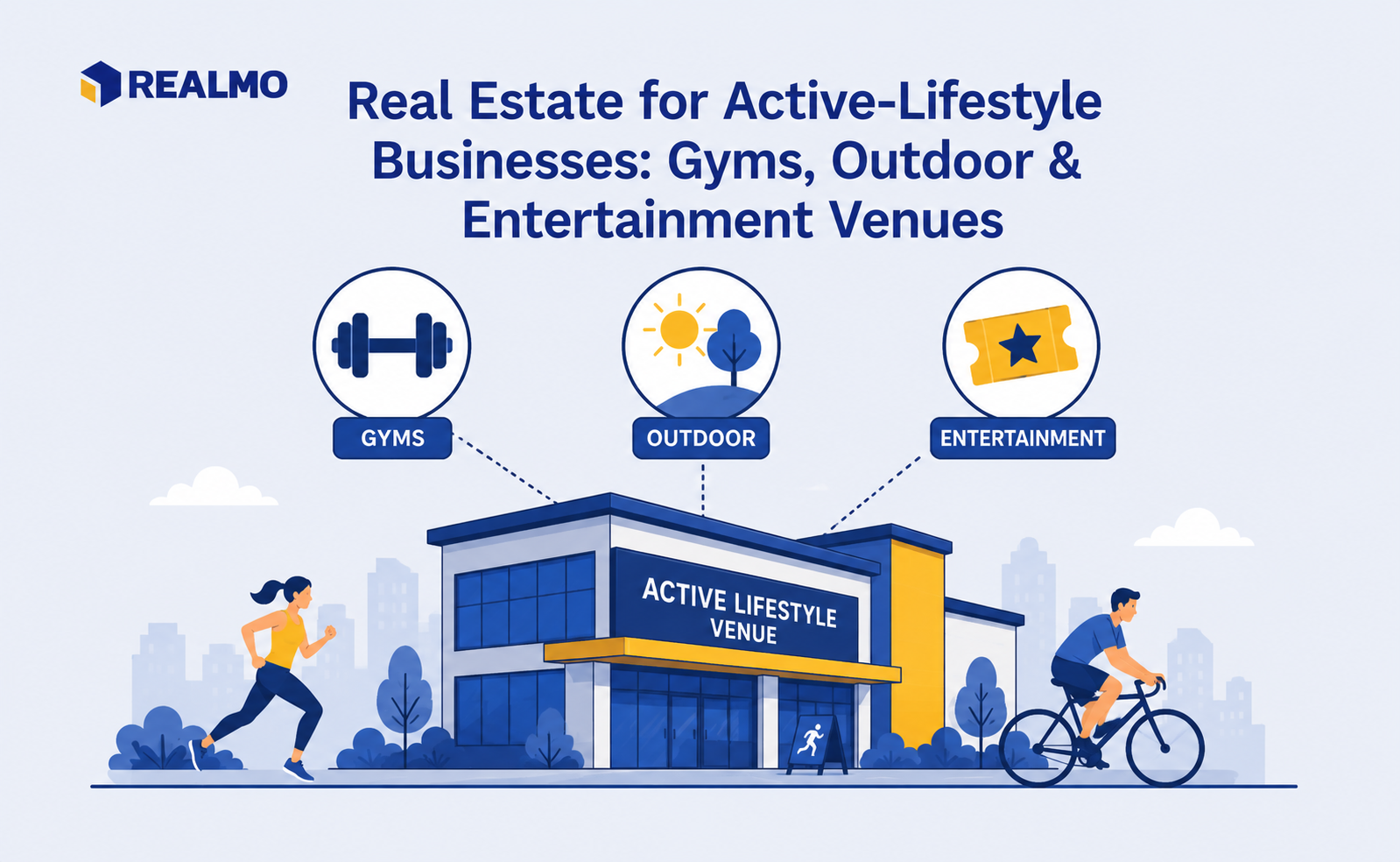
There is a shift happening in how people spend their discretionary money, and it has been building long enough now that it is reasonable to call it structural rather than cyclical. Consumers are spending more on doing things and less on buying things. Gym memberships, recreational sports, live entertainment, outdoor recreation, and experience-driven leisure are all growing categories – not because of a single trend or moment, but because a broad demographic shift toward health, wellness, and memorable experiences has changed where consumer dollars flow.
For commercial real estate investors, that shift has created a category of assets that deserves serious attention. Active-lifestyle properties – fitness centres, entertainment venues, sports facilities, marinas, performance spaces, outdoor recreation businesses – are businesses that generate recurring customer engagement built around participation rather than transaction. They are operationally more complex than a net-lease retail property and require a different kind of due diligence. But for investors who understand what drives performance in these categories, the opportunity is genuinely interesting.
What Makes Active-Lifestyle Real Estate Different
The most important thing to understand about these properties before evaluating any of them is that you are always buying two things simultaneously: the real estate and the operating business. Unlike a warehouse or a retail strip centre, where the building is the primary asset and the tenant handles the operations, active-lifestyle properties derive most of their value from what happens inside them. A fitness centre without members is just a building with expensive equipment. A marina without boats and services is waterfront land with infrastructure. The physical asset matters – but the operating model is what generates the returns.
This means the evaluation framework is fundamentally different from conventional commercial real estate analysis. Square footage, cap rate, and lease term are still relevant inputs. But membership retention, customer acquisition cost, equipment replacement cycles, programming quality, and operational margins are equally important – and they require a different kind of scrutiny to assess properly.
It also means that management quality and transition risk deserve serious attention in any acquisition. Many active-lifestyle businesses are deeply dependent on the relationships, programming decisions, and community presence of the people running them. Understanding what transfers with the keys – and what does not – is often the most consequential question in the entire due diligence process.
The Major Property Categories and What Drives Each One
Fitness and Wellness Properties
Fitness real estate has matured considerably from its origins as a relatively simple membership business. Modern fitness properties range from large multi-service facilities with pools, courts, group fitness studios, and personal training infrastructure to boutique concepts built around specific modalities – cycling, yoga, functional training, recovery services – that generate premium pricing and strong community loyalty from a deliberately smaller member base.
What they share is a revenue model built on recurring engagement rather than one-time transactions, which creates a more predictable income profile than most retail businesses. Fitness centres and gyms for sale – whether established large-format facilities with proven membership bases or boutique concepts in high-demand markets – offer investors exposure to a sector with strong demographic tailwinds and the kind of repeat customer behaviour that supports stable cash flow when the location and programming are right.
The variables that matter most in evaluating fitness properties are not always the obvious ones. Population density and parking availability matter enormously – convenience is arguably the single strongest predictor of membership retention in neighbourhood fitness concepts. Equipment replacement schedules represent a capital expenditure that can significantly affect operating margins if not properly accounted for. And member tenure and retention rates tell a more honest story about the health of the business than current membership count alone.
Entertainment and Recreation Venues
Entertainment properties are among the most operationally interesting assets in commercial real estate – and among the most demanding to evaluate properly. They depend on repeat visitation, community presence, and the quality of the experience they deliver, which makes them highly sensitive to management quality and programming decisions in ways that simpler operating models are not.
Bowling centres are a good example of how the category has evolved. Bowling alleys for sale today are rarely just bowling alleys – the best-performing operations have diversified into food and beverage, private event hosting, corporate bookings, birthday packages, and competitive league programming that generates consistent weekday traffic alongside weekend leisure demand. Lane utilisation, ancillary revenue per visit, and event calendar density are often as revealing as total revenue when evaluating the strength of a specific operation.
Golf has undergone a similar transformation. The traditional 18-hole public course faces real pressure from changing time constraints and participation patterns, but the broader golf entertainment category is genuinely growing. Golf courses and driving ranges for sale – particularly those that have invested in technology-enhanced practice facilities, lesson programming, and social experiences that extend the property’s appeal beyond traditional players – are attracting a more diverse investor audience than the category has historically seen. The land component also provides a capital preservation quality that pure operating businesses rarely carry.
Live performance spaces occupy a distinct and culturally significant position within the entertainment real estate landscape. Theaters and concert halls for sale serve communities in ways that generate genuine loyalty and public goodwill – but they also require careful evaluation of audience capacity, booking relationships, acoustics, technical infrastructure, and the realistic depth of local demand for live programming. Community anchoring can be a genuine competitive advantage. It can also create dependencies on programming relationships and institutional support that need to be understood before acquisition.
Sports Facilities
Sports-focused commercial real estate covers a wide range of formats, each serving a specific community of participants with distinct facility requirements, seasonal patterns, and demographic profiles.
Skating rinks for sale – whether ice or inline – serve a combination of recreational skaters, youth hockey leagues, figure skating programmes, and special events that can generate surprisingly diverse revenue streams from a single facility. Ice time scheduling, refrigeration system maintenance, and the balance between public sessions and league commitments are the operational variables that most directly affect financial performance. The equipment infrastructure is capital-intensive and requires serious assessment during due diligence.
Tennis facilities for sale have benefited from a genuine participation surge in recent years, driven partly by pickleball’s expansion into the same court infrastructure and partly by broader racquet sport growth across multiple age demographics. Well-positioned tennis and racquet sport facilities in markets with strong recreational demand and limited supply have been among the more attractive smaller-format sports investments available. Court surface condition, lesson and programming revenue, membership structure, and the potential to expand into adjacent court sports all factor into the valuation.
Outdoor and Waterfront Recreation
Outdoor recreation demand has proven more durable than many expected, and the commercial real estate businesses built around it have followed accordingly.
Marinas for sale represent one of the more complex but genuinely compelling categories within outdoor recreation real estate. A marina is simultaneously a waterfront real estate asset, a boating services business, a retail operation, and in many cases a hospitality and food and beverage business – all operating from a location that is inherently constrained by water access and rarely replicable nearby. Slip rental income, fuel sales, service revenue, storage, and on-site retail and dining can combine to produce a diversified revenue profile that holds up well across economic cycles when the location and management are strong. The waterfront real estate component also carries appreciation potential that is largely independent of the operating business performance.
Evaluating a marina requires understanding the regulatory environment around water and dock rights, the condition of underwater infrastructure, environmental compliance history, and the depth of the local boating market. These are not simple assessments – but they are the assessments that separate buyers who understand what they are acquiring from those who discover the complexity after closing.
What Location Actually Means in This Sector
Location works differently across active-lifestyle property types, and applying a single framework across the category is a mistake that buyers make more often than they should.
A neighbourhood fitness centre depends on residential density, commuter convenience, and the absence of direct competition within the catchment radius. Move it half a mile in the wrong direction and the membership economics change fundamentally. A marina depends on waterfront access, navigable water depth, and proximity to the boating community it serves – characteristics that are not replicable and that make the specific location essentially irreplaceable. An entertainment venue requires regional accessibility, parking that can handle peak event demand, and enough population density within a reasonable drive time to support consistent programming.
The consistent thread is that each property type has location requirements specific to its operating model, and evaluating location means asking whether this specific site works for this specific type of business – not whether it is generally well-located in a broad commercial sense.
The Trends Creating Long-Term Tailwinds
The demographic and cultural forces driving demand across active-lifestyle real estate are not new, but they have gained momentum in ways that look structural rather than temporary. Health and wellness have moved from discretionary concerns to genuine lifestyle priorities across a wide age range. Experience-driven leisure – the preference for doing something memorable over buying something forgettable – is a sustained behavioural shift rather than a moment. And the integration of technology into recreation, from AI-assisted coaching to digital memberships to online booking and community platforms, is improving the customer experience while giving operators better data to optimise their businesses.
Mixed-use development is reinforcing these trends by combining fitness, entertainment, food, hospitality, and retail into integrated destinations that give visitors multiple reasons to arrive and multiple reasons to stay. The commercial properties within those environments benefit from the mutual reinforcement that complementary businesses create – more traffic, more diversified revenue, and a customer relationship that extends beyond any single transaction.
What Due Diligence Actually Requires
The due diligence framework for active-lifestyle properties needs to cover both the real estate and the operating business with equal rigour. Revenue stability and customer retention trends over multiple years tell a more honest story than any single period’s performance. Equipment replacement schedules and capital expenditure requirements need realistic estimation – not optimistic projection. Zoning needs to be verified for current use and assessed for future flexibility. Insurance requirements, which can be substantially higher for certain recreation categories, need to be factored into operating cost projections from the start.
The competitive landscape deserves specific attention. How many similar businesses operate within the relevant catchment area? Are new entrants likely given market conditions? Is the current performance dependent on limited competition that may not persist?
And the management transition question needs an honest answer: how much of what makes this business work depends on specific people, relationships, or institutional knowledge that may not survive a change of ownership – and what does that mean for the realistic performance trajectory after closing?
Active-lifestyle commercial real estate offers access to businesses built around participation, community, health, and experience – categories with genuine long-term demand tailwinds and the kind of recurring customer engagement that supports durable revenue when the fundamentals are right. From fitness centres and entertainment venues to golf facilities, marinas, skating rinks, and performance spaces, the sector covers more ground than most investors initially realise.
What every category in this sector shares is the requirement to understand the operating business as thoroughly as the real estate. The investors who do that work – who evaluate customer retention alongside cap rates, management quality alongside property condition, and competitive dynamics alongside location – are the ones consistently finding the opportunities that others miss.