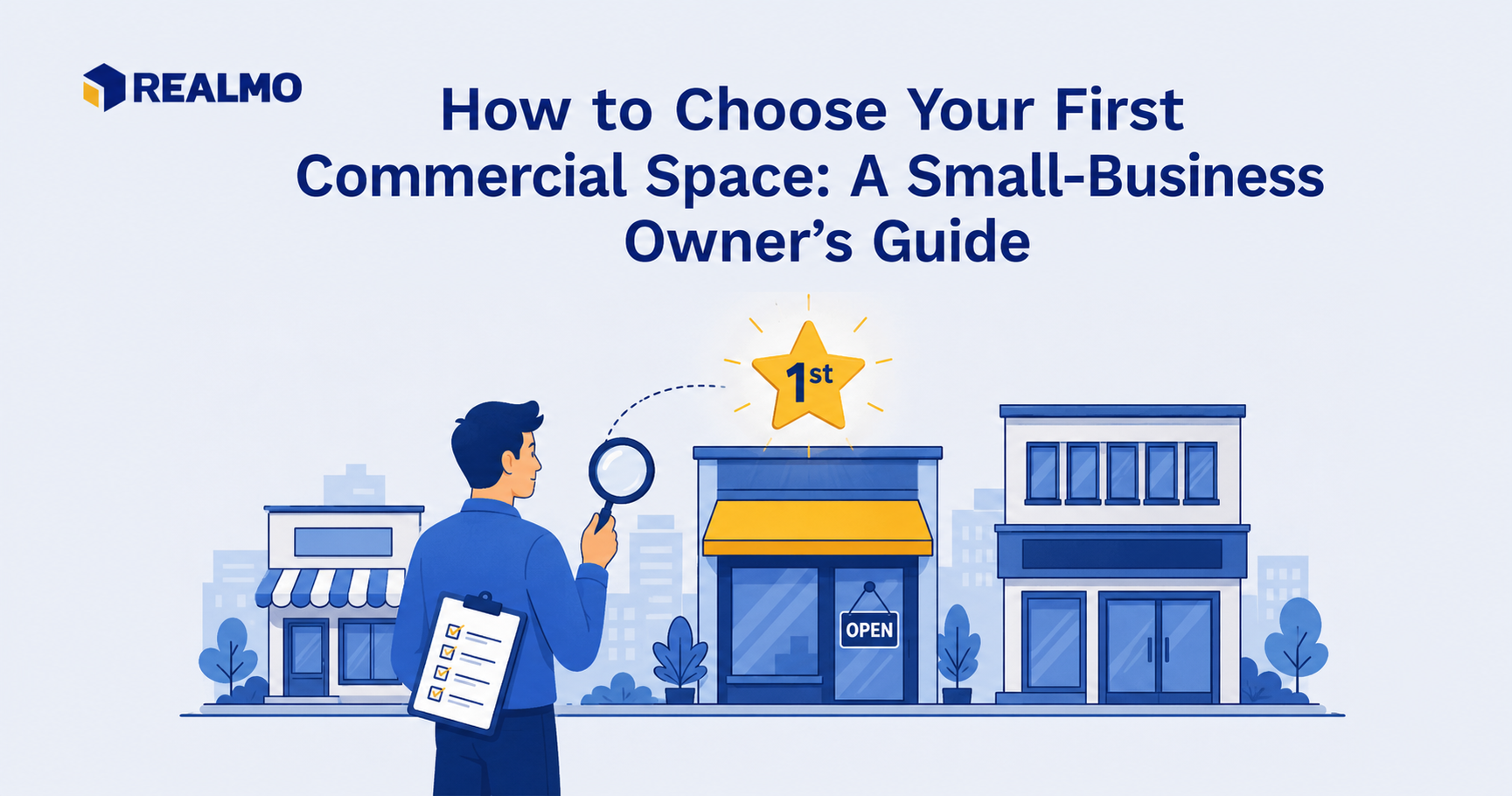
How to Choose Your First Commercial Space: A Small-Business Owner’s Guide
Most business owners who end up in the wrong commercial space will tell you the same thing when they look back: they knew something felt off, but they talked themselves into it anyway. The price was good. The building looked fine. The location seemed close enough to what they wanted. And then six months in, the problems that were always there started showing up in the numbers – in foot traffic that never materialised, in repair bills that arrived before the business had built any real reserves, in a layout that worked on paper and not in practice.
The decisions that determine whether a commercial property works for your business are almost all made before you make an offer. This guide walks through them in the order they should happen – not the order that feels natural when you are excited about a space you just visited.
Step 1: Write Down What You Need Before You Look at Anything
This is the step that almost everyone skips, and it is the one that causes the most downstream problems. The pull of browsing listings is real. Properties are visual, they are concrete, and looking at them feels like progress. But starting with listings before you have defined your requirements means you are evaluating properties against vibes rather than criteria – and vibes are not a reliable filter.
Before you open a single search platform, sit down and answer the operational questions honestly. How much space do you actually need – not the space you could work with, but the space your model genuinely requires? Does your business need specialised infrastructure: service bays, a commercial kitchen, refrigeration, outdoor access, a loading dock, specific utility capacity? What does a typical customer visit look like, and what does that tell you about parking requirements, pedestrian access, and layout? How many people will be working there, and does the space work for them as well as for customers?
Then push the question forward in time. A property that fits your business perfectly today but leaves no room for growth is not a long-term solution – it is a short-term fix that will eventually force a disruptive and expensive move at exactly the moment you can least afford the distraction. Look for layouts that can flex, adjacent land that could be developed, and zoning that accommodates what you might become rather than just what you are today.
Step 2: Search Within the Right Property Category
One of the most practical early decisions you can make is to stop searching broadly and start searching specifically. General commercial listings are useful for getting a feel for the market. They are not useful for developing the precise intuitions you need to evaluate whether a specific property represents good value for your specific business type.
The commercial real estate market is specific enough that each property category operates by its own logic – its own typical pricing, its own infrastructure requirements, its own deal-breakers and value drivers. The earlier you narrow your search to the category that actually matches your model, the faster everything else becomes clearer.
Here is how different business types map to the properties worth looking at – and what matters within each:
If You Are in Retail or Everyday Consumer Services
Retail businesses live and die by visibility and access. Before anything else, you need to know that customers can find you, reach you easily, and come back without friction. Storefront properties are the broadest entry point for any street-level retail concept – a useful place to start developing a feel for formats, locations, and price ranges across different markets before you narrow further.
If your model is built around food, grocery, or everyday household needs, acquiring an existing operation is almost always more practical than converting a generic commercial space from scratch. Grocery and convenience stores for sale come with operational infrastructure already in place and, crucially, real trading history you can review and stress-test before committing to anything. That history is worth considerably more than a projection based on demographic data alone.
Health retail and pharmacy operations come with regulatory complexity that makes purpose-configured properties especially attractive. The licensing environment, dispensing infrastructure, and compliance history of an existing drug store represent genuine value – and genuine time saved – compared to the alternative of building that infrastructure from the ground up in a converted retail unit.
If You Are in Food, Beverage, or Hospitality
Food service is one of the most unforgiving property categories for buyers who underestimate what the infrastructure actually involves. A restaurant space without a properly specified commercial kitchen, functioning ventilation, grease management systems, and adequate electrical capacity is not a restaurant – it is a renovation project that will cost significantly more than you expect and take longer than you plan. When you browse restaurants for sale, the properties where that infrastructure is already in place and well-maintained are worth a meaningful premium over ones that require immediate reinvestment. Licensing and inspection history matters here too: an existing clean record can shave months off the process between closing and opening day.
For bar and nightlife venues, the liquor license is often the most valuable asset in the entire transaction – more valuable, in some markets, than the real estate itself. Acquiring a property with an existing license and an established operational history changes the risk profile of the acquisition fundamentally. Bars for sale in well-positioned entertainment corridors where the licensing and customer base are both transferable represent some of the more genuinely turnkey opportunities available in hospitality. The combination is harder to build than it is to buy.
If You Are Entering Accommodation or Leisure
Accommodation businesses cover an enormous range of operating models, capital requirements, and lifestyle implications – and understanding which one actually fits before falling for a specific property is the difference between a good acquisition and an expensive lesson.
Full-service hotel operations require professional infrastructure and, usually, either brand affiliation or experienced management. Hotels for sale range from small boutique independents to larger flagged properties, and the right fit depends as much on your operational experience and appetite for involvement as it does on the financials.
If a more personal model appeals to you – fewer rooms, more direct guest relationships, a business that feels like an extension of how you want to live – then bed-and-breakfasts for sale deserve serious consideration. The capital entry point is typically lower, the guest relationship is fundamentally different, and the owner’s presence is usually part of what makes the property work. This is a lifestyle acquisition as much as a financial one, and should be evaluated as both.
Outdoor hospitality has been one of the more quietly interesting segments in recent years. Demand for outdoor recreation has been growing consistently, and well-located campgrounds for sale with modern amenities can generate strong revenue across more of the year than seasonal assumptions might suggest. The land component also gives campground acquisitions a capital preservation dimension that pure operating businesses rarely carry – which matters when you are thinking about the long-term picture.
If You Are in Automotive or Parking
Automotive businesses require infrastructure that is both expensive to build and specific enough that the only practical path is usually acquiring a property already configured for the use. The floor reinforcement, lift capacity, drainage systems, ventilation, and service bay layout of an existing auto shop represent years of investment and regulatory compliance that would take significant time and capital to replicate. When evaluating these properties, treat the condition of existing equipment as a first-order concern – it is often as important as the real estate itself.
Car wash operations sit at the intersection of real estate, equipment, and ongoing utility management in a way that makes the operating history of any specific site genuinely informative. When you look at car washes for sale, pay close attention to equipment age, maintenance records, and water management infrastructure. Revenue consistency and site visibility are the variables that most reliably separate acquisitions that perform from ones that require immediate reinvestment the moment the deal closes.
The self-service model solves the staffing problem by design – the business generates revenue around the clock without needing a team on site for most of it. Self-service car washes for sale are attractive for exactly that reason, but the model is entirely dependent on machines that function reliably without constant supervision. A thorough mechanical inspection is not optional here – it is the most important thing you can commission before making a decision.
Parking assets are, in many ways, the simplest commercial real estate operating model available. Demand is predictable, management intensity is low, and in dense urban or mixed-use locations where supply is structurally constrained, the cash flow can be remarkably consistent. Parking lots and garages for sale suit buyers who want real estate exposure and steady income without the operational complexity that comes with an active business model. If your priority is simplicity and reliability rather than growth, this category is worth understanding properly.
Step 3: Evaluate Location With Investor-Level Rigour
There is a version of location evaluation that most first-time buyers do – drive by, check Google Maps, confirm the neighbourhood feels right. And there is the version that actually protects you from making an expensive mistake. The difference is in the specificity and the sources.
Start with the demographics. Population growth trends, household income levels, employment patterns, and consumer spending behaviour tell you whether the market surrounding a property is building toward something or beginning to plateau. A growing area with improving fundamentals will generally support stronger business conditions over a five or ten-year hold than a flat market at the same acquisition cost – even if current conditions look similar on the surface.
Understand the competitive landscape. Complementary businesses nearby can generate synergistic foot traffic that benefits everyone in the corridor. Saturated markets with too many similar operators competing for the same customers are a harder environment to build in. Before shortlisting any property, spend time understanding who else is operating nearby, how well they appear to be doing, and whether the market genuinely has room for another player.
Look into the development pipeline. Planned housing developments, infrastructure investments, and commercial projects in the surrounding area can materially affect both business performance and property value over your holding period. This information is usually publicly available through local planning offices and zoning records – and it is worth the hour it takes to find.
Be honest about visibility and access. For any consumer-facing business, a location that customers struggle to find, park at, or navigate to will underperform a comparable property that removes that friction entirely. For operationally intensive businesses – automotive, food service, convenience retail – also think carefully about logistics: loading access, vehicle flow, delivery routes, and queuing space. These are the details that feel minor during a tour and significant during operations.
Step 4: Build a Realistic Picture of What Ownership Actually Costs
The purchase price is the number that gets all the attention. The actual cost of owning and operating a commercial property is a different, usually larger number – and the gap between the two is where the financial surprises that catch first-time buyers off guard tend to live.
A complete ownership cost model needs to include financing expenses, property taxes, insurance, utilities, maintenance, planned renovations, deferred capital improvements, and the category that surprises most new owners: systems that are functioning but aging. Roofs, HVAC units, plumbing infrastructure, electrical systems, and paved surfaces all carry replacement timelines. A property inspector will identify the condition of each of these – your job is to translate that condition into realistic budget lines before you make an offer, not after.
Be equally realistic about buildout and startup costs. Even a property that appears largely move-in ready will need investment to align it precisely with your operating model. Estimate those costs conservatively. Then think seriously about long-term resale value – buying in a market with strong growth fundamentals and flexible zoning means the real estate itself contributes to your financial picture over time, not just your operational needs today.
Step 5: Do Due Diligence Without Shortcuts
This is the stage where enthusiasm needs to be temporarily replaced with systematic scrutiny. It is also the stage where buyers who are in love with a property are most tempted to skip steps or accept reassurances they should be verifying independently.
Commission a thorough professional inspection that covers structural integrity, foundation condition, roofing, electrical systems, plumbing, HVAC, drainage, and accessibility compliance. For property types with significant operational infrastructure – automotive facilities, food service properties, accommodation businesses – the inspection scope needs to match the complexity of what you are acquiring. A general commercial inspection is not sufficient for a property with specialist systems.
Get an environmental assessment for any property with contamination risk – former automotive sites, dry cleaning operations, or fuel-adjacent properties. Identifying a problem before closing is an inconvenience. Discovering it after is a liability.
Verify market data independently. Comparable sales, local vacancy rates, neighbourhood trajectory, and rental demand trends all inform whether the asking price reflects genuine market value. Seller representations are a starting point, not a conclusion. The buyers who make the best acquisitions are consistently the ones whose decisions are built on research they conducted themselves.