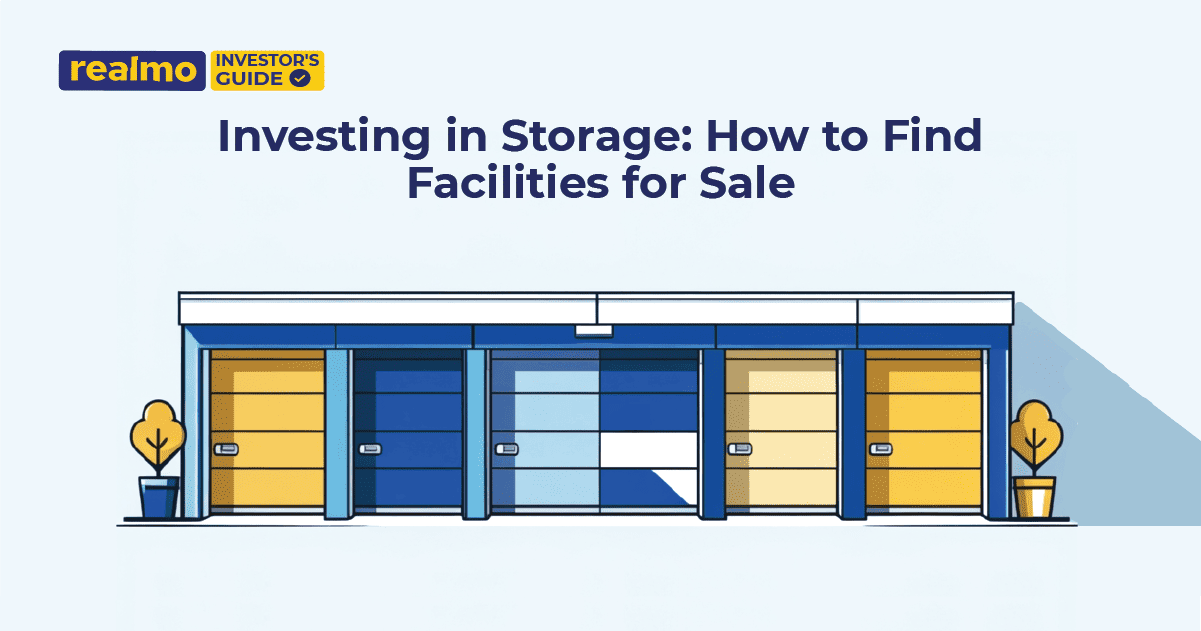
Investing in Storage: How to Find Facilities for Sale
The commercial real estate landscape has shifted dramatically in the post-pandemic era, yet the self-storage industry remains a standout performer. Often cited as “recession-resistant,” the sector’s resilience is driven by the “4 Ds” of demand: Death, Divorce, Downsizing, and Dislocation. Regardless of economic conditions, these life events physically displace goods, creating consistent demand for self-storage units.
For sophisticated investors, the allure is clear: historically, self-storage has delivered risk-adjusted returns that often outperform multifamily and industrial sectors. However, entering this lucrative market without a precision-engineered search strategy is a capital risk. As recent data indicates, while the sector is resilient, shifting migration patterns and interest rate volatility have made market selection more critical than ever. To invest in self storage successfully today requires moving beyond general enthusiasm to rigorous, data-backed acquisition modeling. This guide provides the framework for identifying, underwriting, and acquiring institutional-quality assets.
The Self-Storage Industry & Market Overview
Simple Definition
The self-storage market is a subsector of real estate focused on renting secured ground space or building units to residential and commercial tenants on a short-term, month-to-month basis.
Why It Matters
Investors must grasp the sheer scale of the opportunity. The U.S. market comprises approximately 1.9 billion square feet of rentable space, yet it remains highly fragmented. Unlike consolidated industries, significant ownership is held by independent operators rather than REITs, creating acquisition targets for private capital. This demand profile validates self-storage as a core portfolio stabilizer rather than a niche allocation, with public REIT market capitalization alone exceeding $70 billion.
Pro Tip
Macro statistics are useful for context, but self-storage market mechanics are hyper-local. Do not rely solely on national occupancy trends. A facility’s success is determined by the supply and demographics within a three-mile radius—often tightening to 1.5 miles in urban cores. When analyzing a deal, this three-mile trade area is your entire economic universe; if the million square feet of supply in that circle exceeds demand, national averages become irrelevant.
Sourcing Facilities for Sale
Simple Definition
Sourcing refers to the strategic process of identifying storage facilities for sale, executing acquisitions through listed channels (brokers), or originating off-market transactions directly with owners.
Why It Matters
Relying on public listing portals like LoopNet is often a strategy for finding leftovers, not unicorns. High-yield deals are frequently transacted quietly. Professional buyers and sellers operate in a network where the best storage facilities for sale are under contract before they ever hit the open market. To compete, you must access the “shadow inventory” of assets controlled by independent operators looking to exit.
Pro Tip
While it is advisable to hire an experienced real estate professional or broker who specializes in storage, you should not outsource your deal flow entirely. Approximately 70% of facilities are owned by independent operators, many of whom are “mom-and-pop” owners. These owners often prefer to sell directly to avoid broker commissions. Implementing a direct-to-owner mail campaign targeting specific vintage assets in high-growth corridors allows you to find facilities for sale that institutional competitors miss. Combining broker relationships with proprietary sourcing is the hallmark of a successful acquisition strategy.
Acquisition Strategy: Buying Existing vs. Building New
Simple Definition
This strategy involves deciding between acquiring existing facilities with in-place income or executing a ground-up development play.
Why It Matters
The choice dictates your risk profile and capital velocity. Buying an existing facility provides immediate cash flow and removes entitlement risk, although often at a higher entry premium. Conversely, developing a new facility or a facility from the ground up typically offers a higher yield on cost (development spread) but requires a longer time horizon (12-24 months) before seeing revenue.
Pro Tip
In the current high-interest/high-construction-cost environment, a hybrid approach is often superior: look at converting distressed retail or vacant industrial assets. Adaptive reuse projects often bypass the onerous zoning and entitlement delays associated with ground-up builds. Conversions allow you to bring a new facility to market faster, absorbing demand before competitors can break ground. This speed-to-market can be the difference between dominating a trade area and fighting a price war.
Critical Financial Metrics: NOI & Cap Rate
Simple Definition
Net Operating Income (NOI) represents revenue minus operating expenses (excluding debt service). The Capitalization (Cap) Rate is the ratio of NOI to asset value, essentially the unlevered yield.
Why It Matters
These metrics are the bedrock of the business model. They determine the purchase price you should pay and the asset’s future valuation. A miscalculation here destroys the profit margin. Understanding the nuance of NOI prevents overpaying for “potential” income that may never materialize.
Pro Tip
As an analyst, I advise you to never accept a seller’s stated Cap Rate at face value. Sellers almost universally underreport operational costs to inflate NOI. You must re-underwrite the property using a standardized expense ratio—typically 35% to 40% of gross revenue—as your baseline. If a seller claims they run the facility at a 20% expense ratio, they are likely deferring maintenance or underinsuring the asset.
Financing & SBA Structures
Simple Definition
Capitalization involves structuring the debt stack, often utilizing SBA loans (7a and 504) provided by the Small Business Administration, or conventional commercial financing.
Why It Matters
Leverage makes the returns work. Financing options like SBA loans allow for high leverage (up to 90% LTV), significantly reducing the equity requirement. This accessibility makes financing a self-storage acquisition viable for newer investors, though it requires personal guarantees and owner-operator involvement.
Pro Tip
Include SBA loans in your analysis for acquisitions under $5 million, particularly if you intend to be an operator. However, be vigilant regarding interest rates; SBA 7a loans are floating-rate products. In a volatile rate environment, a floating rate can erode cash flow quickly. If you plan to be a passive investor, or if the deal size exceeds SBA limits, fixed-rate conventional debt or hard money (for bridge scenarios) may offer better stability despite higher down payment requirements.
Physical Facility Classifications: Climate vs. Drive-Up
Simple Definition
Facilities are categorized by their build type and amenities: climate-controlled (temperature regulated, often multi-story) versus standard drive-up units (single-story, garage style).
Why It Matters
Your product must match the local demographic. Climate-controlled units command higher rents per square foot but come with significantly higher utility and construction costs. Conversely, drive-up units offer lower density but operate with minimal overhead.
Pro Tip
Do not fall into the trap of over-improving. Just because you can build Class-A climate control doesn’t mean the market will pay for it. If your trade area functions primarily for vehicle storage or contractor equipment, square feet of storage space with wide drive aisles and drive-up access will outperform vertical climate control. In many secondary markets, the simplicity of a drive-up facility yields a superior ROI due to lower construction basis and maintenance.
Revenue Management: Occupancy & Rental Rates
Simple Definition
This refers to the relationship between the physical occupancy rate (units filled) and the economic rental rates (price per square foot) charged to tenants.
Why It Matters
High occupancy is a vanity metric if not paired with strong pricing. A facility that is 100% full effectively has zero inventory relative to demand for storage, hindering revenue growth. Conversely, aggressive pricing that drives occupancy below 80% signals a disconnect with the competition in the area. The goal is economic occupancy, not just physical capacity.
Pro Tip
Aim for a stabilized occupancy band of 85-92%. If your self-storage units are 98-100% occupied, you are definitively undercharging. Sophisticated operators use dynamic pricing algorithms to adjust rental rates daily based on supply. Furthermore, legacy tenants often pay far below market; executing a scheduled rate increase program every 6-9 months is the fastest way to increase the value of your storage space without incurring capital costs.
Operational Costs & Management Strategies
Simple Definition
These are the expenditures required to maintain the asset, including property taxes, insurance, marketing, and labor, which dictate the efficiency of the storage business.
Why It Matters
Low operational costs are the defining advantage of the storage asset class. Unlike multifamily, you are not maintaining kitchens, bathrooms, or plumbing for every tenant. This structural efficiency creates a storage unit business with naturally higher margins, provided expenses are managed tightly.
Pro Tip
The modern business owner must embrace automation. The “unmanned” model is rapidly becoming the industry standard for smaller facilities. Remote management technologies—such as automated kiosks, smart locks, and cloud-based access control—can reduce on-site payroll (the largest controllable expense) to near zero. By removing the need for a full-time manager, you significantly increase the share of the business that converts to bottom-line profit.
Profitability: ROI & Cash Flow
Simple Definition
Profitability is measured by Return on Investment (ROI), the total gain relative to cost, and cash flow, the net liquidity available after debt service.
Why It Matters
While asset appreciation is valuable, successful self-storage investors prioritize cash flow sustainability. You cannot pay a mortgage with equity. Consistent monthly income is essential to weather economic downturns and service debt obligations across the portfolio.
Pro Tip
Do not judge a deal solely on Year 1 returns. Self-storage is a compounding asset class. Real estate investment trusts (REITs) and private equity favor this sector because month-to-month lease structures enable continuous rent optimization. As you systematically raise rents on the existing tenant base, your effective yield on cost accelerates. A facility that breaks even in Year 1 can become a cash cow by Year 3 purely through operational efficiencies and rent growth.
Conclusion
The self-storage industry remains one of the most accessible yet scalable vehicles for wealth creation in commercial real estate. While the days of “build it and they will come” are over, the fundamentals of the sector—driven by life transitions and a sticky customer base—remain robust. Whether you want to build, start a storage conversion, or acquire a turnkey asset, the key lies in execution.
If you are considering investing, do not leave your success to chance. Start your market research today. Net operating income and ROI are not products of luck; they are the results of a disciplined business plan and rigorous due diligence. Opportunities to acquire operationally efficient assets exist, but they require an investor willing to look where others won’t.