How to Negotiate a CRE Lease
Rent is the second-largest operating expense most businesses carry, after payroll. The draft lease a landlord sends is not the deal but the opening position. Almost every clause in a commercial lease is negotiable, provided the tenant arrives at the table with data, professional support, and a clear understanding of what they actually need.
This guide breaks down how to negotiate a commercial lease and shows you how Realmo helps tenants approach leases with better data, clearer benchmarks, and a stronger negotiating position before anything is signed.
Know Your Position Before You Sit Down
Preparation is where leverage is built. Everything that follows in the negotiation (every clause discussed and every counteroffer made) lands harder when it comes from a tenant who has done the work before showing up.
Define your business needs and budget
Before reviewing a single lease term, clarify what the space actually needs to do:
- How much square footage is genuinely required today, and what does that number look like in two or three years if growth follows its current trajectory?
- Is the lease term length flexible, or does uncertainty about near-term headcount argue for a shorter initial commitment?
Tenants who skip this step routinely end up locked into the wrong square footage, either paying for space they cannot fill or scrambling for expansion rights they never negotiated. Set a hard budget built on total occupancy cost, not just base rent, and know the maximum cost-per-square-foot the business can sustain before the first viewing.
Research market conditions
The single most powerful thing a tenant can bring to a lease negotiation is an accurate read of local market conditions:
- What are comparable spaces actually renting for?
- How long has the target property been on the market?
- What is the current vacancy rate in the submarket?
A landlord with a space that has sat empty for eight months has very different negotiating incentives than one fielding multiple offers. That difference is leverage, but only if the tenant knows it exists.
Pro tip: The best way to assess market conditions is to take a look at the properties the area offers. Use Realmo to search over 1 million assets nationwide, compare prices, and see where you can land rent-wise. On top of that, you can use Realmo’s Analytics Center to get deeper AI-powered reports to support your decisions. Informed tenants consistently get better deals.
Understanding Commercial Lease Types
The type of commercial lease determines which costs the tenant is responsible for, and that, in turn, determines which costs are actually open to negotiation. Getting clear on the lease structure early is the foundation of the entire cost conversation.
- Under a gross rent lease, the tenant pays a single all-in figure that covers base rent and most incidentals: utilities, property taxes, insurance, common area expenses including snow removal, janitorial services, and property management. The predictability is real, and it is worth something. There are no billing surprises at the end of the quarter. Modified gross leases split that incidental burden between landlord and tenant, with the specific allocation varying significantly from deal to deal. The exact division is negotiable, which means it needs to be spelled out clearly rather than left to interpretation.
- Net leases present the most complexity for first-time tenants. The tenant pays base rent plus a defined share of operating expenses – property taxes, insurance, and maintenance, while the landlord covers the remainder. The base rent headline typically looks lower. The total occupancy cost, once pass-throughs are factored in, often is not. “Net” does not carry a universal meaning; always verify precisely what is included before comparing rates across lease types.
- Percentage rent leases, common in malls and multi-tenant retail environments, charge base rent plus a percentage of the tenant’s gross sales above a defined threshold. For retail operators, this structure ties occupancy cost directly to business performance, which can be an advantage in slow periods and an expensive clause in strong ones.
The Must-Review Clauses
The specific terms below are the ones most likely to affect the total cost and operational freedom of a commercial tenancy, and the ones most commonly left unchallenged by tenants who don’t know where to push back.
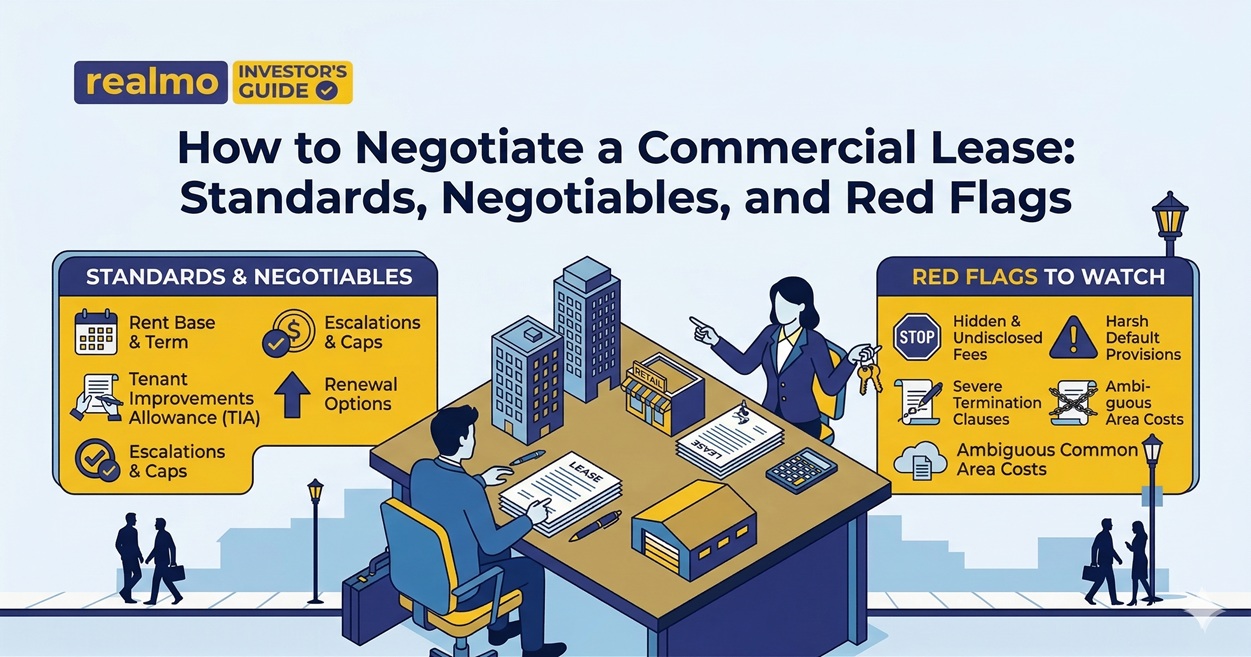
Rent escalation and future base rent increases
Most commercial leases include an automatic rent escalation clause, structured either as a fixed annual percentage increase or as a CPI-linked adjustment. These clauses compound. A 4% annual escalation on a five-year lease increases base rent by more than 21% by year five — a number that looks manageable in isolation and adds up significantly against a real budget. Many first-time tenants sign without registering it.
Negotiate a cap on annual escalation. An annual increase ceiling of 2-3% is achievable in many markets, particularly where vacancy gives the tenant leverage. At least ensure the language specifies exactly when escalation triggers, what the calculation methodology is, and whether any escalation applies from day one or only after a rent-free period expires. Future base rent increases should never be left to a vague formula that the landlord interprets at renewal.
CAM charges and common area expenses
Common area maintenance charges cover shared costs like snow removal, landscaping, janitorial services, building management, lighting in common corridors, and they are one of the most frequently misunderstood cost categories in a commercial lease. In net lease structures especially, CAM charges can add meaningfully to the headline rent, and the amounts are not always calculated the way a tenant might expect.
Request an itemized breakdown of all CAM components before signing anything. Negotiate a cap on year-over-year CAM increases, typically in the range of 3-5%, to limit exposure if operating costs spike. Verify whether charges are calculated on total building square footage or only on occupied space. The difference matters, and landlords don’t always volunteer which method they use. CAM is one of the categories where costs are most easily inflated beyond what is genuinely standard. Knowing the market comparables for similar buildings is the check that keeps those charges honest.
Tenant improvement allowance
Most commercial spaces are delivered in a condition that requires meaningful work before a tenant can operate from them. Partition walls, flooring, lighting configurations, plumbing connections, IT infrastructure — these all come at the tenant’s expense unless a tenant improvement allowance is negotiated into the deal. A TI allowance is a landlord-funded contribution toward those leasehold improvements, and it is standard enough in competitive markets that experienced tenants always ask for it.
Not asking is the most common mistake made at this stage. Many landlords budget for TI requests and expect them. The absence of one is not a negotiating advantage for the tenant but simply money left behind. If the tenant is funding improvements independently, negotiate a leasehold improvement clause that requires the landlord to reimburse all or part of the investment if the lease is terminated early on the landlord’s side. Clarify upfront how unused allowance is handled, whether it carries forward, applies to rent, or lapses.
Exclusivity and competitor clause
A competitor clause requires the landlord to obtain the tenant’s consent before renting space in the same building or center to a direct competitor. For retailers, food and beverage operators, and any business that depends on customer flow within a shared environment, this clause protects a fundamental business interest. It’s very difficult to negotiate retrospectively once a competing tenant has already moved in.
In multi-tenant retail settings and malls, a co-tenancy clause can go further, allowing the tenant to terminate the lease or negotiate a rent reduction if an anchor tenant closes or the occupancy rate in the center falls below a defined threshold. These clauses require careful legal drafting to be enforceable, which is another practical reason to involve a commercial attorney early.
Early termination and break clauses
Consider the scenarios in which a business might need to exit a lease before the term expires:
- A strong growth quarter may mean the space is too small within 18 months
- A revenue downturn may make the monthly obligation unsustainable
- A business sale may transfer the obligation to a buyer who wants different terms
Most tenants don’t think through these scenarios until they are already living them, at which point the lease document determines what options remain.
Many commercial leases require the tenant to pay the full remaining rent obligation if the lease is broken. That liability can be significant, especially in long-term deals. Negotiate a break clause that can be triggered under defined conditions before signing, ideally tied to specific business events or a defined notice period. Confirm sublease rights as an alternative exit pathway. Verify what happens to the lease if the landlord sells the property; the termination conditions should address that scenario explicitly, not leave it to goodwill.
Renewal conditions
Lease renewal terms are frequently auto-inserted at whatever rate the landlord sets at the time of renewal, with limited tenant protection unless the original lease establishes otherwise. The time to negotiate renewal conditions is before the initial lease is signed, not six months before expiration, when the landlord has all the timing leverage.
Push for a renewal option at a defined rate or a rate formula tied to market comparables, and build in a right of first refusal on adjacent space if expansion is a realistic possibility. Avoid automatic renewal clauses that lock the business in without explicit tenant action — these are routinely missed and frequently triggered by inaction. At renewal, market conditions may have shifted considerably, especially in a softening market where landlords are competing for tenants. Operators who have multiple leases expiring with the same landlord, or who are among the stronger tenants in a building, carry real leverage at renewal.
Red Flags Before You Sign
Not all lease terms deserve negotiation. Some warrant walking away from the deal entirely. These are the warning signals that suggest a draft is disproportionately structured in the landlord’s favor.
- Watch for any lease that provides no itemized breakdown of CAM charges or operating expense pass-throughs. If the landlord is unwilling to specify what is included in common area expenses, there is no practical way to verify whether future billings are accurate.
- Similarly, escalation clauses with no caps and no defined calculation methodology should trigger a pushback or a redraft before anything moves forward.
- Vague or one-sided termination language is a consistent red flag. If the conditions under which either party can exit the lease are ambiguous, that ambiguity will resolve in the landlord’s favor in most jurisdictions. No sublease rights removes a key exit pathway from the tenant’s options entirely — it should almost always be negotiated back in. And automatic renewal clauses without clear tenant notice requirements have a tendency to trigger inadvertently, creating multi-year obligations the tenant did not consciously choose to accept.
- A clause giving the landlord the right to relocate the tenant within the building (with limited notice and no rent adjustment) is another provision that warrants careful scrutiny. The lease should reflect a mutual agreement, not a document the landlord can modify unilaterally after signing.
Tactics That Give You Leverage in Negotiations
Tenants have more negotiating power than most of them use. The tactics below are standard practices that experienced tenants apply and that landlords expect.
- Always ask for tenant inducements, especially when a space has been vacant for a meaningful period. Landlords managing empty square footage have carrying costs and strong incentives to secure a stable, creditworthy tenant. Free rent months, landlord-funded renovations, and TI contributions are all tools that become more accessible when vacancy has been running long. The worst outcome from asking is a refusal. The cost of not asking is borne silently through every month of the lease.
- Use competing offers as negotiating tools. Evaluating multiple properties simultaneously is how well-prepared tenants operate. When a landlord knows a tenant is in active conversations elsewhere, the dynamic of the negotiation shifts. Competing offers are real alternatives that demonstrate the tenant has options, which is the clearest signal that the terms being offered need to be competitive.
- Pair that with the straightforward leverage point of being an established, creditworthy tenant with a track record: landlords value stability and predictability, and a tenant who can demonstrate both brings something genuinely useful to the table.
- Request a rent-free period as standard, particularly when significant leasehold improvements are required. This is widely expected in markets with meaningful vacancy and commonly granted to tenants who ask.
- Never sign without a commercial broker providing market context and an attorney reviewing the lease language — the cost of both is modest relative to the multi-year financial exposure the lease creates. And don’t rush. The landlord’s first draft is written to be accepted.