How to Find Commercial Real Estate for Lease: Key Strategies
Leasing commercial real estate requires more than choosing a property that seems to fit your business. The real decision lies in understanding the financial terms, legal obligations, and operational constraints built into the lease itself. A commercial lease can determine your true occupancy costs, your ability to adapt as the business changes, and your exposure to risk over several years.
This guide explains the leasing process step by step, from defining your requirements and evaluating spaces to reviewing lease types, negotiating critical terms, and preparing to sign. You will have a simple, repeatable framework for approaching a commercial lease with more clarity, stronger questions, and fewer expensive surprises.
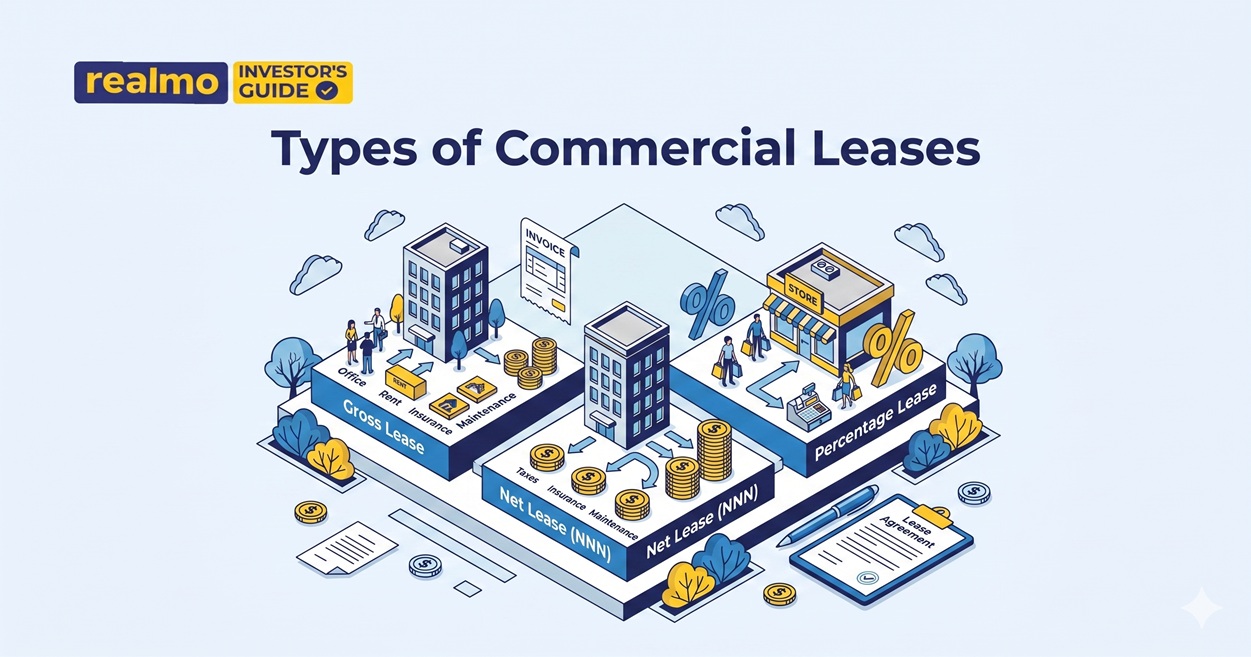
Major Lease Structures
Before you review a single listing, it’s worth being clear on how commercial leases are structured. The type of lease determines far more about your real monthly cost than the rent figure does.
- A gross lease is the simplest arrangement. You pay one number, and the landlord handles operating expenses, like taxes, insurance, and maintenance. Your cost is predictable, which is genuinely valuable for budgeting. The trade-off is that gross leases carry higher base rent, because the landlord is pricing in the risk of costs rising over the lease term. You’re paying for certainty, and the certainty isn’t free.
- A triple net lease works the other way. Base rent comes down, but you take on responsibility for property taxes, building insurance, and maintenance costs on top of it. In markets where those costs are stable and predictable, NNN leases can work out well. In markets where property taxes are reassessed frequently or where the building has deferred maintenance, the variability can be significant. The headline rent looks attractive. The total bill sometimes doesn’t.
- A percentage lease is most common in retail. You pay a lower base rent, and once your revenue crosses a defined threshold, a percentage of sales above that level goes to the landlord. It aligns incentives in an interesting way — the landlord benefits from your success. But it also means your occupancy cost is partially unpredictable, which complicates financial planning as the business grows.
Hidden costs that don’t appear in listings
Rent is quoted per square foot, which makes comparison easy. What it doesn’t tell you is what you’ll actually spend occupying that space. Before comparing any two options, you need to account for:
- CAM charges, which cover shared spaces like lobbies, parking lots, and building corridors. These can add 15 to 30 percent on top of base rent in multi-tenant buildings.
- Property tax passthroughs, particularly in net lease structures, where market conditions or reassessments can push these up unexpectedly.
- Utilities, if they’re not separately metered to your space.
- Building insurance contributions.
- Security deposits, which in commercial leasing routinely run two to four months of rent.
The gap between the advertised rent and total occupancy cost is where most first-time commercial tenants get surprised. Running both numbers before you compare options is the only way to make an honest evaluation.
The Leasing Process, Step by Step
1. Start with a written brief, not a property search
This sounds obvious and yet gets skipped constantly. Before reviewing listings, the most useful thing a business can do is write down exactly what it needs: not a rough idea, but an actual set of criteria with hard limits.
That means:
- a square footage range that reflects both current operations and realistic near-term growth
- location requirements tied to how the business actually functions (where customers come from, where employees live, what operational access the space needs)
- a budget expressed as total occupancy cost
Without criteria defined upfront, the search becomes reactive: you evaluate whatever’s available rather than filtering toward what actually fits.
2. Find spaces worth evaluating
Public listing platforms are the obvious starting point, but they show a fraction of what’s actually available. Experienced brokers maintain relationships that surface off-market opportunities:
- spaces that haven’t been formally listed yet
- landlords who are open to transacting but haven’t gone public
- deals that get done before competition shows up
Not everything in a listing is priced realistically, either. Some properties sit for months because the asking rent is above market, and the landlord is waiting for a tenant who doesn’t know any better. A broker who is genuinely embedded in the submarket can tell you which listings are reasonably priced and which ones you’ll spend time on only to hit a wall during negotiation.
3. Evaluate a space beyond the tour
A good walkthrough tells you whether a space feels right. It doesn’t tell you whether it is right. The evaluation that actually matters happens on paper.
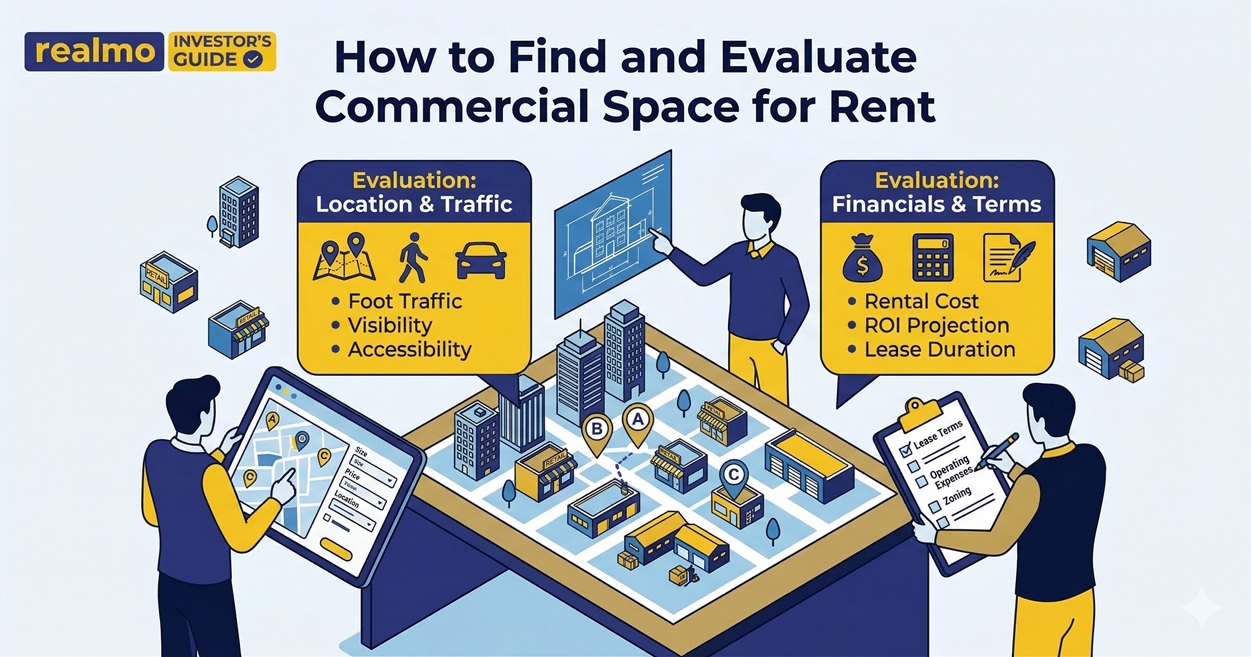
Location deserves real analytical attention, not just intuition. For retail businesses, the questions are specific:
- How many people pass the space each day, at what times, traveling in which direction?
- What’s the parking situation for customers?
- What do neighboring tenants attract, and does that foot traffic overlap with your customer profile?
For office-based businesses, the calculus shifts toward employee commute convenience, proximity to clients, and the professional character of the neighborhood. Industrial tenants care about something else entirely: loading access, ceiling clearance, truck routes, and zoning that permits their actual operations.
Zoning is also worth verifying independently before you get deep into lease negotiations. The previous tenant’s use doesn’t guarantee yours is permitted. Finding out after you’ve invested time in a space that you’d need a variance is a frustrating and avoidable situation.
4. Do due diligence before you sign
Commercial lease due diligence isn’t as intensive as buying a property, but it still deserves serious attention. At minimum:
- read the full lease document, not just the summary sheet or the business terms the broker walked you through
- have a commercial real estate attorney review it — someone who reads commercial leases regularly and knows what unusual provisions look like
- verify the physical condition of the space, particularly any systems you’ll be responsible for maintaining
- confirm that everything agreed verbally is actually in the written document before you sign it
That last point trips people up more than it should. Landlords and brokers sometimes make commitments in conversation that don’t make it into the final draft. If the landlord agreed to replace the HVAC, paint the space, or allow subletting under certain conditions, it has to be in writing. A verbal agreement in commercial leasing is worth approximately nothing when a dispute arises.
Negotiation: Potential for Leverage
The rent figure is just the starting point
Commercial leases are negotiated documents. Landlords build flexibility into initial proposals precisely because they expect tenants to push back. The businesses that sign the best commercial leases aren’t necessarily the ones with the most leverage. They’re the ones that showed up knowing what to ask for.
Rent itself is negotiable, but it’s often not where the most meaningful value sits. The terms that tend to matter more over the life of a lease:
- Free rent periods: one to three months of no-rent occupancy at the start of a lease is standard in many markets, especially for longer terms or spaces that have been vacant a while.
- Tenant improvement allowances: landlord-funded contributions toward fitting out the space, which can range from a few dollars per square foot to full build-out depending on market conditions and how badly the landlord wants the deal.
- Annual escalation caps: a 3 percent annual increase sounds manageable; compounded over eight years, it means rent in year eight is nearly 27 percent higher than at signing, capping or reducing that escalation rate has real financial value.
- Renewal options: the right to extend the lease at a defined rate or methodology, rather than renegotiating from scratch at a point when you’ve invested in the space and the landlord knows it.
- Early termination rights: particularly valuable for businesses whose growth trajectory is uncertain.
A lease with slightly higher base rent but strong terms on these provisions will frequently outperform one with lower rent and none of them.
Who pays for the build-out
If the space needs significant customization (different floor plan, specific infrastructure, particular finishes), the negotiation over improvement costs matters a lot. Landlords in softer markets often offer meaningful TI allowances to secure longer commitments. In tighter markets, those allowances shrink, and tenants end up funding more of their own build-out.
The general principle is to match the scale of build-out investment to the lease term. A three-year lease with a basic renewal option isn’t the right context for a $200,000 tenant-funded renovation. If the landlord won’t extend the lease or the renewal terms are unfavorable, there’s a real risk you don’t recover that investment. A longer lease with clear renewal protection is a different situation: the build-out cost can be amortized over a term that actually justifies the investment.
Picking the Right Location
1. Work backward from the business
The most reliable way to evaluate location is to start from what the business actually needs and work backward to geography, not to browse what’s available and then rationalize a location choice.
- For retail, that means understanding where your customers actually are and how they move, not where you want to be. A high-foot-traffic corridor that attracts the wrong demographic is still the wrong location. A slightly less prominent space that sits on the route your actual customer base travels every day can dramatically outperform it.
- For service businesses, proximity to existing clients and ease of employee commute usually matter more than visibility. For industrial users, the location variables are almost entirely operational – distance to suppliers, highway access, labor availability in the surrounding area, and whether neighboring uses are compatible with daily operations.
Pro tip: Use Realmo to narrow location options before you tour anything. With 1M+ active commercial listings across the U.S., it gives you a much broader view of available inventory than manually checking scattered listing sites.
You can search traditionally with filters, or use Rey, Realmo’s AI assistant, to describe what you need in plain language, such as the type of business, target area, budget, size, and strategy. From there, Realmo’s reports and analytics can help you evaluate whether a location actually fits the business, using data like pricing context, property insights, estimated value, ownership records, and location intelligence. That makes it much easier to compare locations based on real business fit, not just surface appeal.
Common CRE Lease Mistakes
Treating the landlord’s first draft as the final offer. Some tenants do this out of unfamiliarity, some out of eagerness to close. Either way, it consistently produces worse outcomes than a straightforward negotiation would have. Most landlords have room to move. The question is whether you ask.
Leasing for growth that hasn’t happened yet. Taking on 8,000 square feet because the plan is to grow into it in two years is reasonable if that growth is highly predictable and the business has the financial cushion to carry the space until then. If the growth is aspirational, that extra space becomes dead overhead with a long-term lease attached to it.
Not modeling the escalation math. A 4 percent annual rent increase sounds modest. Over a seven-year lease, it means you’re paying more than 30 percent more in year seven than you were in year one. Very few businesses build that into their projections when they sign, and then act surprised when it arrives. Run the numbers for the full lease term before you commit.