Commercial Property Owner Search: How to Find the Owner of a Property
Let’s say you’ve found a vacant retail building, a tired office property, or a small industrial site with obvious potential. There’s no “For Sale” sign, no broker flyer, and no clear contact person. The opportunity is there, but first, you need to know who really owns it. Now, a commercial property owner search comes in, and it’s not as straightforward as you might think. In commercial real estate, the owner is often hidden behind an LLC, corporation, or holding company, so a quick Google search rarely tells the whole story.
This article walks through the free public records, business filings, parcel tools, and property databases that can help you find the owner of a commercial property and get all the information for a confident conversation.
Why You Might Need to Find a Commercial Property Owner
Investors and property buyers
For investors, owner information is often the first step toward an off-market deal. Direct outreach to the building owner can open a conversation before the asset ever reaches the market, especially if a property is:
- Underperforming
- Poorly maintained
- Sitting in a strong location with weak current use
Ownership research also helps you understand the property before making an offer.
Sales history can show how many times the asset has changed hands. Mortgage history and debt history can point to existing financial obligations. If a property investor sees an owner with long hold history, upcoming loan pressure, or signs of repositioning potential, the outreach becomes much more targeted than a generic message asking if they’re interested in selling.
Brokers, real estate professionals, and business owners
Commercial real estate professionals use owner data to prospect more precisely. A clean building owners list can help brokers:
- Find more clients
- Identify landlords with multiple assets
- Reach owners whose properties match a specific buyer or tenant requirement
Business owners and tenants may need the same information for more practical reasons. For example, they may want to:
- Negotiate a lease directly with the property owner
- Resolve a maintenance issue when the property manager is not responding
- Find out who controls the building before expanding into a nearby space
- Confirm the right contact before discussing repairs, renewals, or future occupancy
In all these cases, property owner information makes outreach more relevant and gives you a more direct path to the right decision-maker.
Start With Public Records: Free Methods First
County tax records and the assessor’s office
The county assessor’s office is usually the best starting point because every commercial property has a tax record tied to a parcel number. In many counties, you can search the assessor’s website by property address and pull up the owner name, mailing address, assessed value, parcel ID, square footage, building age, and other basic property details.
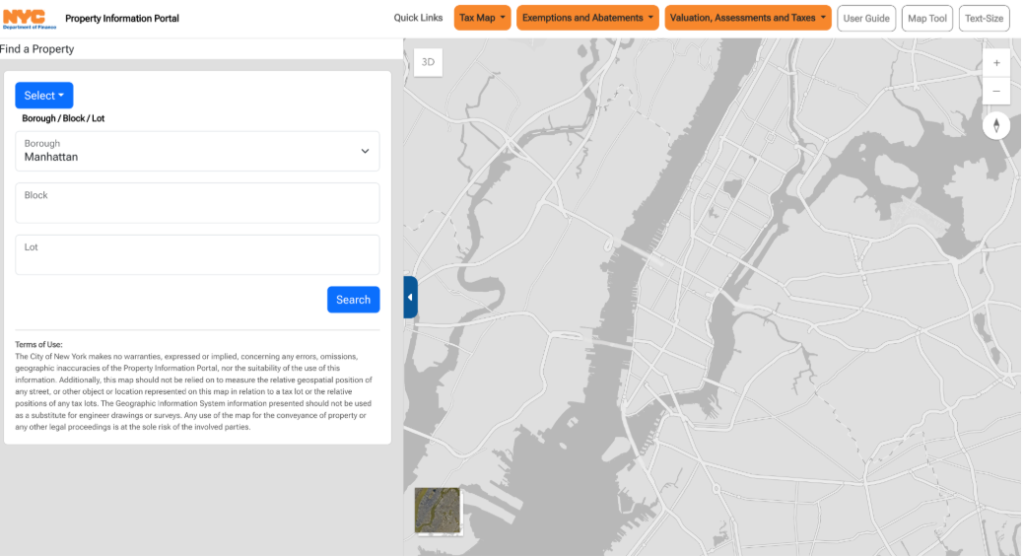
https://propertyinformationportal.nyc.gov/
This search is usually free of charge, but the depth and usability vary a lot by county. Some assessor websites are clean and easy to use, while others look like they were built 20 years ago and never touched again. Still, tax records are worth checking first because they often give you the owner of record and the mailing address used for tax notices (which may be different from the property address).
A few details to save from this step:
- Owner name or business name
- Mailing address
- Parcel number
- Assessed value
- Building size and land area
- Property classification
The parcel number is especially useful. If the property address is formatted differently across databases, the parcel number gives you a more reliable identifier for later searches.
County clerk’s office and deed records
- Tax records tell you who receives the bill
- Deed records show the chain of title: who legally took ownership, when the transfer happened, and how the property changed hands over time
You can usually find deed and ownership records through the county clerk’s office, recorder’s office, or register of deeds, depending on the county. Many records are available online through a county records search. Older records may require an in-person visit, a formal request, or help from a title company.
A deed search can reveal details that tax records don’t, including:
- Current owner of record
- Previous owners
- Sale dates
- Transfer amounts, when disclosed
- Mortgage documents
- Liens or recorded financial obligations
Pro tip: The two searches work best together. The assessor’s office gives you a quick property snapshot. The deed records give you the ownership trail and a better view of the property’s transaction history.
Secretary of State business filings
At this point, commercial property owner search gets a bit more complicated since many commercial buildings are not owned by a person directly. They are owned by an LLC, corporation, or holding company.
So, instead of seeing “John Smith” on the deed, you might see something like “Main Street Retail Holdings LLC.” That business name is technically the owner of record, but it doesn’t immediately tell you who controls the company.
To go deeper, search the business name in the Secretary of State database for the state where the entity was formed. These databases often show the registered agent, filing address, entity status, formation date, and sometimes members, managers, or officers.
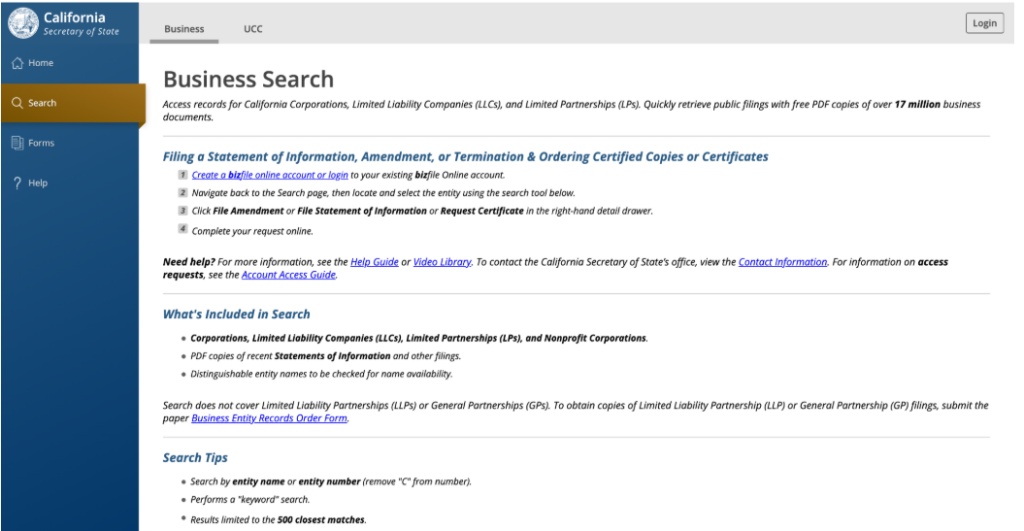
https://bizfileonline.sos.ca.gov/search/business
A simple lookup process looks like this:
- Take the business name from the deed or tax record.
- Search it in the relevant Secretary of State database.
- Review the registered agent, mailing address, and management information.
- Cross-check those names and addresses against other properties, company websites, LinkedIn, or CRE databases.
This may not reveal the true owner every time, but it’s the first serious step toward finding who owns a commercial property behind a business entity.
Using Online Tools and Property Databases
CRE-specific property data platforms
Public records are useful, but they aren’t always fast. If you are researching one building, manual searches may be enough. Prospecting across an entire market, however, can become painfully slow.
CRE-specific property data platforms are a great solution. These tools aggregate ownership records, contact information, property data, debt history, mortgage history, and commercial building details into one searchable database. Instead of jumping between county websites, assessor portals, Secretary of State filings, and spreadsheets, you can usually get a cleaner list of results in one place.
The best platforms focus on property data, not just generic web search. Some cover residential and mixed-use assets too, but for CRE, you want tools that understand commercial property information, including asset type, square footage, owner mailing address, sales history, tenants, loan data, and decision-maker contact details.
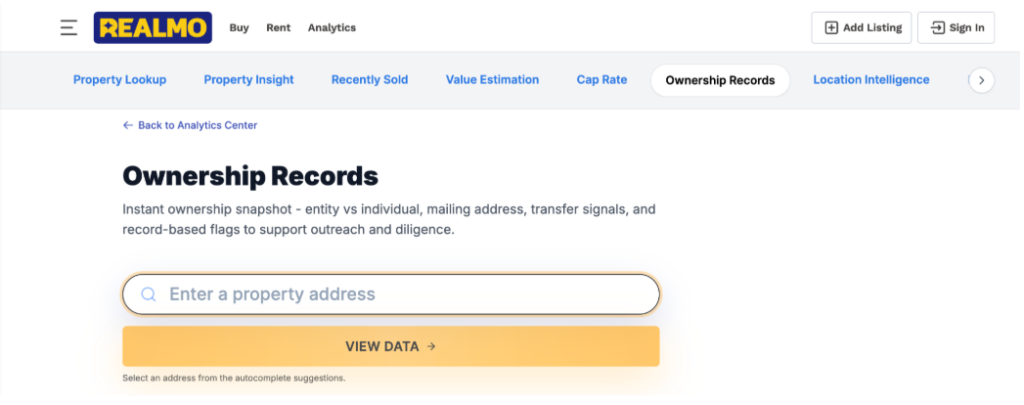
For example, Realmo’s Analytics Center includes a dedicated Ownership Records report that lets users review available owner details alongside the property’s broader commercial context. Instead of treating ownership as a separate lookup, Realmo connects it with listing data, market signals, and property-level insights. Brokers, buyers, and investors can evaluate both the asset and the owner behind it in one place.
County GIS and parcel mapping tools
Many counties also offer free GIS tools. GIS stands for Geographic Information System, but in simple terms, it’s a parcel map that lets you click on properties and see related records.
These maps are helpful when:
- The address is unclear
- The property is part of a larger parcel
- You want to identify adjacent owners
For example, if you are researching a redevelopment site, the parcel map can show surrounding lots, property boundaries, and nearby owners who may also be worth contacting.
GIS tools aren’t usually the main method for finding ownership, but they’re a strong complement to tax records. In many jurisdictions, the parcel map links directly to the county tax assessor database, so you can move from map view to property record without starting over.
Building your own database vs. buying one
You can put together your own database from public sources, which costs nothing but time. For a single commercial building, that makes sense: check the tax record, pull the deed, look up the LLC, and save your notes.
For market-wide prospecting, the math changes. If you need a building owners list for 200 retail centers, 500 industrial properties, or every underused office building in a submarket, manual research gets expensive in a different way. You’re paying with hours and inconsistent data.
A simple rule works well:
- Researching one property? Start with free public records.
- Researching a small target list? Use public records and organize the results in your own spreadsheet.
- Building a pipeline across a market? Use a paid property database or CRE platform with ownership data and contact information.
The right choice depends on deal volume, urgency, and how hard the owners are to locate.
How to Find the True Owner Behind an LLC
This is probably the most frustrating part. The owner’s name isn’t always easy to find in CRE because commercial properties are frequently held in LLCs for tax, liability, privacy, and asset management reasons.
- The deed may show a business name, not an individual
- The tax record may show the same LLC
- The mailing address may point to a registered agent, attorney, accountant, or property manager
None of that means the search is over. However, it means you need to cross-reference.
A working sequence looks like this:
- Start with the deed record. Confirm the exact business name that owns the property.
- Check the county assessor record. Save the mailing address, parcel number, and any ownership details.
- Search Secretary of State filings. Look for registered agents, members, managers, officers, and formation details.
- Search the business name online. Look for company websites, press mentions, LinkedIn profiles, portfolio pages, or related entities.
- Use CRE databases or skip tracing tools. These can surface manager names, member names, phone numbers, and email addresses that public records do not show directly.
Some states make this easier than others. States such as Wyoming, Delaware, and Nevada are known for stronger LLC privacy protections, so the public record may reveal only limited information. In those cases, a title company, skip tracing provider, or real estate attorney may be needed to uncover ownership information.
Also, be careful with assumptions:
- A registered agent is not always the owner
- A mailing address is not always the owner’s office
- A property manager may control day-to-day access but not sale decisions
The goal is to keep narrowing the search until you identify the person or group with actual authority over the property.
Turning Owner Information Into a Conversation
Finding contact information is only the start, and the real value comes from using it well.
Direct mail can work for off-market outreach because the owner’s mailing address from tax records is often tied to official notices. A short, specific letter may stand out more than another generic email. Keep it clear:
- Mention the property
- Explain why you are reaching out
- Say what kind of conversation you want to have
Cold calling and email outreach can also work if you have decision-maker contact information. But the message needs to be about the owner’s interests, not just yours. “I want to buy your building” is easy to ignore. “We’re tracking demand for small-bay industrial assets in this corridor and noticed your property has long-term repositioning potential” gives the owner a reason to listen.
Here are a few outreach angles that feel more useful:
- Recent property value trends in the area
- Demand from tenants or buyers in that asset class
- A specific redevelopment or repositioning opportunity
- A lease, expansion, or acquisition need tied to that location
- A market shift that may affect the owner’s hold/sell decision
Property managers can also be valuable gatekeepers. They may not make ownership decisions, but they often know how to reach owners and managers, whether the property is actively leased, and whether there has been any recent discussion about selling, refinancing, or repositioning.
Conclusion
Finding the owner of a commercial property usually takes more than one search. Start with free public records: county tax records, assessor data, deed records, and Secretary of State filings. Then move to GIS tools, CRE databases, skip tracing, or professional help when the ownership structure gets more complex.
The more properties you research, the more important speed and data quality become. Use Realmo to speed up the research phase. Open a property, check its ownership records, review available owner details, and compare them with listing information, location data, and market signals before deciding whether to reach out.