How to Evaluate Commercial Space for Rent: Location, Zoning, and the Hidden Costs Tenants Miss
Choosing commercial space requires more than finding something affordable that looks workable on paper. A space can match your budget, size needs, and timeline, and still be the wrong decision once zoning limits, weak demand, operating costs, and day-to-day logistics come into play.
This guide shows how to evaluate commercial space the way a smart operator should before signing anything. You will learn how to look past the asking rent, ask better questions, and spot risks early, when they are still avoidable. It also shows how Realmo helps tenants make better-informed decisions with market data, location intelligence, and property-level insights that bring clarity to the process before lease negotiations begin.
Why Location Is the Most Important Decision You’ll Make
Unlike a pricing strategy or a product feature, a commercial lease locks a business in, typically for three to ten years, with early exit penalties that can run into tens of thousands of dollars. A bad product can be revised in a quarter. A bad location is a fixed overhead that drains revenue every single month until the term expires.
Besides, location shapes more than foot traffic. It affects how easily customers find the business, whether employees can reasonably commute to it, what the address signals about brand positioning, and whether the physical space can grow with the company over the lease term. Smart operators run the numbers on location before they run the numbers on build-out. The following sections provide the framework for doing exactly that.
How to Analyse a Location Before You Sign
The criteria most business owners evaluate (price and square footage) describe a space. They say nothing about whether it will perform. The analysis that actually informs a sound decision runs across three dimensions: foot traffic and accessibility, demographic alignment, and the competitive landscape.
Foot traffic, accessibility, and visibility
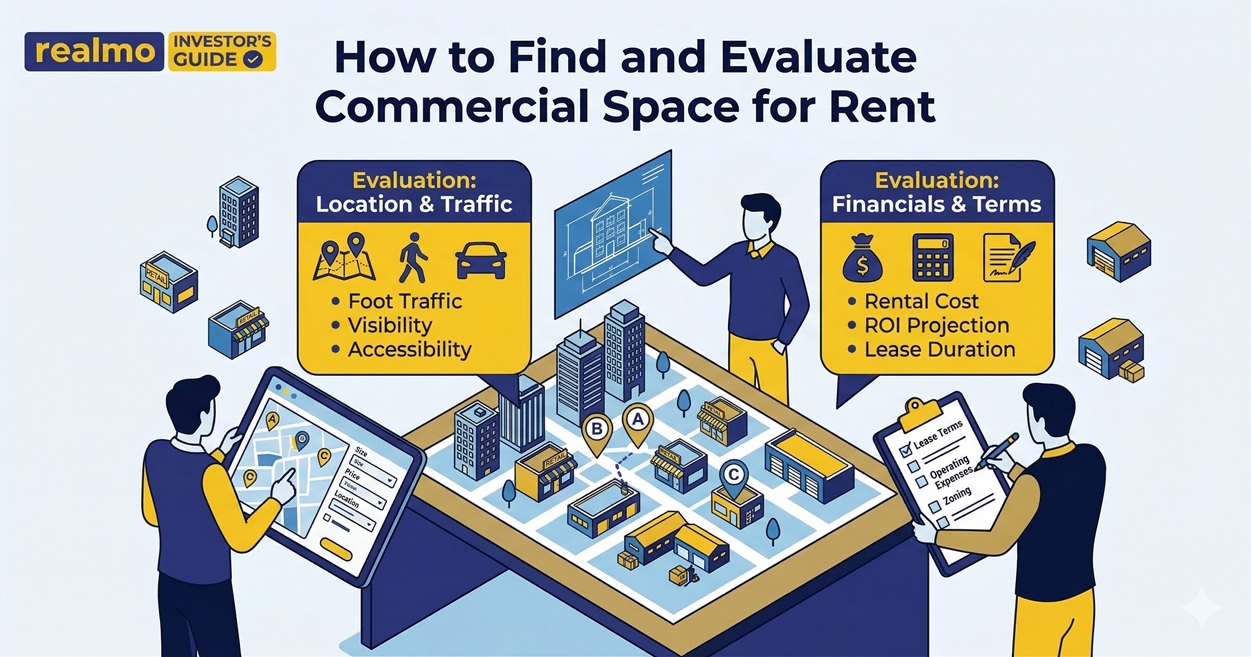
For any business that depends on walk-in customers, like retail stores, restaurants, and personal service providers, foot traffic is a core revenue variable. But volume alone is not the question. The question is whether the traffic passing a location matches the customer profile of the business. A high-footfall location near a transit hub attracts very different customers than a high-footfall location in an upscale residential corridor, even if the raw numbers look comparable.
Here’s what you can do:
- Visit candidate properties at different times of day and on different days of the week
- Observe parking availability and pedestrian flow patterns during the hours the business would actually operate
- Assess visibility: sightlines from the street, signage placement options, and whether the building setback works for or against organic discovery
- Public transit proximity and ADA-compliant access also belong in this evaluation. They determine not just who can reach the space but how easily.
The good news is, this analysis doesn’t need to be manual. You can use Realmo to browse 1 million+ property listings and take a look at AI-powered property reports to get all the insights you need in one place. For example, use Location Intelligence to identify the most in-demand space uses around the place or Business Placement to find ideal expansion locations by modeling demographics, local supply, and analyzing existing businesses to identify underserved areas.
Demographics and your target customer
A location’s demographic profile must align with the business’s customer base. Income levels, age distribution, population density, and the ratio of daytime to residential population all shape who is available to buy. The mismatch cases are instructive: a high-end boutique in a low-income corridor, a family-focused restaurant in a predominantly transient neighborhood, a premium service business in an area where the target income bracket is simply not represented. In each case, the business fights its location from day one.
This is the data layer most operators skip. Median household income, daytime population estimates, and demographic composition by age bracket are available and relevant, and they should inform site selection before a shortlist forms, not after. Weak demographic fit is a risk factor a landlord should price for during lease negotiation; when the data shows a mismatch, that is a negotiating input, not just a business concern.
Competitor mapping
Nearby competitors are neither automatically a threat nor automatically an asset. Understanding which depends on the category. Restaurant districts work partly because the concentration of options draws diners who might not have visited a single standalone location. Boutique fitness studios cluster in high-income corridors for similar reasons – the category density generates traffic that benefits each operator.
That is the cluster effect, and it is real. But it applies specifically to categories where consumer behavior involves comparison or where multiple purchases within a category are natural. For businesses where a customer selects once and returns to the same provider, direct saturation narrows market share before the business opens.
The practical approach is to identify the number of businesses in the same category operating within a defined radius, assess their quality tier and likely customer overlap, and determine whether the area is under-served, well-served, or saturated.
Zoning, Permitted Use, and ADA Compliance
Two compliance dimensions can disqualify an otherwise well-located property entirely. Both are verifiable before any commitment is made.
Zoning and permitted use
Commercial zoning categories (retail, office, industrial, mixed-use) determine which business types can legally operate in a given space. Within a zoning category, the “permitted use” clause in the lease defines specifically what the tenant can do with the property. Those two things are not the same, and both matter. A space zoned for commercial use may not be permitted for food preparation. A space zoned mixed-use may carry restrictions on operating hours that are incompatible with the business model.
The cost of discovering a zoning mismatch after signing is significant: the business may be unable to operate as planned, face a costly rezoning application, or be in breach of the lease from day one. Zoning also affects signage rights, outdoor seating permissions, and delivery access — all material to certain business types. A commercial real estate agent or attorney can verify permitted use before any offer is made.
ADA compliance
The Americans with Disabilities Act requires commercial spaces open to the public to meet specific accessibility standards: ramp access, door widths, restroom specifications, and designated parking. Non-compliant spaces expose the tenant, not just the landlord, to legal liability. That distinction matters more than it often registers.
If a property requires upgrades to meet ADA standards, the cost and responsibility must be clarified and negotiated into the lease before signing. Businesses serving the public or operating with a diverse workforce have both a legal obligation and a practical interest in full accessibility. Confirming compliance status is a two-hour due diligence task. Discovering a non-compliance issue after occupancy is considerably more expensive.
The Real Cost of Renting Commercial Space
The monthly rent figure on a commercial listing is the beginning of the cost conversation, not the end. Total occupancy cost — what the business actually pays to operate from the space — is consistently higher.
Fit-out costs and build-out allowances
Most commercial spaces are delivered in shell or semi-finished condition. The tenant pays to build out the interior to operational standard: walls, flooring, lighting, plumbing connections, technology infrastructure, and any specialist requirements.
Fit-out costs vary significantly by property type and existing condition. A basic office fit-out might run $30-80 per square foot. A restaurant or medical build-out can exceed $200 per square foot once ventilation, plumbing, and equipment connections are factored in.
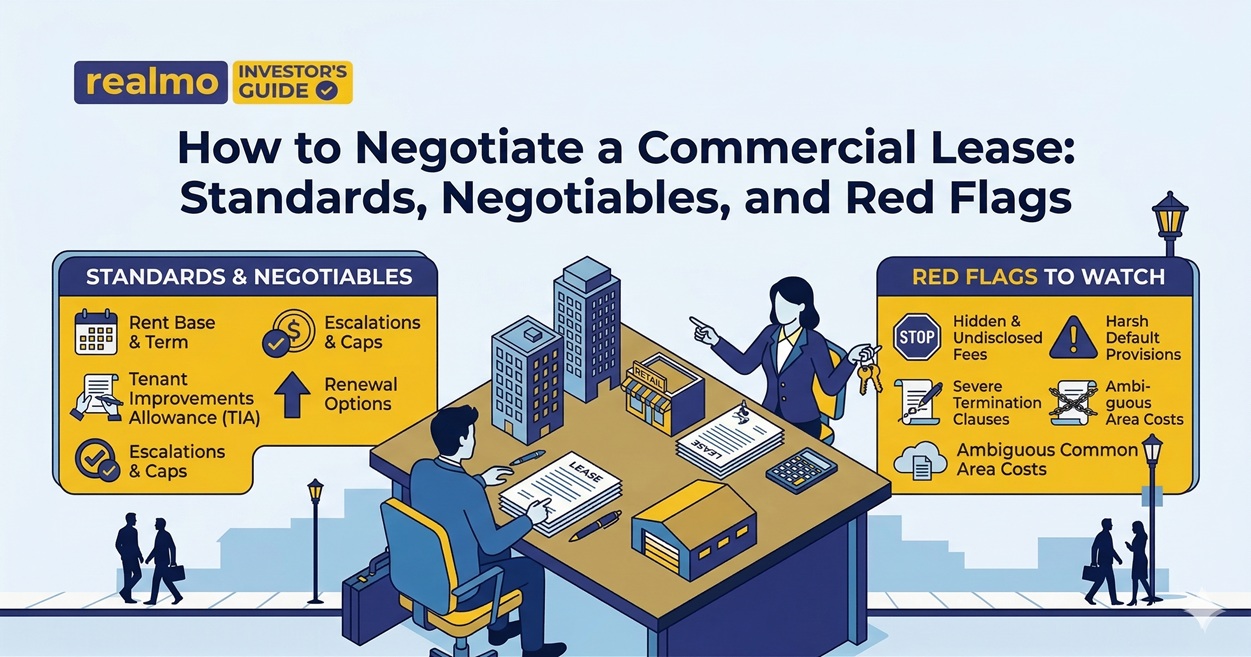
Here’s what the rent figure doesn’t tell you: the condition of the existing infrastructure (plumbing capacity, electrical load, HVAC state) directly determines how much build-out work is required. A space with a lower headline rent and a higher-cost shell condition may cost more to occupy in year one than a higher-rent space in better condition. Build-out allowances (tenant improvement allowances negotiated into the lease) partially or fully offset these costs in competitive markets. Experienced tenants treat TI as a negotiating variable, not a fixed given. This leverage is available and worth using.
Hidden costs of a commercial lease
Net lease structures require tenants to pay property taxes, insurance, and common area maintenance charges on top of base rent. Those additions can increase total occupancy cost by 20 to 40 percent over the headline figure, a number that consistently surprises first-time commercial tenants who budgeted against the rent line alone. Beyond NNN charges, a realistic cost model accounts for utilities that are rarely included, signage fabrication and permits, security deposits, periodic rent escalations built into the lease, and the end of any rent abatement period when free-rent months expire.
The lease document defines all of these. Review it carefully (ideally with a commercial attorney) before signing. A landlord who presents a below-market base rate may be recovering margin through pass-through charges and escalation structures that are not visible in the headline number. The budget number that matters is total occupancy cost over the full term. All of this due diligence moves significantly faster when the right analytical tools are in play from the start.
Using Realmo to Analyse Commercial Locations Before You Commit
Standard commercial real estate search platforms show what is available. They do not tell you whether a specific location will actually work for a specific business. This distinction is the gap that most tenants discover only after they have committed.
Realmo is a map-based commercial real estate platform that layers location intelligence directly onto property listings. For a business owner working through the framework described above, it compresses weeks of manual research into a single interface. Population density and demographic data, competition analysis across 60 business categories, and business opportunity scores are available alongside listing information. This way, the analytical work and the property search happen together rather than sequentially.
Just follow these simple steps:
- Identify candidate properties on Realmo.
- Review population density and demographic composition for each location.
- Run competition analysis for the relevant business category to assess saturation or cluster opportunity.
- Cross-reference the business opportunity score.
- Shortlist properties that pass those filters for physical visits.
Operators who follow that process arrive at property viewings with data rather than intuition, and they ask better questions of landlords, agents, and the spaces themselves.
Conclusion
The right commercial space is not the cheapest available option. It is the one that aligns location quality, compliance, and total occupancy cost with the specific operational needs of the business, and that remains viable if growth runs slower or faster than projected.
A commercial lease is one of the most significant financial commitments a business owner will make. The due diligence should match the stakes. Analyse the location first – traffic, demographics, competition, then verify zoning and ADA compliance, then calculate total occupancy cost. Start the search with data, not just a budget and a square footage requirement.