1031 Exchange: All you need to know
Consider this scenario: disposing of an investment property, capturing the full proceeds, and reallocating capital into a superior asset without triggering immediate federal tax liability. This framework exists under Section 1031 of the Internal Revenue Code, representing one of the most substantial advantages available to commercial real estate investors currently.
Portfolio expansion versus capital stagnation frequently depends upon understanding this specific tax code provision. Section 1031 exchanges constitute legitimate strategic deferral mechanisms – not tax evasion – that sophisticated investors utilize to compound wealth accumulation, enhance property quality, and accelerate portfolio expansion while deferring tax obligations.
What is 1031 Exchange
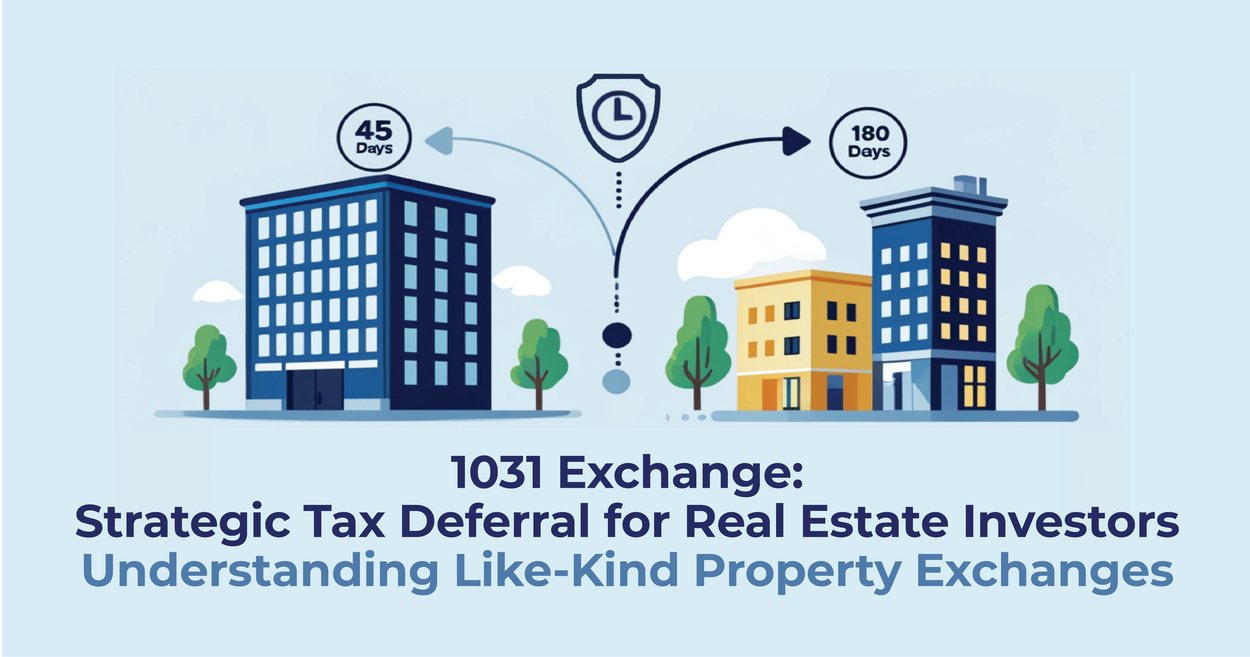
1031 Exchange is a U.S. tax strategy that allows real estate investors to defer paying capital gains taxes when they sell a property and reinvest the proceeds into a “like-kind” property. The exchange must follow IRS rules, including strict timelines – generally 45 days to identify a replacement property and 180 days to close the purchase. By rolling over gains, investors can preserve more capital to grow their portfolios. While it defers taxes, it does not eliminate them, as liability is triggered if the investor eventually sells without reinvesting.
This isn’t just a minor tax break; it’s a wealth-building engine. By deferring taxes, you keep 100% of your capital working for you, allowing you to acquire larger assets and compound your returns significantly faster than if you paid taxes on every sale.
Expert Investment Insight
Many new investors think “like-kind” is restrictive, assuming they must exchange an apartment for an apartment. This is a costly myth. Since the Tax Cuts and Jobs Act of 2017 limited exchanges to real property, the definition is incredibly broad.
You can exchange raw land for a commercial building, or a single-family rental for a multi-tenant office space. The key requirement is that both properties must be held for productive use in a trade, business, or for investment – not for personal use.
Capital Gains Tax Deferral
Tax deferral means you are postponing the payment of taxes owed on the profit (capital gain) from your property sale to a future date. It is not tax elimination – the tax liability transfers to the new property.
A 20-30% tax bill on your gains can cripple the momentum of your portfolio growth. Deferral means that the entire sum can be used as a down payment on your next, larger acquisition, significantly increasing your buying power.
Advanced Wealth Strategy
The ultimate strategy here is “swap ’til you drop.” You can perform 1031 exchanges repeatedly throughout your life, continuously building wealth without immediate tax consequences. Upon your death, your heirs receive the property at a “stepped-up” basis, meaning its new cost basis becomes the fair market value at the time of your death.
If they sell immediately after inheritance, they could potentially eliminate decades of deferred capital gains taxes forever. This represents the most powerful, long-term aspect of Section 1031 for generational wealth building.
The Key Components: Properties & People
The relinquished property is the investment asset you are selling. The replacement property is the new like-kind asset you intend to acquire with the proceeds from the sale.
The rules of the exchange are anchored to these two assets. The clock starts ticking the moment the relinquished property is sold, and all rules regarding value and debt are based on a comparison between the two properties.
Critical Qualification Requirements
A critical error is failing to ensure both properties qualify as investment assets. Your primary residence or a vacation home you use most of the year does not qualify as a relinquished property under IRS regulations.
The IRS standard requires that the property must be “held for productive use in a trade or business or for investment.” If you want to exchange a vacation property, you need to prove its investment intent by renting it out at fair market rent for a significant period before initiating the exchange process.
Qualified Intermediary (QI)
A Qualified Intermediary, also known as an accommodator or facilitator, is an independent third party essential to a valid 1031 exchange. They hold the proceeds from the sale of the relinquished property and use them to acquire the replacement property on behalf of the investor.
If you, the taxpayer, take actual or constructive receipt of the sale proceeds, the exchange is immediately disqualified and the gains become taxable. The QI acts as a legally required “safe harbor” to prevent this disqualification. You cannot use your own agent, attorney, or accountant if they have worked for you in the past two years.
Professional Selection Criteria
Choosing your QI represents the most important decision you’ll make in the exchange process. The industry operates with limited federal regulation, though some states like California require bonding for additional protection.
Thoroughly vet your QI by examining their insurance coverage (Errors & Omissions and Fidelity Bond), transaction volume history, and security protocols for holding funds. A cheap QI is not worth the substantial risk of bankruptcy or poor security while holding your entire sale proceeds.
Taxpayer / Exchangor
The taxpayer (or exchangor) is the individual or entity selling the relinquished property and acquiring the replacement property in the exchange transaction.
A core requirement is the “Same Taxpayer Rule.” The name on the title of the relinquished property must be the exact same name on the title of the replacement property. An individual cannot sell a property and have their LLC buy the new one without disqualifying the exchange.
Strategic Entity Structuring
This requirement often creates complications for partnerships and married couples. However, important exceptions exist for proper planning. A single-member LLC, which the IRS treats as a “disregarded entity,” can be utilized effectively.
For example, if ‘John Smith’ sells the old property, ‘John Smith, LLC’ (a single-member LLC) can acquire the new one. This structure provides liability protection without violating the same taxpayer rule. Proper legal and tax structuring before the sale is paramount for successful execution.
The Rules of the Road: Timelines and Identification
45-Day Identification Period
From the closing date of your relinquished property sale, you have exactly 45 calendar days to formally identify potential replacement properties in writing to your Qualified Intermediary.
This deadline is absolute and non-negotiable. There are no extensions for weekends, holidays, or any other reason. Failure to identify within 45 days invalidates the entire exchange, making your sale taxable.
Strategic Planning Considerations
The biggest mistake is starting your search on Day 1. You should have been looking for your replacement property long before you listed your relinquished property. The 45-day window is for formalizing your choices, not for starting from scratch in a competitive market.
The identification must be in writing, unambiguous (street address or legal description), and signed by you. An email to your QI is standard practice for meeting this requirement.
180-Day Exchange Period
You must close on the purchase of one or more of your identified replacement properties within 180 calendar days of the relinquished property’s sale date, OR by the due date of your tax return for that year (whichever is earlier).
Like the 45-day rule, this is a hard deadline. The 45-day and 180-day periods run concurrently. If you identify a property on Day 45, you only have 135 days left to complete all due diligence, financing, and closing.
Tax Filing Deadline Complications
The phrase “or the due date of your tax return” is a hidden trap. If you sell a property in late November, your 180-day clock would end sometime in May. However, your tax return is due on April 15th.
Unless you file an extension for your tax return, your 1031 exchange period would be cut short on April 15th. Always file an extension if your exchange period crosses the tax filing deadline.
The Identification Rules (Three-Property, 200%, 95%)
When identifying properties within your 45-day window, you must adhere to one of the following three rules:
- Three-Property Rule: Identify up to three properties of any value.
- 200% Rule: Identify any number of properties, as long as their total fair market value does not exceed 200% of the relinquished property’s value.
- 95% Rule: Identify any number of properties, but you must acquire at least 95% of the total value of all properties identified.
Compliance Requirements
You must strictly follow one of these rules for your identification to be valid. The Three-Property Rule is the most common and safest bet for most investors.
Strategic Selection Guidelines
The 95% rule is rarely used because it’s extremely risky; if even one small deal falls through, the entire exchange could be disqualified. Most investors I work with use the Three-Property rule as their primary strategy.
The 200% rule can be useful if you’re looking to acquire a portfolio of smaller assets, but it requires careful tracking of market values. Always identify a backup property (or two) in case your primary target falls through.
Follow the Money: Boot, Basis, and Financial Pitfalls
Boot
“Boot” is any non-like-kind property received in an exchange. The two most common types are cash boot (sale proceeds left over after acquiring the replacement property) and mortgage boot (when the debt on the new property is less than the debt on the old property).
Receiving boot doesn’t necessarily disqualify the exchange, but the fair market value of the boot received is taxable as a capital gain. To fully defer all taxes, you must have zero boot in your transaction.
Strategic Avoidance Techniques
To completely avoid taxes, the rule is simple: reinvest all cash proceeds and acquire a property of equal or greater market value with equal or greater debt. A common mistake is forgetting that paying off closing costs with exchange funds can be considered cash boot. Work with your QI to structure the transaction so eligible closing costs are handled properly.
Mortgage boot is also easy to miss. If you sell a property with a $500,000 mortgage and buy a new one with a $400,000 mortgage, you have $100,000 of mortgage boot, which is taxable unless you add $100,000 of new cash to the deal.
Adjusted Basis & Depreciation Recapture
Your Adjusted Basis is the original purchase price of a property, plus capital improvements, minus accumulated depreciation. Depreciation Recapture is the process by which the IRS taxes the gain from depreciation you’ve claimed, typically at a higher ordinary income tax rate (capped at 25%).
A 1031 exchange allows you to defer both capital gains tax and the often-overlooked depreciation recapture tax. The adjusted basis from your old property rolls over to the new property, carrying the deferred tax liability with it.
Hidden Tax Liability Considerations
Depreciation recapture can be a nasty surprise for investors who sell without an exchange. For example, if you’ve claimed $100,000 in depreciation over the years, that $100,000 will be taxed at up to 25% – that’s a $25,000 tax bill in addition to regular capital gains tax on the economic appreciation.
A 1031 exchange defers this entire liability, which is a massive, often underestimated benefit that significantly enhances the total tax savings compared to a traditional sale.
Advanced Strategies and Special Considerations
Reverse Exchange
A reverse exchange occurs when an investor acquires the replacement property before selling their relinquished property. This requires a special entity, an Exchange Accommodation Titleholder (EAT), to purchase and “park” the new property until the exchange completion.
In a hot market where good deals are scarce, this allows you to secure a desirable replacement property without the pressure of the 45-day identification clock.
Reverse exchanges are more complex and expensive than standard ones. The EAT, set up by your QI, takes title to the replacement property. From that moment, you have 45 days to formally identify which of your properties you will relinquish.
You then have 180 days from the EAT’s purchase date to complete the sale of your relinquished property and finalize the exchange. This is an invaluable tool for sophisticated investors, but requires a highly competent QI with extensive reverse exchange experience.
State Rules (e.g., California “Clawback”)
While Section 1031 is federal law, some states have their own specific rules and reporting requirements. California, for example, has a “clawback” provision affecting exchange transactions.
If you exchange a California property for one in a state without an income tax (like Texas or Florida), California still expects to collect taxes on the deferred gain when you eventually sell the new, out-of-state property.
Ongoing Compliance Requirements
California’s Form FTB 3840 requires investors to file an annual information return, tracking the deferred gain. The “clawback” ensures that the state eventually gets its tax revenue from the original California gain, no matter where the investor moves their capital.
It’s a crucial reminder that while a 1031 exchange is a federal tool, you must always consult with a professional about state-level implications before executing any interstate exchange strategy.
Conclusion
Section 1031 represents one of the most powerful wealth-building tools available to commercial real estate investors. While the regulations are strict and the timelines unforgiving, these challenges are not insurmountable when you have proper planning and professional guidance from a qualified team.
Don’t let the complexities deter you from leveraging this strategic advantage. Understand the terminology, assemble a team of experts including a qualified intermediary, attorney, and CPA, and use the 1031 exchange to transform your tax liabilities into your next great investment opportunity.