Types of Commercial Leases Explained: A Practical Guide for Businesses
The type of commercial lease you sign shapes your real occupancy costs, not just the rent line on the listing. A space may look affordable at first, but the lease structure determines whether you will also be paying for taxes, insurance, maintenance, common area expenses, and future cost increases. That’s where many businesses get caught off guard.
In this guide, we’ll break down the main types of commercial leases, explain how each one works, and show you what they actually mean for budgeting, risk, and flexibility. The goal is simple: help you compare lease options more confidently and avoid expensive surprises before you sign.
What a Commercial Lease Is and How It Differs from Residential Leases
At its core, a commercial lease is a legally binding agreement that governs how a business occupies a commercial property. What’s less obvious to first-time commercial tenants is how different these agreements are from the residential leases most people are familiar with.
Residential leases are largely standardized. Commercial leases aren’t. They’re negotiated, customizable, and, importantly, they don’t come with the same tenant protections that residential agreements do. What the document says is what applies, which is why understanding what you’re agreeing to before you sign matters considerably more in a commercial context.
Beyond the lack of standardization, commercial leases typically run longer (three to ten years is common) and place substantially more financial responsibility on the tenant. There’s also no government agency looking out for commercial tenants the way housing authorities do in residential contexts. The quality of your lease depends almost entirely on the quality of your review and negotiation before signing.
Key Lease Terms Worth Knowing Before You Compare Options
There are a handful of terms that appear across almost every commercial lease, and being clear on them makes every comparison easier:
- Base rent: the fixed periodic payment for occupying the space, usually expressed per square foot annually
- CAM charges (Common Area Maintenance): the tenant’s proportional share of maintaining shared spaces – lobbies, parking areas, corridors, landscaping
- Operating expenses: a broader category that can include property taxes, building insurance, utilities, and general maintenance, depending on how the lease is structured
- Rent escalation clauses: provisions for annual rent increases, typically tied to a fixed percentage or a cost-of-living index
- NNN: shorthand for triple net, a lease structure that comes up constantly in commercial real estate conversations
The most important thing to internalize before comparing lease types is this: base rent is not the same as total occupancy cost. A lease with a lower base rent can easily cost more overall once all the pass-through expenses are added in. More on that shortly.
The Main Types of Commercial Lease Structures
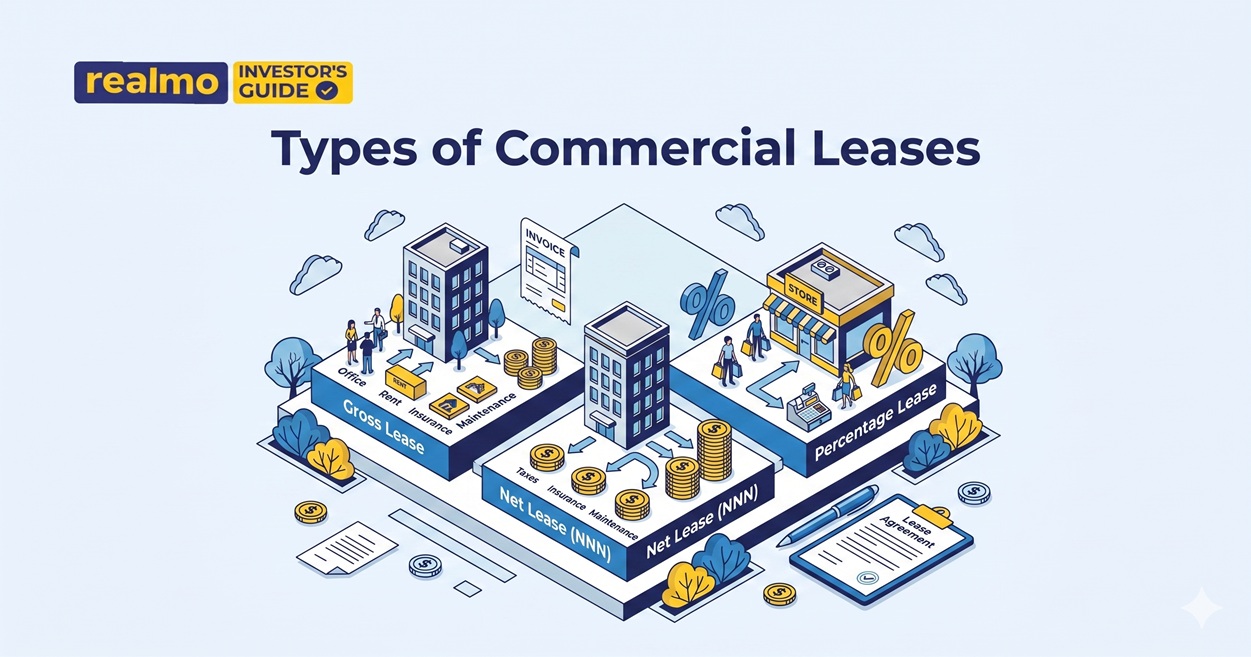
The gross-to-net spectrum
Every commercial lease type sits somewhere on a spectrum.
- On one end, you have gross leases, where the landlord handles operating expenses and the tenant pays a single inclusive rent.
- On the other end, net leases shift those expenses progressively onto the tenant in exchange for lower base rent.
Most real-world leases sit somewhere in the middle.
Gross leases vs. net leases
The fundamental trade-off is simple: predictability versus upside.
- Gross leases give tenants stable, foreseeable monthly costs. The landlord absorbs the risk that taxes or insurance go up, but prices that risk into the base rent.
- Net leases bring base rent down but introduce variability. When operating costs rise, the tenant feels it.
Neither structure is universally better. The right one depends entirely on how the business operates, how much cost volatility it can absorb, and how much control it actually wants over the physical space.
Hybrid structures fill the gap
Between gross and net leases are several hybrid structures, most notably the modified gross lease, where certain expenses are split in ways both parties negotiate. These models are more common in practice than the textbook extremes – landlords and tenants both have incentives to find middle ground, and the modified gross lease is often where they land.
Breaking Down Each Lease Type
Full-service gross lease
This is the most straightforward commercial lease structure. The tenant pays one monthly amount, and the landlord handles essentially everything else:
- property taxes
- building insurance
- Utilities
- maintenance, etc.
What you see is what you pay.
It’s easy to understand why tenants, especially those new to commercial real estate, gravitate toward this structure. Budgeting is clean, there are no surprise bills, and the administrative burden is minimal compared to other lease types.
The catch is the base rent. It’s higher than comparable net leases because the landlord is pricing in the risk of rising operating costs over the lease term. You’re paying for certainty, and that certainty has a cost. Full-service gross leases are most common in multi-tenant office buildings, where centralized management makes bundling services efficient for everyone involved.
Single net lease
In a single net lease, the tenant covers base rent plus one additional expense category, property taxes, most commonly. Everything else, insurance and maintenance, stays with the landlord.
The reduction in base rent compared to a gross lease reflects this partial cost shift. The tenant gains a bit of cost visibility and gets slightly lower fixed rent, but also takes on direct exposure to property tax changes. Depending on the municipality and the trajectory of local assessed values, that exposure can be meaningful over a multi-year lease.
Single net leases tend to appear in smaller commercial properties and shorter-term or transitional arrangements — situations where neither party wants to negotiate the full complexity of a triple net structure.
Double net lease
Add insurance to the tenant’s responsibility, and you have a double net lease. The tenant now covers property taxes and building insurance on top of base rent. Maintenance obligations stay with the landlord.
Base rent comes down further to reflect the expanded tenant responsibility. But two variable cost categories — taxes and insurance — can move independently of each other and independently of anything the business does. It’s worth modeling what a 10-15% increase in either would do to your actual monthly occupancy cost before committing to this structure.
Double net leases show up frequently in retail and multi-tenant commercial properties, where landlords want more predictable net income and tenants are willing to take on some exposure for lower fixed payments.
Triple net lease
The NNN lease is probably the most talked-about commercial lease structure, and it gets discussed a lot because it flips the traditional landlord-tenant cost relationship almost entirely. The tenant pays base rent plus property taxes, insurance, and maintenance. Essentially, all operating costs fall on the tenant side.
In exchange, base rent is typically the lowest of any structure. For tenants who understand what they’re taking on, there are real advantages:
- full operational control over the property
- freedom to choose vendors
- the ability to manage maintenance proactively rather than waiting on a landlord to respond
For long-term tenants with stable operations and the capacity to manage the property well, NNN leases can make excellent financial sense.
The risk, though, is real:
- maintenance costs in older properties can be unpredictable
- property taxes in rapidly appreciating markets can climb significantly
And tenants in triple net leases are on the hook for all of it. This structure suits large, established tenants (standalone retailers, industrial operators, national brands) much more than it suits growing businesses with variable cash flow.
Modified gross lease
The modified gross lease doesn’t have a fixed definition, which is sort of the point. It’s a negotiated structure where specific operating expenses are allocated between tenant and landlord in ways that make sense for that particular deal. One modified gross lease might have the tenant covering utilities and their proportional share of property taxes. Another might have the landlord handling taxes and insurance while the tenant takes on common area maintenance.
The advantage here is flexibility. Costs can be assigned to whoever has more control over them, which often produces a more rational arrangement than either extreme. The risk is that the allocation needs to be documented precisely. Vague expense-sharing language is a reliable source of disputes when actual bills arrive and both parties interpret the lease differently.
Modified gross leases are particularly common in office properties, where landlords and tenants typically have relatively balanced negotiating positions and incentives to find a workable middle ground.
Percentage lease
Percentage leases work differently from every other type. The tenant pays a lower base rent, often significantly lower, plus a percentage of their gross revenue once it exceeds a defined threshold. The landlord participates financially in the tenant’s success.
This creates something genuinely interesting: a shared incentive structure. The landlord has reason to want the tenant to perform well, which can translate into more cooperative lease management, greater flexibility on certain terms, and occasionally better positioning within a retail center. For tenants, the lower fixed rent reduces financial pressure during slow periods or during the initial ramp-up phase.
But there are downsides, naturally:
- total occupancy cost becomes impossible to predict with precision
- revenue reporting requirements add administrative overhead
- in a genuinely strong year, the percentage component can push total lease costs well above what a conventional fixed structure would have cost
Percentage leases are most common in shopping centers, malls, and high-traffic retail environments where the landlord’s portfolio performance is directly tied to tenant sales. They’re worth considering at certain stages of growth, but probably not as a long-term structure once revenue is stable and predictable.
Comparing the Structures
Before going further, it’s worth looking at these side by side – particularly for anyone trying to evaluate multiple lease offers at once.
| Lease Type | Base Rent Level | Tenant Cost Exposure | Predictability | Typical Use |
| Full-Service Gross | Highest | Low | High | Multi-tenant office |
| Single Net | Moderate | Low to moderate | Moderate | Smaller properties |
| Double Net | Moderate | Moderate | Moderate | Retail, multi-tenant |
| Triple Net | Lowest | High | Low | Standalone retail, industrial |
| Modified Gross | Varies | Varies | Moderate | Office, negotiated deals |
| Percentage Lease | Low fixed | Revenue-linked | Low | High-traffic retail |
Risk: Who Absorbs It and When
Every lease structure is essentially a negotiation over who bears financial risk when operating costs change.
- In gross leases, landlords absorb that risk.
- In net leases, it transfers to the tenant, and the more “nets” in the structure, the more complete that transfer is.
There’s a useful way to think about this: control and risk tend to travel together. Triple net tenants have maximum control over how their space operates. They also have maximum exposure when something goes wrong or when costs increase. Full-service gross tenants have much less say in how building expenses are managed – but they’re insulated from the consequences when those expenses go up.
Choosing the Right Structure for Your Business
1. Start with how the business operates
- Service businesses with steady revenue and no particular need to control the physical space tend to do well with gross leases: the simplicity reduces friction and makes financial planning straightforward.
- Retail businesses, especially those in early growth stages, sometimes find percentage leases worth considering precisely because they lower the fixed cost burden during the period when performance is most uncertain.
- Industrial tenants who need to control their operating environment often choose net leases for the autonomy they provide.
There’s no universal answer. The right lease structure is the one that fits how the business actually works, not the one with the lowest headline rent figure.
2. Factor in where the business is in its growth cycle
A business with uncertain near-term growth should weigh cost predictability heavily. Variable exposure in a net lease is manageable when cash flow is stable and significantly harder to absorb when it isn’t. More established businesses, particularly those with the operational capacity to manage property-level costs, may find the lower base rent in a net structure worth the trade-off.
Before comparing final options, it’s worth doing a basic total cost calculation:
- Add up all the expenses the lease requires the tenant to cover, not just base rent.
- Model what happens to that total if property taxes increase 10% or insurance premiums jump at renewal.
- Consider how much operational control the business actually needs over the space.
- Review escalation clauses carefully. A 4% annual increase compounded over seven years adds up faster than most tenants expect when they sign.
Common Mistakes That Cost Businesses More Than They Should
Comparing leases on base rent alone
This is probably the most common mistake in commercial lease evaluation. A triple net lease at $18 per square foot might sound significantly better than a full-service gross lease at $27 per square foot. It might also cost more in total once taxes, insurance, and maintenance are factored in. Tenants who compare headline rent figures without accounting for what each structure actually requires them to pay are comparing different things and often don’t realize it until bills start arriving.
Not pushing back on initial terms
Commercial leases are negotiated documents. Most landlords expect tenants to push back, and initial terms are rarely final. What surprises many first-time commercial tenants is how much room for negotiation actually exists, not just on rent, but on annual escalation rates, CAM expense caps, tenant improvement allowances, renewal option terms, and early termination provisions.
None of these is fixed. Rent escalations can often be capped or adjusted. CAM reconciliations can be limited by expense stop provisions. Renewal options can be negotiated at favorable terms rather than prevailing market rates. The businesses that sign the best commercial leases aren’t necessarily the ones with the most leverage; they’re the ones who arrive at the negotiation knowing which terms matter most to their situation.